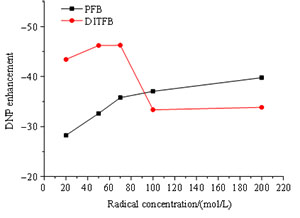
卤键与氢键相似,是实现分子与分子非共价键连接的作用之一,其广泛地应用于工程材料和生命化学等领域.有关卤键相互作用的动态核极化(DNP)研究还未见报道.本文利用连续波-电子顺磁共振(CW-EPR)谱仪及自主研制的DNP实验平台对存在卤键相互作用的体系——1,4-二碘四氟苯(DITFB)/4-羟基-2,2,6,6-四甲基吡啶-1-氧自由基(4-OH-TEMPO)进行19F DNP研究,并与无卤键作用对照组——六氟苯(PFB)/4-OH-TEMPO的19F DNP增强效果进行了比较.结果发现,DITFB/4-OH-TEMPO较PFB/4-OH-TEMPO具有更窄的EPR线宽和更大的19F DNP增强.这表明自由基与DITFB卤键作用削弱了自由基之间的电子自旋-自旋相互作用,从而使自由基横向弛豫时间(T2e)增加、线宽变窄,导致DNP饱和因子和增强倍数变大.因此,可以通过卤键调控自由基电子自旋相互作用,以改善核的DNP增强效果.
高珊
,
黄重阳
,
张震
,
陈俊飞
,
贺玉贵
,
陈黎
,
陈方
,
张金枝
,
刘朝阳
. DITFB/4-OH-TEMPO体系中卤键作用的19F DNP研究[J]. 波谱学杂志, 2017
, 34(4)
: 421
-428
.
DOI: 10.11938/cjmr20172557
Halogen bond, as hydrogen bond, is a non-covalent bond. Dynamic nuclear polarization (DNP) technique has been used previously to study hydrogen bonds-mediated intermolecular interactions. However, no study has been carried out so far to study the halogen bond-mediated intermolecular interactions with DNP. In this work, 19F DNP polarization efficiency of the halogen bonds existing in supramolecular assembling by 4-OH-TEMPO and 1,4-diiodotetrafluorobenzene (DITFB) was studied on a home-made DNP system. The formation of intermolecular halogen bonds appeared to increase 19F DNP polarization efficiency, suggesting that the spin-spin interactions among electrons were weakened by the halogen bonds, resulting in an increased T2e and a larger saturation factor.
[1]OVERHAUSER A W.Polarization of nuclei in metals[J].Phys Rev,1953,92(2):411-415. [2]MALY T,DEBELOUCHINA G T,BAJAJ V S,et al.Dynamic nuclear polarization at high magnetic fields[J].J Chem Phys,2008,128(5):052211-052219. [3]MARIN-MONTESINOS I,PANIAGUA J C,VILASECA M,et al.Self-assembled trityl radical capsules-implications for dynamic nuclear polarization[J].Phys Chem Chem Phys,2015,17(8):5785-5794. [4]CINČIĆ D,FRIŠČIĆ T,JONES W.A stepwise mechanism for the mechanochemical synthesis of halogen-bonded cocrystal architectures[J].J Am Chem Soc,2008,130(24):7524-7525. [5]IBRAHIM M A.AMBER empirical potential describes the geometry and energy of noncovalent halogen interactions better than advanced semiempirical quantum mechanical method PM6-DH2X[J].J Phys Chem B,2012,116(11):3659-3669. [6]PARKER A J,STEWART J,DONALD K J,et al.Halogen bonding in DNA base pairs[J].J Am Chem Soc,2012,134(11):5165-5172. [7]METRANGOLO P,NEUKIRCH H,PILATI T,et al.Halogen bonding based recognition processes:A world parallel to hydrogen bonding[J].Acc Chem Res,2005,38(5):386-395. [8]DUMAS J M,GOMEL M,GUERIN M.ChemInform abstract:Molecular interactions involving organic halides[J].Chem Inform,1984,15(34):985-1020. [9]PANG X,ZHAO X R,WANG H,et al.Modulating crystal packing and magnetic properties of nitroxide free radicals by halogen bonding[J].Crystal Growth Des,2013,13(8):3739-3745. [10]MUGNAINI V,PUNTA C,LIANTONIO R,et al.Noncovalent paramagnetic complexes:detection of halogen bonding in solution by ESR spectroscopy[J].Tetrahedron Lett,2006,47(19):3265-3269. [11]BOUBEKEUR K,SYSSA-MAGALE J L,PALVADEVU P,et al.Self-assembly of nitroxide radicals via halogen bonding-directional NO⋯I interactions[J].Tetrahedron Lett,2006,47(8):1249-1252. [12]CAVALLOTTI C,METRANGOLO P,MEYER F,et al.Binding energies and 19F nuclear magnetic deshielding in paramagnetic halogen-bonded complexes of TEMPO with haloperfluorocarbons[J].J Phys Chem A,2008,112(112):9911-9918. [13]KNAUER B R,NAPIER J J.The nitrogen hyperfine splitting constant of the nitroxide functional group as a solvent polarity parameter.The relative importance for a solvent polarity parameter of its being a cybotactic probe vs.its being a model process[J].Chem Inform,1976,7(41):4395-4400. [14]METRANGOLO P,PILATI T,RESNATI G.Halogen bonding and other noncovalent interactions involving halogens:A terminology issue[J].Crystengcomm,2006,8(12):946-947. [15]张震.液态杂核的低场DNP-NMR/MRI方法研究[D].武汉:中国科学院武汉物理与数学研究所,2016.