研究论文

通过高斯加权的1H CPMG弛豫曲线测定橡胶交联密度

  • 高鹏飞 ,
  • 褚琳琳 ,
  • 杨翼 ,
  • 江纪锋 ,
  • 王嘉琛 ,
  • 姚叶锋 ,
  • 周兵
展开
  • 1. 华东师范大学 物理与材料科学学院, 上海市磁共振重点实验室, 上海 200062;
    2. 上海纽迈电子科技有限公司, 上海 200333;
    3. 双钱集团上海轮胎研究所有限公司, 上海 200237;
    4. 同济大学 材料科学与工程学院, 上海 201804

收稿日期: 2017-07-29

  网络出版日期: 2018-03-05

基金资助

国家自然科学基金资助项目(21574043,41572103);国家重点基础研究发展计划(“973计划”)资助项目(2013CB921801);上海市科委资助项目(15142200500);华东师范大学科研创新基金资助项目.

Measurement of Crosslinking Density of Rubbers by Analyzing Gaussian-Weighted 1H CPMG Relaxation Curves

  • GAO Peng-fei ,
  • CHU Lin-lin ,
  • YANG Yi ,
  • JIANG Ji-feng ,
  • WANG Jia-chen ,
  • YAO Ye-feng ,
  • ZHOU Bing
Expand
  • 1. Shanghai Key Laboratory of Magnetic Resonance, Department of Physics, East China Normal University, Shanghai 200062, China;
    2. Shanghai Niumag Electronic Technology Co., Ltd., Shanghai 200333, China;
    3. Double Coin Group Shanghai Tire Research Institute Co., Ltd., Shanghai 200237, China;
    4. School of Materials Science and Engineering, Tongji University, Shanghai 201804, China

Received date: 2017-07-29

  Online published: 2018-03-05
摘要

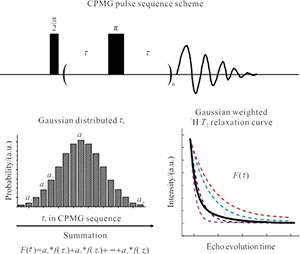
CPMG(Carr-Purcell-Meiboom-Gill)回波法是测量橡胶交联密度[常用交联点之间的分子量(Mc)表示]的一种常用核磁共振(NMR)技术,但实验发现通过该技术获得的Mc对于CPMG序列中脉冲间隔时间具有较强的依赖性,导致交联密度NMR测量值与橡胶材料硬度的相关性低.为了克服这一缺点,本文对不同脉冲间隔时间下CPMG实验测得的质子横向驰豫曲线进行高斯加权.通过对高斯加权求和后的质子横向驰豫曲线进行处理分析,实现了对橡胶交联密度更加准确地测量,大幅提升了天然橡胶交联密度NMR测量值与材料硬度的相关性.本文方案测量能获得与1H DQ NMR方法相当,或比之更佳的交联密度-硬度相关性.同时,本文方案比1H DQ NMR方法更为高效,整体测量时间缩短为1H DQ NMR实验时间的1/10.

本文引用格式

高鹏飞 , 褚琳琳 , 杨翼 , 江纪锋 , 王嘉琛 , 姚叶锋 , 周兵 . 通过高斯加权的1H CPMG弛豫曲线测定橡胶交联密度[J]. 波谱学杂志, 2018 , 35(1) : 60 -74 . DOI: 10.11938/cjmr20172590

Abstract

CPMG sequence is widely used to measure crosslink density of rubber. However, the crosslink density obtained by this technique has a strong dependence on the interval times between the pulses in CPMG sequence, and the results measured have only a weak correlation with rubber hardness. To overcome this shortcoming, we proposed in this work to construct a 1H T2 relaxation curve by summing Gaussian-weighted CPMG relaxation curves acquired at by varying the interval time between the pulses in CPMG sequence. Using the multi-echo Gaussian-weighted relaxation curve to calculate the crosslink density gave results that had greatly improved correlation with the rubber hardness. The new method was also fast and efficient, as it took only one-tenth of the experimental time required for the conventional 1H double quantum NMR (1H DQ NMR) experiment.
文章导航

/