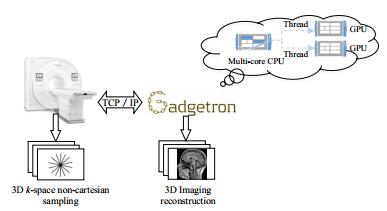
为了满足磁共振成像(MRI)临床扫描的需求,磁共振图像重建算法的开发一直在不断进行.目前广泛使用的算法实现方式是利用中央处理器(CPU)对磁共振扫描数据进行数学变换得到图像,随着算法复杂度的提升,计算性能问题逐渐显露.利用CPU在大数据量下执行复杂算法时,计算并行性的缺失以及运算中产生的海量数据的存储负荷会导致计算变得极为缓慢,使得一些算法因为重建时间过长,在临床上面临难以推广的问题,也制约了基础研究中新算法的研发.本文设计并实现了一种新的重建算法执行方式,利用Gadgetron磁共振软件重建平台在多核CPU基础上搭载多块图形处理器(GPU),将磁共振图像重建以分布式并行计算方式实现,并以重建耗时较长的3D径向数据采集Stack of Star(SOS)的图像重建为实例,展示这种重建的实现方法能以相对低廉的硬件成本极大提升重建的速度.
徐嘉文
,
徐健
,
周晓东
,
张聪
,
陈群
. 基于Gadgetron平台的多GPU分布式磁共振图像重建[J]. 波谱学杂志, 2018
, 35(3)
: 303
-317
.
DOI: 10.11938/cjmr20182626
Clinical magnetic resonance imaging (MRI) scanning requires fast image reconstruction. At present, most image reconstruction algorithms are implemented with central processing unit (CPU)-based processing. However, with massive amount of raw data and increasing complexity of the algorithm, CPU-based processing can be inefficient due to lack of computation parallelism and slow computation speed. For this reason, some advanced algorithms are difficult to implement in clinical practice. In this paper, a new image reconstruction algorithm was designed and implemented, which combined multiple cores CPU with multi-graphic processing unit (GPU) to reconstruct magnetic resonance images by distributed parallel computing on the Gadgetron software platform. Taking the Stack of Star (SOS) reconstruction as an example, it was demonstrated that the proposed method improved the reconstruction speed significantly without the requirement of expensive hardware.
[1] KECSKEMETI S, JOHNSON K, WU Y J, et al. High resolution three-dimensional cine phase contrast MRI of small intracranial aneurysms using a stack of stars k-space trajectory[J]. J Magn Reson Imaging, 2012. 35(3):518-527.
[2] LUSTIG M, DONOHO D, PAULY J M. Sparse MRI:The application of compressed sensing for rapid MR imaging[J]. Magn Reson Med, 1999, 58(6):1182-1195.
[3] HANSEN M S, SØRENSEN T S. Gadgetron:an open source framework for medical image reconstruction[J]. Magn Reson Med, 2013, 69(6):1768-1776.
[4] XUE H, INATI S, SØRENSEN T S, et al. Distributed MRI reconstruction using Gadgetron-based cloud computing[J]. Magn Reson Med, 2015, 73(3):1015-1025.
[5] KALINOV A, LASTOVETSKY A, ROBERT Y. Heterogeneous computing[J]. Parallel Computing, 2005. 31(7):649-652.
[6] SORENSEN T S, SCHAEFFTER T, NOE K O, et al. Accelerating the nonequispaced fast Fourier transform on commodity graphics hardware[J]. IEEE Trans Med Imaging, 2008. 27(4):538-547.
[7] COOK S. CUDA programming:A developer's guide to parallel computing with GPUs[M]. Waltham MA:Elsevier, 2012.
[8] HANSEN M S, SØRENSEN T S. Gadgetron users guide v3.8.2[OL].[2014-11-06]. https://sourceforge.net/p/gadgetron/home/Manual/.
[9] NVIDIA. Programming guide[OL].[2018-3-5]. https://docs.nvidia.com/cuda/cuda-c-programming-guide/index.html#compute-capability.
[10] STORTI D, YURTOGLU M. CUDA for engineers[M]. New Jersey:Addison-Wesley, 2016.
[11] WRIGHT K L, HAMILTON J I, GRISWOLD M A, et al. Non-cartesian parallel imaging reconstruction[J]. J Magn Reson Imaging, 2014, 40(5):1022-1040.
[12] PIPE J. Gridding for non-cartesian k-space sampling[C]//Seattle:International Society for Magnetic Resonance in Medicine(ISMRM), 2006.
[13] SEDARAT H, NISHIMURA D G. On the optimality of the gridding reconstruction algorithm[J]. IEEE Trans Med Imaging, 2000, 19(4):306-317.
[14] KANDROT E, SANDERS J. CUDA by example[M]. Amsterdam:Addison-Wesley Longman, 2010.
[15] LEA D. A Java fork/join framework[C]//Association for Computing Machinery(ACM) conference. Texas:ACM Press, 2000.
[16] BARLAS G. Multicore and GPU programming[M]. Waltham MA:Elsevier, 2015.