[1] RODRIGUEZLUGO R E, TRINCADO M, VOGT M, et al. A homogeneous transition metal complex for clean hydrogen production from methanol-water mixtures[J]. Nat Chem, 2013, 5(4):342-347.
[2] NIELSEN M, ALBERICO E, BAUMANN W, et al. Low-temperature aqueous-phase methanol dehydrogenation to hydrogen and carbon dioxide[J]. Nature, 2013, 495(7439):85-89.
[3] CLARKE H T, GILLESPIE H B, WEISSHAUS S Z. The action of formaldehyde on amines and amino acids[J]. J Am Chem Soc, 1933, 55(11):4571-4587.
[4] HEYDUK A F, NOCERA D G. Hydrogen produced from hydrohalic acid solutions by a two-electron mixed-valence photocatalyst[J]. Science, 2001, 293(5535):1639-1641.
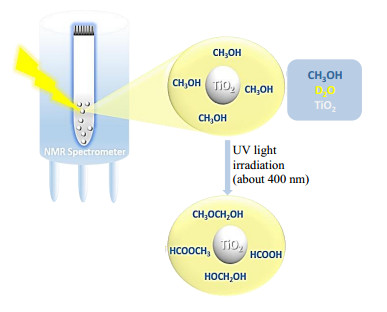
[5] WANG X L, LIU W, YU Y Y, et al. Operando NMR spectroscopic analysis of proton transfer in heterogeneous photocatalytic reactions[J]. Nat Communi, 2016, 7:11918.
[6] CHEN X B, SHEN S H, GUO L J, et al. Semiconductor-based photocatalytic hydrogen generation[J]. Chem Rev, 2010, 110(11):6503-6570.
[7] ONISHI H, IWASAWA Y. Dynamic visualization of a metal-oxide-surface/gas-phase reaction:Time-resolved observation by scanning tunneling microscopy at 800 K[J]. Phys Rev Lett, 1996, 76(5):791-794.
[8] SCHEIBER P, RISS A, SCHMID M, et al. Observation and destruction of an elusive adsorbate with STM:O2/TiO2(110)[J]. Phys Rev Lett, 2010, 105(21):5332-5337.
[9] ZHANG Z, BONDARCHUK O, WHITE J M, et al. Imaging adsorbate O-H bond cleavage:methanol on TiO2(110)[J]. J Am Chem Soc, 2006, 128(13):4198-4199.
[10] LI B, ZHAO J, ONDA K, et al. Ultrafast interfacial proton-coupled electron transfer[J]. Science, 2010, 110(12):7082-7099.
[11] MCLAREN A D. The beckmann rearrangement of aliphatic ketoximes[J]. Science, 1946, 103(2678):503.
[12] XU C B, YANG W S, GUO Q, et al. Molecular hydrogen formation from photocatalysis of methanol on anatase-TiO2(101)[J]. J Am Chem Soc, 2014, 136(2):602-605.
[13] XU C B, YANG W S, GUO Q, et al. Molecular hydrogen formation from photocatalysis of methanol on TiO2(110)[J]. J Am Chem Soc, 2013, 135(28):10206-10209.
[14] GUO Q, XU C B, REN Z F, et al. Stepwise photocatalytic dissociation of methanol and water on TiO2(110)[J]. J Am Chem Soc, 2012, 134(32):13366.
[15] ZHANG M, DE R M, FREI H. Time-resolved observations of water oxidation intermediates on a cobalt oxide nanoparticle catalyst[J]. Nat Chem, 2014, 6(4):362-367.
[16] HIGHFIELD J G, CHEN M. H, NGUYEN P T, et al. Mechanistic investigations of photo-driven processes over TiO2 by in-situ DRIFTS-MS:Part 1. Platinization and methanol reforming[J]. Energy Environ Sci, 2009, 2(9):991-1002.
[17] CHEN T, FENG Z C, WU G P, et al. Mechanistic studies of photocatalytic reaction of methanol for hydrogen production on Pt/TiO2 by in situ fourier transform IR and time-resolved IR spectroscopy[J]. J Phys Chem C, 2007, 111(22):8005-8014.
[18] BLANC F, LESKES M, GREY C P. In situ solid-state NMR spectroscopy of electrochemical cells:batteries, supercapacitors, and fuel cells[J]. Acc Chem Res, 2013, 46(9):1952-1963.
[19] CATTANEO A S, VILLA D C, ANGIONI S, et al. Operando electrochemical NMR microscopy of polymer fuel cells[J]. Energy Environ Sci, 2015, 8(8):2383-2388.
[20] CHAN K W H. Probing adsorbates on Pt electrode surfaces by the Use of 13C spin-echo NMR[J]. J Electrochem Soc, 1990, 137(1):367-368.
[21] TONG Y Y, WIECKOWSKI A, OLDFIELD E. NMR of electrocatalysts[J]. J Phys Chem B, 2002, 106(10):2434-2446.
[22] XU S T, ZHANG W P, LIU X C, et al. Enhanced in situ continuous-flow MAS NMR for reaction kinetics in the nanocages[J]. J Am Chem Soc, 2009, 131(38):13722-13727.
[23] YAMAMOTO M, NAKAMURA R, KASAYA T, et al. Back cover:spontaneous and widespread electricity generation in natural deep-sea hydrothermal fields[J]. Angew Chem, 2017, 56(21):5725.
[24] ZHANG W P, XU S T, HAN X W, et al. ChemInform abstract:in situ solid-state NMR for heterogeneous catalysis:A joint experimental and theoretical approach[J]. Chem Soc Rev, 2011, 43(1):192-210.
[25] SÁNCHEZ V M, COJULUN J A, SCHERLIS D A. Dissociation free energy profiles for water and methanol on TiO2 surfaces[J]. J Phys Chem C, 2010, 114(26):11522-11526.
[26] SETVÃN M, ASCHAUER U, SCHEIBER P, et al. Reaction of O2 with subsurface oxygen vacancies on TiO2 anatase (101)[J]. Science, 2013, 341(6149):988-991.
[27] SULEIMANOV N M, KHANTIMEROV S M, SCHEUERMANN R, et al. In situ muSR and NMR investigation of methanol dissociation on carbon-supported nanoscaled Pt-Ru catalyst[J]. J Solid State Electr, 2013, 17(8):2115-2121.
[28] SCHRAUBEN J N, HAYOUN R, VALDEZ C N, et al. Titanium and zinc oxide nanoparticles are proton-coupled electron transfer agents[J]. Science, 2012, 336(6086):1298-1301.
[29] PILLENTON S, RAFTERY D. Solid-state NMR studies of the adsorption and photooxidation of ethanol on mixed TiO2-SnO2 photocatalysts[J]. Solid State Nuclear Magnetic Resonance, 2003, 24(4):236-253.
[30] BALDOVINO-MEDRANO V G, POLLEFEYT G, BLIZNUK V, et al. Synergetic behavior of TiO2-supported Pd(z)Pt(1-z) catalysts in the green synthesis of methyl formate[J]. Chemcatchem, 2016, 8(6):1157-1166.