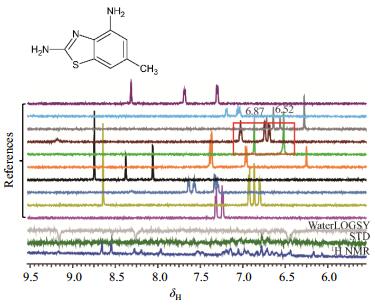
包含SET结构域的核受体结合蛋白1(NSD1)是一种组蛋白甲基转移酶,它能够特异性的甲基化组蛋白H3赖氨酸第36位(H3K36).异常表达的NSD1主要发现于Sotos综合症患者体内,但它同样也能导致其他多种人类疾病的发生.目前已有靶向组蛋白甲基转移酶DOT1L和EZH2的小分子抑制剂报道,然而,靶向NSD1的化学探针分子尚未被发现.本文使用基于片段的核磁共振(NMR)筛选方法寻找到3个以NSD1蛋白作为靶点的苗头化合物,利用化学位移扰动分析技术测定了这些化合物与NSD1的结合亲和力.另外,利用分子对接方法选择获得苗头化合物与NSD1蛋白的最可能的结合模型.结果显示苗头化合物1结合于NSD1天然底物S-腺苷酸甲硫氨酸(SAM)的结合口袋中.我们的研究成果为进一步以结构为指导的从苗头化合物到先导化合物的衍化奠定了基础.
汤衡
,
Gilbert NSHOGOZA
,
刘明清
,
刘亚茜
,
阮科
,
马荣声
,
高佳
. 基于片段的核磁共振筛选方法识别NSD1 SET结构域的全新苗头化合物[J]. 波谱学杂志, 2019
, 36(2)
: 148
-154
.
DOI: 10.11938/cjmr20182696
Nuclear receptor binding SET domain protein 1 (NSD1), which is a family member of histone methyltransferases, functions to methylate histone H3 on lysine 36 (H3K36). NSD1-related abnormalities are the major cause of Sotos syndrome, and also known to be associated with other human diseases. Inhibitors targeting histone methyltransferases DOT1L and EZH2 have been reported recently. However, no chemical probes targeting NSD1 have been found so far. Here, we identified three hits targeting the NSD1 SET domain using ligand-observed nuclear magnetic resonance (NMR) fragment-based screening. The binding affinities of the hit compounds to the NSD1 SET domain were determined by dose-dependent chemical shift perturbation analysis. Furthermore, the potential binding modes of the hit compounds to NSD1 were obtained by molecular docking. The hit compound 1 was found to bind to the binding pocket of S-adenosylmethionine (SAM), an endogenous ligand of the protein, in the NSD1 SET domain. The study provided valuable information for further structure-guided hit-to-lead evolution towards the potent and specific inhibitors of the NSD1 SET domain.
[1] BAYLIN S B, JONES P A. A decade of exploring the cancer epigenome-biological and translational implications[J]. Nat Rev Cancer, 2011, 11(10):726-734.
[2] COLE P A. Chemical probes for histone-modifying enzymes[J]. Nat Chem Biol, 2008, 4(10):590-597.
[3] HAN J Y, LEE I G, JANG W, et al. Identification of a novel de novo nonsense mutation of the NSD1 gene in monozygotic twins discordant for Sotos syndrome[J]. Clin Chim Acta, 2017, 470:31-35.
[4] BERDASCO M, ROPERO S, SETIEN F, et al. Epigenetic inactivation of the Sotos overgrowth syndrome gene histone methyltransferase NSD1 in human neuroblastoma and glioma[J]. Proc Natl Acad Sci U S A, 2009, 106(51):21830-21835.
[5] LU T, JACKSON M W, WANG B L, et al. Regulation of NF-kappaB by NSD1/FBXL11-dependent reversible lysine methylation of p65[J]. Proc Natl Acad Sci U S A. 107(1):46-51.
[6] PERI S, IZUMCHENKO E, SCHUBERT A D, et al. NSD1-and NSD2-damaging mutations define a subset of laryngeal tumors with favorable prognosis[J]. Nat Commun. 2017, 8(1):1772.
[7] SHIBA N, ICHIKAWA H, TAKI T, et al. NUP98-NSD1 gene fusion and its related gene expression signature are strongly associated with a poor prognosis in pediatric acute myeloid leukemia[J]. Genes Chromosomes Cancer, 2013, 52(7):683-693.
[8] QIAO Q, LI Y, CHEN Z, et al. The structure of NSD1 reveals an autoregulatory mechanism underlying histone H3K36 methylation[J]. J Biol Chem, 2011, 286(10):8361-8368.
[9] SU X P, ZHANG J P, MOUAWAD R, et al. NSD1 inactivation and SETD2 mutation drive a convergence toward loss of function of H3K36 writers in clear cell renal cell carcinomas[J]. Cancer Res, 2017, 77(18):4835-4845.
[10] VISSER R, LANDMAN E B, GOEMAN J, et al. Sotos syndrome is associated with deregulation of the MAPK/ERK-signaling pathway[J]. PLoS One, 2012, 7(11):e49229.
[11] WANG G G, CAI L, PASILLAS M P, et al. NUP98-NSD1 links H3K36 methylation to Hox-A gene activation and leukaemogenesis[J]. Nat Cell Biol, 2007, 9(7):804-812.
[12] TATTON-BROWN K, RAHMAN N. The NSD1 and EZH2 overgrowth genes, similarities and differences[J]. Am J Med Genet C Semin Med Genet, 2013, 163C(2):86-91.
[13] CHANG Y Q, ZHANG X, HORTON J R, et al. Structural basis for G9a-like protein lysine methyltransferase inhibition by BIX-01294[J]. Nat Struct Mol Biol, 2009, 16(3):312-317.
[14] YAO Y, CHEN P H, DIAO J S, et al. Selective inhibitors of histone methyltransferase DOT1L:design, synthesis, and crystallographic studies[J]. J Am Chem Soc, 2011, 133(42):16746-16749.
[15] MCCABE M T, OTT H M, GANJI G, et al. EZH2 inhibition as a therapeutic strategy for lymphoma with EZH2-activating mutations[J]. Nature, 2012, 492(7427):108-112.
[16] ZHANG X Q, SONG F B, KUO G H, et al. Optimization of a pyrazole hit from FBDD into a novel series of indazoles as ketohexokinase inhibitors[J]. Bioorg Med Chem Lett, 2011, 21(16):4762-4767.
[17] MA R S, WANG P C, WU J H, et al. Process of fragment-based lead discovery-A perspective from NMR[J]. Molecules, 2016, 21(7):E854.
[18] WHITTAKER M. Picking up the pieces with FBDD or FADD:invest early for future success[J]. Drug Discov Today, 2009, 14(13/14):623-624.
[19] GAO J, MA R S, WANG W, et al. Automated NMR fragment based screening identified a novel interface blocker to the LARG/RhoA complex[J]. PLoS One, 2014, 9(2):e88098.
[20] LIU J Y, ZHANG S Y, LIU M Q, et al. Structural plasticity of the TDRD3 Tudor domain probed by a fragment screening hit[J]. FEBS J, 2018, 285(11):2091-2103.
[21] GAO J, LIANG E, MA R S, et al. Fluorine pseudocontact shifts used for characterizing the protein-ligand interaction mode in the limit of NMR intermediate exchange[J]. Angew Chem Int Ed Engl, 2017, 56(42):12982-12986.
[22] XU D F, LI B, GAO J, et al. Ligand proton pseudocontact shifts determined from paramagnetic relaxation dispersion in the limit of NMR intermediate exchange[J]. J Phys Chem Lett, 2018, 9(12):3361-3367.
[23] LIU J Y, GAO J, LI F D, et al. NMR characterization of weak interactions between RhoGDI2 and fragment screening hits[J]. Biochim Biophys Acta Gen Subj, 2017, 1861(1 Pt A):3061-3070.
[24] WILLIAMSON M P. Using chemical shift perturbation to characterise ligand binding[J]. Prog Nucl Magn Reson Spectrosc, 2013, 73:1-16.

