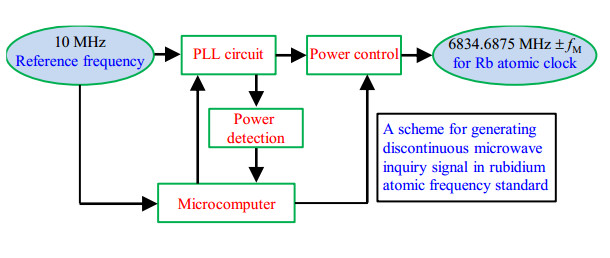
铷原子频标(RAFS)的微波探询信号可用于激励铷原子产生基态能级之间的跃迁,从而实现共振探测.目前常用的微波产生方案都存在电路结构复杂、功耗大、不便于集成的缺点.本文提出了一种利用锁相环(PLL)技术产生非连续微波探询信号的设计方案,这种方案以10 MHz信号作为参考频率,在单片机的合理配置下可直接得到(6 834.687 5 MHz±fM)信号(fM表示最大频偏).该方案具有电路结构简单、功耗低、数字化程度高等优点,利用该方案实现的整机稳定度优于1.5E-11/√τ(1 s≤τ≤100 s),性能指标均可满足小型商业铷原子钟要求.
包婉静
,
曾庆琦
,
余钫
,
秦蕾
,
陈智勇
. 一种非连续微波探询信号的实现[J]. 波谱学杂志, 2020
, 37(2)
: 209
-215
.
DOI: 10.11938/cjmr20192722
The microwave probing signal of the rubidium atomic frequency standard (RAFS) is used to excite the transitions between the ground-state energy levels of rubidium atoms, and realize resonance detection. At present, the microwave generation schemes commonly used all have the disadvantages of complicated circuit structure, high power consumption and inconvenient integration. This work introduces a design scheme for generating discontinuous microwave inquiry signal using the phase-locked loop (PLL) technology. The scheme takes the 10 MHz signal as a reference frequency, and is capable of obtain the (6 834.687 5 MHz ±fM) signal directly under a reasonable configuration of single chip microcomputer. The scheme has the advantages of simple circuit structure, low power consumption and high digitization. The stability of the whole machine was found to be better than 1.5E-11/√τ(1 s ≤ τ ≤ 100 s). The performance indexes can meet the requirements of small commercial rubidium atomic clock.
[1] 费元春. 固态倍频[M]. 北京:高等教育出版社, 1985:79-113.
[2] HUANG Z, YAN S D, MEI G H, et al. Design and implementation of a new scheme of rubidium atomic frequency standard frequency synthesizer[J]. Chinese J Magn Reson, 2017, 34(4):481-488.黄争, 阎世栋, 梅刚华, 等. 一种铷原子频标频率综合器新方案的设计与实现[J]. 波谱学杂志, 2017, 34(4):481-488.
[3] LUO Q, BAO W J, QIN L, et al. A small power amplitude stabilization circuit for rubidium atomic frequency standard[J]. Chinese J Magn Reson, 2017, 34(4):474-480.罗奇, 包婉静, 秦蕾, 等. 一种小型铷原子频标功率稳幅电路[J]. 波谱学杂志, 2017, 34(4):474-480.
[4] FENG K M, WANG L, GUO P X, et al. A new circuit scheme of rubidium vapor chamber frequency standard[J]. Journal of Astronautic Metrology and Measurement, 2004, 24(1):16-19.冯克明, 王亮, 郭鹏翔, 等. 一种新型铷汽室频标电路方案[J]. 宇航计测技术, 2004, 24(1):16-19.
[5] 巧莉. 基于DDS的微波频率源设计与实现[D]. 成都:电子科技大学, 2013.
[6] 仲崇霞, 夏振华. 短期频率稳定度时频域转换的验证[C]. 2008年全国频率控制技术年会论文集.北京无线电计量测试研究所, 2008:51-57.
[7] VANIER J, AUDOIN C. The quantum physics of atomic frequency standards[M]. IOP Publishing Ltd, 1989.
[8] 杨世宇, 王世伟, 冯浩, 等. 阶跃倍频器温度敏感性对铷原子钟频率稳定度的影响[C]. 全国时间频率学术会议论文集, 2011:65-69.