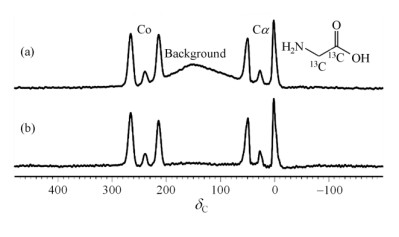
由静态探头线圈外有机材料产生的13C NMR背景信号强度大,化学位移范围广(δC 20~250),此背景信号在交叉极化实验中还可被增强,并随着样品信号的累积而累积,严重影响谱图分析.将相位步进脉冲引入交叉极化实验(称为PIPCP)中可以有效去除经交叉极化增强的13C NMR背景信号,但样品信号不受影响.这是由于经过相位步进脉冲后,线圈外相位严重畸变,而且线圈外锁定场强度急剧降低,来自探头材料的13C NMR背景信号无法有效地进行交叉极化.而对于被测样品甘氨酸来说,由于I核和S核之间强烈的偶极耦合作用,所加相位步进脉冲对锁定场强度的影响只有1.4%.
The background 13C NMR signal originated from the organic materials in the probe head cross-polarizes from 1H nucleus to 13C nucleus. This background 13C NMR signal is very broad (δC 20~250) and accumulates as the sample signal accumulating. Hartman-Hahn cross polarization with phase-incremented pulses in the S spin channel (denoted as PIPCP) is developed to suppress this background signal. The application of PIPCP results in severe phase distortion outside the radio frequency coil such that the background 13C NMR signal cannot cross polarize and thus be suppressed. In comparison, depending on the dipolar coupling constant between 1H and 13C nuclei, PIPCP induces only a small amount of Hartman-Hahn mismatch (1.4%) to the desired signals.
[1] SMERNIK R J, OADES J M. Background signal in solid state 13C NMR spectra of Soil Organic Matter (SOM)-Quantification and minimization[J]. Solid State Nucl Magn Reson 2001, 20(1/2):74-84.
[2] CHEN Q, HOU S S, SCHMIDT-ROHR K. A simple scheme for probehead background suppression in one-pulse 1H NMR[J]. Solid State Nucl Magn Reson, 2004, 26(1):11-15.
[3] MEIER S, BENIE A J, DUUS J, et al. Adiabatic low-pass J filters for artifact suppression in heteronuclear NMR[J]. Chem Phys Chem, 2009,10(6):893-895.
[4] KONUMA T, NAGADO A, KURITA J I, et al. Analysis of artifacts caused by pulse imperfections in CPMG pulse trains in NMR relaxation dispersion experiments[J]. Magnetochemistry, 2018, 4(3):33-50.
[5] LBUESS M, LPETERSEN G. Acoustic ringing effects in pulsed nuclear magnetic resonance probes[J]. Rev Sci Instrum, 1978, 49(8):1151-1157.
[6] ZHANG S M, WU X L, MEHRING M. Elimination of ringing effects in multiple-pulse sequences[J]. Chen Phys Lett, 1990, 173(5/6):481-484.
[7] BAIN A D, HUGHES D W, ANAND C K, et al. Problems, artifacts and solutions in the INADEQUATE NMR experiment[J]. Magn Reson Chem, 2010, 48(8):630-641.
[8] GEROTHANASSIS I P. Simple reference baseline subtraction-90˚ pulse sequence for acoustic ringing elimination in pulsed Fourier transform NMR spectroscopy[J]. Magn Reson Chem, 1986, 24(5):428-433.
[9] MALLONI W M, SANCTI S D, TOME A M, et al, Automated solvent artifact removal and base plane correction of multidimensional NMR protein spectra by AUREMOL-SSA[J]. J Biomol NMR, 2010, 47(2):101-111.
[10] SPEIGHT P A, JEFFREY K R, COURTENEY J A. A probe modification for pulsed nuclear magnetic resonance to eliminate spurious ringing[J]. J Phys E Sci Instrum, 1974, 7:801-802.
[11] CORY D G, RITCHEY W M. Suppressionof signals from the probe in bloch decay spectra[J]. J Magn Reson, 1988, 80(1):128-132.
[12] BODENHAUSEN G, FREEMAN R, TURNER D L. Suppressionof artifacts in two-dimensional J spectroscopy[J]. J Magn Reson, 1977, 27:511-515.
[13] BENDALL M R, GOEDON R E. Depth and refocusing pulses designedfor multipulse NMR with surfacecoils[J]. J Magn Reson, 1983, 53(3):365-385.
[14] FU R Q, Arturo J H M. Boosting sensitivity and suppressing artifacts via multi-acquisition in direct polarization NMR experiments with small flip-angle pulses[J]. J Magn Reson, 2018, 293:34-40.
[15] CHRISTIAN J, HEMMANN F. EASY:A simple tool for simultaneously removing background, deadtime and acoustic ringing in quantitative NMR spectroscopy-Part I:Basic principle and applications[J]. Solid State Nucl Magn Reson, 2014, 57-58:22-28.
[16] CHRISTIAN J, HEMMANN F. EASY:A simple tool for simultaneously removing background, deadtime and acoustic ringing in quantitative NMR spectroscopy-Part II:Improved ringing suppression, application to quadrupolar nuclei, cross polarisation and 2D NMR[J]. Solid State Nucl Magn Reson, 2014, 63-64:13-19.
[17] WHITE J L, BECK L B, FERGUSON D B, et al. Background suppression in MAS NMR[J]. J Magn Reson, 1992, 100(2):336-341.
[18] MOLLIC G, ZIARELLI F, TINTARU A, et al. Suppressing background signals in solid state NMR via the Electronic Mixing-Mediated Annihilation (EMMA) method[J]. J Magn Reson, 2012, 218:1-4.
[19] LIU Z J, SHU J, ZHANG L L, et al. A study on the cross-polarization kinetics of polyethylene crystals[J]. Chinese J Magn Reson, 2008, 25(2):159-164. 刘志健, 舒婕, 张莉莉, 等. 聚乙烯结晶区的交叉极化动力学研究[J]. 波谱学杂志, 2008, 25(2):159-164.
[20] SUN Y, CHEN Y K, LI J P, et al. Efficiency of double cross polarization in magic-angle spinning solid-state NMR studies on membrane proteins[J]. Chinese J Magn Reson, 2017, 34(3):257-265. 孙毅, 陈艳可, 李建平, 等. 固体核磁共振中膜蛋白双交叉极化效率与动力学参数相关的定量分析[J]. 波谱学杂志, 2017, 34(3):257-265.
[21] ZHANG L, YANG G, CHEN Q. Influence of CP time on intermolecular cross polarization in the composite of poly(ethylene oxide) and fullerene[J]. Chinese J Magn Reson, 2005, 22(3):245-251. 张磊, 杨光, 陈群. 交叉极化时间对分子间交叉极化的影响的研究[J]. 波谱学杂志, 2005, 22(3):245-251.
[22] ZHANG S M. Phase incremented pulses in NMR with applications[J]. Annu Rep NMR Spectro, 2004, 53:1-66.
[23] GUENDOUZ L, ROBERT A, RRTOURNARD A, et al. Off-resonance effects and selectivity profiles in pulsed nitrogen-14 nuclear quadrupole resonance[J]. Solid State Nucl Magn Reson, 2012, 47-48:39-46.