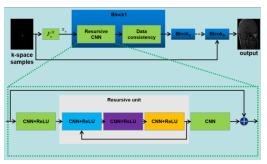
快速磁共振成像是磁共振研究领域重要的课题之一.随着大数据和深度学习的兴起,神经网络成为快速磁共振技术的重要方法.然而网络性能表现和网络参数量之间较难取得平衡,且对于多通道数据重建的并行成像问题,相关研究较少.本文构建了一种深度递归级联卷积神经网络结构,用于处理并行成像问题.这种网络结构在减少网络参数量的同时,能够尽可能地提高网络的表达能力,提高网络重建的精确度.实验结果表明,相较于传统并行成像方法,通过训练好的神经网络对欠采样磁共振数据进行重建,可以得到更准确的重建结果,且重建时间大大缩短.
程慧涛
,
王珊珊
,
柯子文
,
贾森
,
程静
,
丘志浪
,
郑海荣
,
梁栋
. 基于深度递归级联卷积神经网络的并行磁共振成像方法[J]. 波谱学杂志, 2019
, 36(4)
: 437
-445
.
DOI: 10.11938/cjmr20192721
Fast magnetic resonance imaging (MRI) has been attracting more and more research interests in recent years. With the emergence of big data and development of advanced deep learning algorithms, neural network has become a common and effective tool for image reconstruction in fast MRI. One main challenge to the deep learning-based methods for fast MRI reconstruction is the trade-off between the network performance and the network capacity. Few previous studies have used the deep learning-based methods in parallel imaging. In this work, a deep recursive cascaded convolutional network (DRCCN) architecture was designed for parallel MRI, with reduced number of network parameters while maintaining a satisfactory performance. The experimental results demonstrated that, compared to the classical methods, image reconstruction with the well-trained DRCCN networks were more accurate and less time consuming.
[1] LUSTIG M, DONOHO D L, SANTOS J M, et al. CompressedSensing MRI[J]. IEEE Signal Proc Mag, 2008, 25(2):72-82.
[2] GRISWOLD M A, JAKOB P M, HEIDEMANN R M, et al. Generalized autocalibrating partially parallel acquisitions (GRAPPA)[J]. Magn Reson Med, 2002, 47(6):1202-1210.
[3] PRUESSMANN K P, WEIGER M, SCHEIDEGGER M B, et al. SENSE:sensitivity encoding for fast MRI[J]. Magn Reson Med, 1999, 42(5):952-962.
[4] LUSTIG M, PAULY J M. SPIRiT:iterative self-consistent parallel imaging reconstruction from arbitrary k-space[J]. Magn Reson Med, 2010, 64(2):457-471.
[5] CHAI Q H, SU G Q, NIE S D. Compressive sensing low-field MRI reconstruction with dual-tree wavelet transform and wavelet tree sparsity[J]. Chinese J Magn Reson, 2018, 35(4):486-497. 柴青焕, 苏冠群, 聂生东. 双树小波变换与小波树稀疏联合的低场CS-MRI算法[J]. 波谱学杂志, 2018, 35(4):486-497.
[6] LIANG D, WANG H F, CHANG Y C, et al. Sensitivity encoding reconstruction with nonlocal total variation regularization[J]. Magn Reson Med, 2011, 65(5):1384-1392.
[7] LIU Q G, WANG S S, YING L, et al. Adaptive dictionary learning in sparse gradient domain for image recovery[J]. IEEE T Image Process, 2013, 22(12):4652-4663.
[8] SONG Y, XIE H B, YANG G. Dictionary learning with segmentation for compressed-sensing magnetic resonance imaging[J]. Chinese J Magn Reson, 2016, 33(4):559-569. 宋阳, 谢海滨, 杨光. 用于压缩感知磁共振成像的分割字典学习算法[J]. 波谱学杂志, 2016, 33(4):559-569.
[9] JASPAN O N, FLEYSHER R, LIPTON M L. Compressed sensing MRI:a review of the clinical literature[J]. Br J Radiol, 2015, 88(1056):20150487.
[10] HOLLINGSWORTH K G. Reducing acquisition time in clinical MRI by data undersampling and compressed sensing reconstruction[J]. Phys Med Biol, 2015, 60(21):R297.
[11] WANG S S, SU Z H, YING L, et al. Accelerating magnetic resonance imaging via deep learning[C]//IEEE:2016 IEEE 13th International Symposium on Biomedical Imaging (ISBI), 2016:514-517.
[12] YANG Y, SUN J, LI H B, et al. Deep ADMM-Net for compressive sensing MRI[C]//LEE D D, SUGIYAMA M, LUXBURG U V, et al. Advances in neural information processing systems 29, 2016:10-18.
[13] HAMMERNIK K, KLATZER T, KOBLER E, et al. Learning a variational network for reconstruction of accelerated MRI data[J]. Magn Reson Med, 2018, 79(6):3055-3071.
[14] KNOLL F, HAMMERNIK K, KOBLER E, et al. Assessment of the generalization of learned image reconstruction and the potential for transfer learning[J]. Magn Reson Med, 2019, 81(1):116-128.
[15] SCHLEMPER J, CABALLERO J, HAJNAL J V, et al. A deep cascade of convolutional neural networks for dynamic MR image reconstruction[J]. IEEE T Med Imaging, 2018, 37(2):491-503.
[16] ZHU B, LIU J Z, CAULEY S F, et al. Image reconstruction by domain-transform manifold learning[J]. Nature, 2018, 555(7697):487-492.
[17] HAN Y, YOO J, KIM H H, et al. Deep learning with domain adaptation for accelerated projection-reconstruction MR[J]. Magn Reson Med, 2018, 80(3):1189-1205.