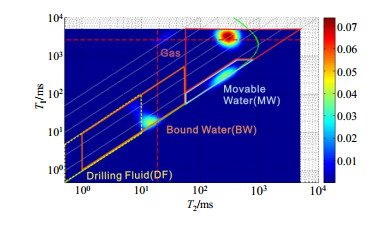
川西气田雷口坡组四段白云岩储层具有良好的天然气勘探开发前景,但是储层分布具有较强的非均质性,利用常规测井和一维核磁共振测井方法判断储层流体性质存在多解性.通过分析川西雷四段白云岩储层地质特征与测井响应特征,开展岩心二维核磁共振实验,明确了实验室分析与测井过程中环境、参数等影响因素,建立了岩心分析结果的校正方法,明确了钻井液、束缚流体、可动水与天然气信号在二维核磁共振测井中谱分布区间,建立了基于T2-T1、T1/T2(R)的白云岩储层二维核磁共振测井气水识别图版.利用图版对川西雷四段储层流体性质开展评价,二维核磁共振测井解释结论得到了实钻测试结果的验证,该气水识别方法填补了常规测井、一维核磁共振测井在评价储层气水关系中的缺陷,可有效解决白云岩储层流体性质判别难题.
张世懋
,
葛祥
,
王辛
,
侯克均
. 川西气田白云岩储层二维核磁共振测井气水识别方法[J]. 波谱学杂志, 2020
, 37(3)
: 360
-369
.
DOI: 10.11938/cjmr20192754
The dolomite reservoirs in the fourth member of Leikoupo formation of the western Sichuan gas field have good prospects for natural gas exploration and development. However, the conventional and one-dimensional nuclear magnetic resonance (1D NMR) logging data are not sufficient for a definitive classification of the reservoir fluid type, likely because of heterogeneity of the reservoirs. Through geological characteristics analysis, log response analysis and two-dimensional (2D) NMR experiment, the environmental factors and technical parameters leading to the differences between the laboratory results and actual logging data were determined. According to the analysis of T2-T1 and T1/T2 (R) differences, the distribution range of drilling fluid, bound fluid, movable water and natural gas signals in the 2D NMR spectra was delineated to build a gas-water 2D NMR identification chart. The results obtained using the identification chart were verified with the actual drilling test results. Complementary to conventional and 1D NMR logging, the 2D NMR identification method was proposed, and can be used to determine the fluid properties in the dolomite reservoirs effectively.
[1] XIE R H, XIAO L Z. The (T2, D) NMR logging method for fluids characterization[J]. Chinese Journal of Geophysics, 2009, 52(9):2410-2418.谢然红, 肖立志. (T2, D)二维核磁共振测井识别储层流体的方法[J]. 地球物理学报, 2009, 52(9):2410-2418.
[2] SHAO W Z. On effect of NMR differential and shifted spectrum method in laboratory[J]. Well Logging Technology, 2004, 27(6):502-507.邵维志. 核磁共振测井移谱差谱法影响因素实验分析[J]. 测井技术, 2004, 27(6):502-507.
[3] HU F L, ZHOU C C, LI C L, et al. Fluid identification method based on 2D diffusion-relaxation nuclear magnetic resonance (NMR)[J]. Petroleum exploration and developmen, 2012, 39(5):552-558.胡法龙, 周灿灿, 李潮流, 等. 基于弛豫-扩散的二维核磁共振流体识别方法[J]. 石油勘探与开发, 2012, 39(5):552-558.
[4] FENG D J, ZHU T, LI H T. Geological features and control factors of reservior forming in middle Triassic Leikoupo Formation in western Sichuan Basin[J].Jouranal of Xi'an shiyou university(Natural science edition), 2013, 28(6):1-7.冯动军, 朱彤, 李宏涛. 川西海相雷口坡组成藏地质特征及控制因素[J]. 西安石油大学学报(自然科学版), 2013, 28(6):1-7.
[5] CHENG J J. Application of NMR log data to productivity evaluation of tight sandstone gas reserviors[J]. Offshore oil, 2017, 37(4):57-62.成家杰. 核磁测井资料在致密砂岩储层产能评价中的应用[J]. 海洋石油, 2017, 37(4):57-62.
[6] DING Y J, CAI X Y, SHAO W Z, et al. Key parameters of water saturation based on concentration of T2 sprctrum distribution[J]. Well logging technology, 2017, 41(4):405-411.丁娱娇, 柴细元, 邵维志, 等. 基于核磁共振T2谱集中度的低孔隙度低渗透率储层饱和度参数研究[J]. 测井技术, 2017, 41(4):405-411.
[7] ZHANG S M, ZHANG S N, GE X, et al. Optimal design and application of two-dimensional NMR logging in Chuanxi Tight Gas Reservoir[J]. Chinese J Magn Reson, 2018, 35(2):234-242.张世懋, 张哨楠, 葛祥, 等. 川西致密气藏二维核磁共振测井优化设计与应用[J]. 波谱学杂志, 2018, 35(2):234-242
[8] HOU K J, WU J M, GE X, et al. Porosity computational method based on 2D NMR relaxation spectra of leikoupo group's 4th section in western Chuanxi[J]. Chinese J Magn Reson, 2020, 37(2):162-171.侯克均, 吴见萌, 葛祥, 等. 基于二维核磁共振弛豫谱的川西雷四段孔隙度计算方法[J]. 波谱学杂志, 2020, 37(2):162-171.
[9] HAYASHI S, AKIBA E. Nuclear spin-lattice relaxation mechanisms in kaolinite confirmed by magic-angle spinning[J]. Solid State Nucl Magn, 1995, 4(6):331-340.
[10] HÜRLIMANN M D. Effective gradients in porous media due to susceptibility differences[J]. J Magn Reson, 1998, 131(2):232-240.
[11] HÜRLIMANN M D. Diffusion and relaxation effects in general stray field NMR experiments[J]. J Magn Reson, 2001, 148(2):367-378.
[12] ITSKOVICH G, REIDERMAN A. Method and apparatus for multi-frequency NMR diffusion measurements in the presence of internal magnetic field gradients:US, US7049815[P]. 2006.
[13] CHITALE D V, COATES G R, DAY P I, et al. System and method for clay typing using nmr-based porosity modeling:US, US 6646437 B1[P]. 2003.
[14] HAGIWARA T. NMR Logging using time-domain averaging:US, US7135862[P]. 2006.
[15] DUNN K J, Latorraca G A. The inversion of NMR log data sets with different measurement errors[J]. J Magn Reson, 1999, 140(1):153-161.
[16] MENG X N, XIE R H, LI C X, et al. An NMR log echo data de-noising method based on the wavelet packet threshold algorithm[J]. J Geophys Eng, 2015, 12(6):956-968.

