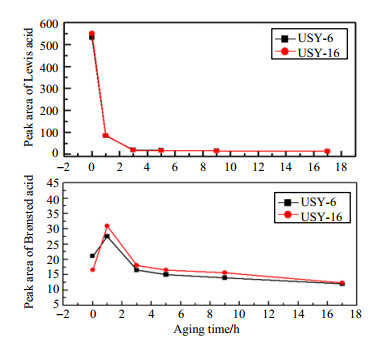
利用固体核磁共振(NMR)结合探针分子技术,探讨了超稳Y分子筛在水热老化过程中酸中心结构和酸性的变化规律.结果表明,水热老化初期,大量的骨架铝脱出最终形成了非骨架五配位铝,使得丙酮探测到的Brønsted酸(B酸)酸量随着老化时间的增加而减少.而非骨架五配位铝会向表面迁移并形成多聚铝,使得分子筛中Lewis酸(L酸)酸量也随老化时间的增加而减少.在老化过程的前3 h内,酸量的变化幅度较大.整体硅/铝原子比相等的分子筛,其B酸酸量的变化幅度与新鲜剂的晶胞大小呈正比;随着老化时间的继续增加,不同配位的铝物种的含量趋于稳定,B酸和L酸的酸量变化幅度很小.在整个水热老化过程中,超稳Y分子筛中B酸和L酸的协同效应一直存在,由协同效应产生的一种酸性增强的B酸位的稳定性最好.
高秀枝
,
张翊
,
王秀梅
,
张智华
,
徐广通
. NMR研究超稳Y分子筛水热老化过程中结构与酸性的变化[J]. 波谱学杂志, 2020
, 37(1)
: 95
-103
.
DOI: 10.11938/cjmr20192745
Structure and acidity changes of the acid sites in ultra-stable Y zeolites of different cell sizes during the hydrothermal aging process were studied by solid-state nuclear magnetic resonance (NMR) combined with molecular probes. The experimental results demonstrated that, during the initial stage of hydrothermal aging, parts of the framework aluminum species were removed from the framework and formed five-coordinate extra-framework aluminum species. In the meanwhile, the five-coordinate extra-framework aluminum species migrated to the surface and formed poly-aluminum species, resulting in decreases of both Brønsted acid sites and Lewis acid sites. The acidity of ultra-stable Y zeolites changed considerably during the first 3 h of the aging process, and the change of Brønsted acid content was proportional to the unit cell dimension of the fresh zeolites agent. With the increase of aging time, the aluminum distribution tended to become stable, with little further changes in the amounts of Brønsted acid and Lewis acid sites. The synergy between Brønsted/Lewis acids in the ultra-stable Y zeolites existed during the entire aging process, resulting in a stably enhanced acidity for the Brønsted acid sites.
[1] ARRIBAS J, CORMA A, FORNES V, et al. Influence of framework aluminum gradients on the catalytic activity of Y zeolites:Cracking of gas-oil on Y zeolites dealuminated by different procedures[J]. J Catal, 1987, 108(1):135-142.
[2] CORMA A, FORNES V, MARTINEZ A, et al. Influence of the method of dealumination of Y zeolites on its behaviour for cracking N-heptane and vacuum gas oil[J]. Stud Surf Sci Catal, 1988, 37(6):495-503.
[3] WILLIAMS B A, BABITZ S M, MILLER J T, et al. The roles of acid strength and pore diffusion in the enhanced cracking activity of steamed Y zeolites[J]. Appl Catal A:Gen, 1999, 177(2):161-175.
[4] CORMA A, FORNES V, MARTINEZ A, et al. Parameters in addition to the unit cell that determine the cracking activity and selectivity of dealuminated HY zeolites[J]. ACS Sym Ser, 1988, 368(368):542-554.
[5] XU B, BORDIGA S, PRINS R, et al. Effect of framework Si/Al ratio and extra-framework aluminum on the catalytic activity of Y zeolite[J]. Appl Catal A:Gen, 2007, 333(2):245-253.
[6] CORMA A, GRANDE M, FORNéS V, et al. Interaction of zeolite alumina with matrix silica in catalytic cracking catalysts[J]. Appl Catal, 1990, 66(1):45-57.
[7] WANG Q L, GIANNETTOG, GUISNET M. Dealumination of zeolites III. Effect of extra-framework aluminum species on the activity, selectivity, and stability of Y zeolites in n-heptane cracking[J]. J Catal, 1991, 130(2):471-482.
[8] LOEFFLER E, LOHSE U, PEUKER C H, et al. Study of different states of nonframework aluminum in hydrothermally dealuminated HZSM-5 zeolites using diffuse reflectance IR spectroscopy[J]. Zeolites, 1990, 10(4):266-271.
[9] MEYERSBL, FLEISCH TH, RAY G J, et al. Multitechnique characterization of dealuminatedmordenites[J]. J Catal, 1988, 110(1):82-95.
[10] GAO X Z, WANG X M, XU G T, et al. Insight into structureand acidity evolution mechanism of Y zeolites during hydrothermal aging[C]. Chinese zeolite conference, 2013.高秀枝, 王秀梅, 徐广通, 等. Y型分子筛水热老化过程中结构和酸性变化规律的研究[C]. 全国分子筛学术大会会议. 2013.
[11] GAO X Z, ZHANG Y, XU G T, et al. Insight into structure evolution mechanism of ultra-stable Y zeolites during hydrothermal aging[J]. Acta Petrolei Sinica, 2016, 32(2):357-363.高秀枝, 张翊, 徐广通, 等. 超稳Y分子筛水热老化过程中的结构变化规律[J]. 石油学报, 2016, 32(2):357-363.
[12] GAO X Z, ZHANG Y, WANG X M, et al. State of acidic center and acidity of dealuminated HY zeolites investigated by solid-state NMR spectroscopy[J].Acta Petrolei Sinica, 2012, 28(2):180-187.高秀枝, 张翊, 王秀梅, 等. 脱铝HY分子筛酸中心结构与酸性的固体NMR研究[J]. 石油学报, 2012, 28(2):180-187.
[13] YU Z W, AMOUREUX J P, DENG F, et al. Insights into the dealumination of zeolite HY revealed by sensitivity-enhanced 27Al DQ-MAS NMR spectroscopy at high field[J]. Angew Chem Int Ed, 2010, 49(46):8657-8661.
[14] LI S H,YE C H, DENG F, et al. Brønsted/Lewis acid synergy in dealuminated HY zeolite:A combined solid-state NMR and theoretical calculation study[J]. J Am Chem Soc, 2007, 129(36):11161-11171.
[15] HAW J F, NICHOLAS J B, XU T, et al. Physical organic chemistry of solid acids:Lessons from in situ NMR and theoretical chemistry[J]. Accounts Chem Res, 1996, 29(6):259-267.
[16] LUNSFORD J H, ROTHWEL W P. Acid sites in zeolite Y:A solid-state NMR and infrared study using trimethylphosphine as a probe molecule[J]. J Am Chem Soc, 1985, 107:1540.
[17] ZHANG Y, OLDFIELD E. 31P NMR chemical shifts in hypervalent oxyphosphoranes and polymeric orthophosphates[J]. J Phys Chem B, 2006, 110:579.
[18] ZHENG A, LIU S B, DENG F. 31P NMR chemical shifts of phosphorus probes as reliable and practical acidity scales for solid and liquid catalysts[J]. Chem Rev, 2017, 117(19):12475-12531.

