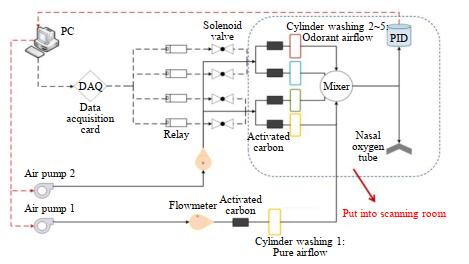
现有的基于磁共振测量的嗅觉刺激器,通过调节嗅剂液体浓度的方法可以实现不同浓度的嗅觉刺激,但随着实验进行,受到嗅剂挥发以及实验环境(温度、湿度、气流量)变化的影响,很难确保输送至鼻腔的嗅剂气体浓度的稳定性,进而影响实验结果的准确性.本研究对本实验室前期开发的嗅觉刺激装置进行改进,实现了气体浓度精确定量.改进后的嗅觉刺激器主要分为三个部分:控制系统、反馈系统和气路系统.控制系统主要实现气路系统的送气控制和嗅剂气体浓度调节;反馈系统则负责对气体浓度进行测量;气路系统则在原有基础上添加活性炭装置,降低无关因素干扰.装置改进之后,不同气路切换时间为75.2 ms,比原装置减少了1 s,有效提高刺激精度.实验结果显示,气体浓度调节前,300 s内乙醇、吡啶、乙酸戊酯嗅剂气体浓度分别下降6.7%、71.4%、79.2%,嗅剂气体浓度短时间内发生较大改变.加入气体浓度调节功能后,当气体浓度下降至目标浓度的90%时,可通过调节气泵电压改变嗅剂气流与空气气流比例,从而调节嗅剂气体浓度至目标值,其中吡啶、乙酸戊酯用时13 s.
孙韦
,
王慧
,
张寅
,
常严
,
杨晓冬
. 基于气体浓度定量的嗅觉刺激器优化设计[J]. 波谱学杂志, 2021
, 38(1)
: 12
-21
.
DOI: 10.11938/cjmr20202820
The existing olfactory stimulator based on magnetic resonance measurement can provide different concentration of olfactory stimulation by adjusting the concentration of olfactory liquid. However, with the progress of the experiment, it is difficult to ensure the concentration stability of odorant gas delivered to the nasal cavity, due to the odorant volatilization and the change of experimental environments (temperature, humidity, air flow), thus affecting the experimental accuracy. In this research, we improved the olfactory stimulation device previously developed by our laboratory to achieve accurate quantification of gas concentration. The improved olfactory stimulator mainly consists of three parts: control system, feedback system and pneumatic system. The control system is mainly use to control gas delivery and adjust concentration of olfactory gas. The feedback system is responsible for measuring the gas concentration. In the pneumatic system, an activated carbon device is added to the original foundation to reduce interference of irrelevant factors. After the improvement, the switching response time between different pneumatic branches reached to 75.2 ms, which is nearly 1 s less than the original device, and effectively improves the accuracy of stimulus. The experimental results show that the olfactory gas concentration of ethanol, pyridine and amyl acetate decrease by 6.7%, 71.4%, and 79.2% respectively, within 300 s before adjusting the gas concentration. The odorant gas concentration changes significantly in a short time. The gas concentration regulation function can be realized by adjusting the voltage of air pump of the feedback system to change the ratio of odorant airflow and pure airflow. When the gas concentration drops to 90% of the target value, it took 13 s to adjust the odorant gas concentration to the target value for pyridine and amyl acetate.
[1] LI B, WU R Q, LI A A, et al. Application of functional magnetic resonance imaging in human olfaction studies[J]. Physics, 2011, 40(6):374-380.李博,吴瑞琪,李安安,等.脑功能磁共振成像在人类嗅觉研究中的应用[J].物理, 2011, 40(6):374-380.
[2] DOTY R L. Olfactory dysfunction in neurodegenerative diseases:is there a common pathological substrate?[J]. Lancet Neurol, 2017, 16(6):478-488.
[3] ELKHATIB A H, SOLDATOVA L, CARRAU R L. Role of 18F-FDG PET/CT differentiating olfactory neuroblastoma from sinonasal undifferentiated carcinoma[J]. Laryngoscope, 2016, 127(2):321-324.
[4] HAN P F, SCHRIEVER V A, PETERS P, et al. Influence of airflow rate and stimulus concentration on olfactory event-related potentials (OERP) in humans[J]. Chem Senses, 2018, 43(2):89-96.
[5] ZHAO F Q, WANG X H, ZARIWALA H A, et al. fMRI study of olfaction in the olfactory bulb and high olfactory structures of rats:Insight into their roles in habituation[J]. NeuroImage, 2016, 127:445-455.
[6] PAIN F, L'HEUREUX B, GURDEN H. Visualizing odor representation in the brain:a review ofimaging techniques for the mapping of sensory activity in the olfactory glomeruli[J]. Cell Mol Life Sci, 2011, 68:2689-2709.
[7] CERF-DUCASTEL B, MURPHY C. FMRI brain activation in response to odors is reduced in primary olfactory areas of elderly subjects[J]. Brain Res, 2003, 986(1/2):39-53.
[8] DALTON P. Psychophysical and behavioral characteristics of olfactory adaptation[J]. Chem Senses, 2000, 25(4):487-492.
[9] KOBAL G. Pain-related electrical potentials of the human nasal mucosa elicited by chemical stimulation[J]. Pain, 1985, 22(2):151-163
[10] JOHNSON B N, SOBEL N. Methods for building an olfactometer with known concentration outcomes[J]. J Neurosci Methods, 2007, 160(2):231-245.
[11] ANDRIEU P, BONNANS V, JAIME M, et al. A modular, computer-controlled system for olfactory stimulation in the MRI environment[J]. Behav Res Methods, 2014, 46(1):178-184.
[12] XU F Q, LIU N, KIDA L, et al. Odor maps of aldehydes and esters revealed by functional MRI in the glomerular layer of the mouse olfactory bulb[J]. P Natl Acad Sci U S A, 2003, 100(19):11029-11034.
[13] HUANG C M. Analysis of clinical application of subjective olfactory evaluation method[J]. Chinese Medical Equipment, 2014, B08:152-153.黄春梅.嗅觉主观评价方法临床应用分析[J].中国医学装备, 2014, B08:152-153.
[14] WANG J, JIANG L H, DU H Y, et al. An ethanol vapor chamber system for small animals[J]. J Neurosci Methods, 2012, 208(1):79-85.
[15] INVITTO S, CAPONE S, MONTAGNA G, et al. Virtual olfactory device in eeg and olfactory conditioning task:an OERP study[C]//Cham:Springer International Publishing, 2018:315-321.
[16] 庄柳静.在体生物电子鼻气味检测及嗅觉感知机理研究[D].杭州:浙江大学, 2017.
[17] BURGHART-MESSTECHNIK CORPORATION. Olfactometer OL022(OM i/m)[EB/OL]. 2020-03-13. http://www.burghart-mt.de/index.php?p1=produkte&p2=olfaktometrie&p3=omi_m.
[18] EMERGING TECH TRANS CORPORATION. Emerging tech trans, LLC-products we offer[EB/OL]. 2020-03-13. http://www.emergingtechtrans.com/products.php.
[19] LIU W, WANG H, WANG E L, et al. Optimization and evaluation of an olfactory stimulator for fMRI studies[J]. Chinese J Magn Reson, 2017, 34(4):519-527.刘伟,王慧,王二磊,等.一种用于fMRI的嗅觉刺激装置优化与验证[J].波谱学杂志, 2017, 34(4):519-527.
[20] FAN R, HOU Y B, GUO Q H, et al. Technology temperature compensation technology of the methane sensor with tunable semiconductor laser spectrum absorption[J]. Journal of China Coal Society, 2015, 40(1):226-231.樊荣,侯媛彬,郭清华,等.可调谐半导体激光吸收光谱式甲烷传感器温度补偿技术[J].煤炭学报, 2015, 40(1):226-231.
[21] PETERSEN J K K, KRISTENSEN J K, ELARGA H, et al. Accuracy and air temperature dependency of commercial low-cost NDIR CO2 sensors:An experimental investigation[C]. International Conference On Building Energy, Melbourne, Australia:Environment. 2018:203-207.
[22] AGBROKO S O, COVINGTON J. A novel, low-cost, portable PID sensor for detection of VOC[J]. Proceedings, 2017, 1(4):482.
[23] 有慧.嗅觉系统结构和功能MR成像研究[D].北京:中国协和医科大学, 2007.
[24] YANG J, DING Y Y, LIAO C D. Research of manganese-enhanced MRI application in animal olfactory nervous system[J]. Chinese Medical Imaging Technology, 2014, 30(2):287-290.杨军,丁莹莹,廖承德.锰离子增强MRI在动物嗅觉神经系统研究中的应用[J].中国医学影像技术, 2014, 30(2):287-290.

