

稠油储层核磁共振孔隙度校正方法
收稿日期: 2020-08-21
网络出版日期: 2020-10-26
基金资助
国家自然科学基金资助项目(41302106)
Correction for the Nuclear Magnetic Resonance Porosity in Heavy Oil-bearing Reservoirs
Received date: 2020-08-21
Online published: 2020-10-26
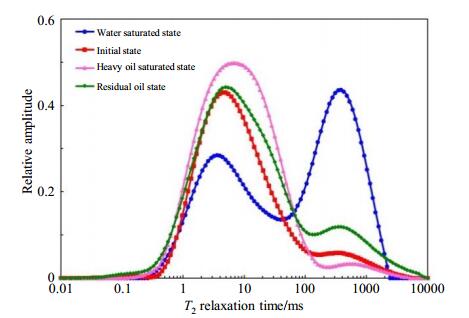
受原油粘度的影响,利用核磁共振(NMR)测井获取的稠油储层的测井NMR孔隙度远低于地层的真实孔隙度,给稠油储层评价和NMR测井技术的应用带来极大挑战.为提高稠油储层孔隙度计算精度,必须对测井NMR孔隙度进行稠油校正.本研究选取我国南海东部盆地某油田韩江组10块代表性岩心样品,分别开展了原始状态、饱含稠油、残余油和饱含水状态的NMR实验.研究了孔隙含油相对体积对岩心NMR孔隙度的影响,并建立了基于地层深测向电阻率分类的岩心NMR孔隙度校正模型.将基于实验结果建立的岩心NMR孔隙度校正模型推广到实际地层,对目标区域A14井稠油储层实测测井NMR孔隙度进行处理的结果表明:本文提出的方法能够有效地校正孔隙含稠油对实测测井NMR孔隙度的影响,得到地层的真实孔隙度;校正前、后的稠油储层测井NMR孔隙度与常规气驱法测量的岩心孔隙度之间的相对误差由11.19%降低到4.84%.
张伟 , 吴意明 , 崔维平 , 肖亮 . 稠油储层核磁共振孔隙度校正方法[J]. 波谱学杂志, 2021 , 38(2) : 204 -214 . DOI: 10.11938/cjmr20202847
The porosity acquired from nuclear magnetic resonance (NMR) logging is lower than the true value in heavy oil-bearing reservoirs due to the viscosity of heavy oil, which is a great challenge in heavy oil-bearing characterization and NMR logging. To improve the porosity prediction accuracy, the effect of heavy oil should be first corrected. In this study, 10 typical core samples, which were drilled from the Hanjiang Formation of eastern South China Sea Basin, were chosen for the laboratory NMR experimental measurements under four conditions. These four conditions were initial condition, heavy oil saturated condition, residual oil condition and water saturated condition. The effects of heavy-oil volume on NMR porosity were analyzed, and a method to estimate true NMR porosity based on formation resistivity classification was established. The method was applied in our target well A14, and the true formation porosity was predicted from field NMR logging. The result showed that, the average relative error between NMR porosity and convention core derived porosity was improved from 11.19% to 4.84% by oil viscosity correct using this method. Thus the proposed method is able to effectively correct the effect of oil viscosity on NMR porosity.
| 1 | COATES G R , XIAO L Z , PRIMMER M G . NMR logging principles and applications[M]. Houston, USA: Gulf Publishing Company, 2000, 1- 256. |
| 2 | DUNN K J , BERGMAN D J , LATORRACA G A . Nuclear magnetic resonance: petrophysical and logging applications[M]. New York, USA: Handbook of Geophysical Exploration, 2002, 1- 176. |
| 3 | ZHU X J , ZHANG X M , SHAN S S . Evaluation of core samples from low-porosity and low-permeability carbonate reservoir with NMR experiments[J]. Chinese J Magn Reson, 2020, 37 (3): 349- 359. |
| 3 | 朱学娟, 张向明, 单沙沙. 岩心NMR实验对低孔低渗碳酸盐岩储层的适应性研究[J]. 波谱学杂志, 2020, 37 (3): 349- 359. |
| 4 | LIU H , XU J X , ZHENG Y , et al. Factors affecting and correction methods for porosity measured by NMR logging in the J oilfield of bohai bay[J]. Chinese J Magn Reson, 2020, 37 (3): 370- 380. |
| 4 | 刘欢, 徐锦绣, 郑炀, 等. 渤海J油田储层NMR测井孔隙度影响因素分析及校正[J]. 波谱学杂志, 2020, 37 (3): 370- 380. |
| 5 | HOU K J , WU J M , GE X , et al. Calculating porosity from two-dimensional NMR relaxation spectra of the Leikoupo Group's 4th Section[J]. Chinese J Magn Reson, 2020, 37 (2): 162- 171. |
| 5 | 侯克均, 吴见萌, 葛祥, 等. 基于二维NMR弛豫谱的雷四段孔隙度计算方法[J]. 波谱学杂志, 2020, 37 (2): 162- 171. |
| 6 | ZHANG G , HE Z B , CAO W Q , et al. Effects of echo time on NMR apparent porosity and correction methods[J]. Chinese J Magn Reson, 2020, 37 (2): 172- 181. |
| 6 | 张宫, 何宗斌, 曹文倩, 等. 回波间隔对NMR表观孔隙度的影响及矫正方法[J]. 波谱学杂志, 2020, 37 (2): 172- 181. |
| 7 | LIU H , XU J X , ZHENG Y , et al. Analysis and correction of influential factors of reservoir porosity by NMR logging in J oilfield of Bohai Bay[J]. Chinese J Magn Reson, 2020, 37 (3): 370- 380. |
| 7 | 刘欢, 徐锦绣, 郑炀, 等. 渤海J油田储层NMR测井孔隙度影响因素分析及校正[J]. 波谱学杂志, 2020, 37 (3): 370- 380. |
| 8 | XIAO L , MAO Z Q , LI G R , et al. Calculation of porosity from nuclear magnetic resonance and conventional logs in gas-bearing reservoirs[J]. Acta Geophys, 2012, 60 (4): 1030- 1042. |
| 9 | GUBELIN G , BOYD A . Total porosity and bound-fluid measurements from an NMR tool[J]. J Petrol Technol, 1997, 49 (7): 718. |
| 10 | MENGER S, PRAMMER M. Can NMR porosity replace conventional porosity in formation evaluation?[C]. SPWLA 39th Annual Logging Symposium, 1998, SPWLA-1998-RR. |
| 11 | COATES G R, MENGER S, PRAMMER M, et al. Applying NMR total and effective porosity to formation evaluation[C]. SPE Annual Technical Conference and Exhibition, 1997, SPE-38736-MS. |
| 12 | KHARRAA H S, AL-AMRI M A, MAHMOUD M A, et al. Assessment of uncertainty in porosity measurements using NMR and conventional logging tools in carbonate reservoir[C]. SPE Saudi Arabia Section Technical Symposium and Exhibition, 2013, SPE-168110-MS. |
| 13 | GRANADO L M, SOSA J C, GALICIA J A, et al. Application of an artificial neural network ANN for the correction of NMR total porosity, effective porosity and the bulk volume irreducible water data obtained from a heavy oil reservoir using an oil based mud drilling fluid in the Samaria: Tertiary on the Southeastern of Mexico[C]. SPE Latin American and Caribbean Petroleum Engineering Conference, 2010, SPE-139135-MS. |
| 14 | ROMERO P, QUINTAIROS M. New applications of NMR in understanding heavy-oil behavior[C]. SPE International Thermal Operations and Heavy Oil Symposium, 2001, SPE-69696-MS. |
| 15 | LIU D R , YIN Q L , YUAN J H , et al. Nuclear magnetic resonance logging observation model for heavy oil reservoir and its application[J]. Lithologic Reservoirs, 2012, 24 (2): 7- 10. |
| 15 | 刘迪仁, 殷秋丽, 袁继煌, 等. 稠油储层NMR测井观测模式选择及其应用[J]. 岩性油气藏, 2012, 24 (2): 7- 10. |
| 16 | SHAO W Z , DING Y J , WANG Q M , et al. A quantitative evaluation method for heavy-oil reservoir with NMR log data[J]. Well Logging Technology, 2006, 30 (1): 67- 71. |
| 16 | 邵维志, 丁娱娇, 王庆梅, 等. 用NMR测井定量评价稠油储层的方法[J]. 测井技术, 2006, 30 (1): 67- 71. |
| 17 | GALFORD J E, MARSCHALL D M. Combining NMR and conventional logs to determine fluid volumes and oil viscosity in heavy-oil reservoirs[C]. SPE Annual Technical Conference and Exhibition, 2000, SPE-63257-MS. |
| 18 | COELHO DE PADILHA S T, BAUDOT P. Application of NMR logging for heavy oil identification and quantification in oil-based mud environments[C]. SPWLA 42nd Annual Logging Symposium, 2001, SPWLA-2001-FF. |
| 19 | JIANG Q T , ZHANG W , BAI L K , et al. Identification and evaluation of shallow low-resistivity reservoirs while drilling based on logging data: taking the Hanjiang Formation in Enping Sag of the Pearl River Mouth Basin as an example[J]. Journal of Yangtze University (Natural Science Edition), 2020, 17 (4): 16- 22. |
| 19 | 蒋钱涛, 张伟, 白林坤, 等. 基于录井资料的浅层低阻油层随钻识别及评价: 以珠江口盆地恩平凹陷韩江组为例[J]. 长江大学学报(自然科学版), 2020, 17 (4): 16- 22. |
| 20 | HU W L , FENG J , GAO C Q , et al. Identification of the low resistivity reservoirs by water cut calculated from well-logging data in Enping Sag[J]. Offshore Oil, 2013, 33 (3): 65- 69. |
| 20 | 胡文亮, 冯进, 高楚桥, 等. 利用测井资料计算的含水率识别恩平凹陷低阻油层[J]. 海洋石油, 2013, 33 (3): 65- 69. |
| 21 | 邹长春, 谭茂金, 尉中良, 等. 地球物理测井教程[M]. 北京: 地质出版社, 2010, 1- 287. |
| 22 | 中华人民共和国国土资源部. 石油天然气储量计算规范[P]. DZ/T 0217-2005, 2005. |
/
| 〈 |
|
〉 |