

基于19F化学标记磷酸化泛素的温度传感器开发
收稿日期: 2020-10-16
网络出版日期: 2020-11-16
基金资助
国家重点研发计划(2018YFA0507700)
Development of a Temperature Senor Based on 19F-labeled Phosphorylated Ubiquitin
Received date: 2020-10-16
Online published: 2020-11-16
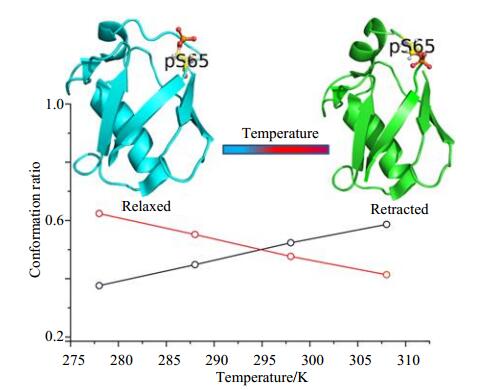
泛素是一种真核细胞信号分子,主要参与蛋白质降解和DNA修复等生命活动.泛素Ser65位被磷酸化之后,在溶液中呈现两个稳定的溶液构象,这两种构象的比例能够被pH调控,本研究利用NMR进一步发现它还受到温度影响.基于该发现,对磷酸化泛素进行了19F化学标记,利用19F NMR方法表征了不同温度下磷酸化泛素两种构象的比例,发现两者比例变化与温度之间的关系可以通过线性方程来描述,利用该方程可以通过构象比例计算样品内部温度,因此可以作为一种基于NMR检测的温度传感器.本文所开发的基于19F化学标记磷酸化泛素的温度传感器不仅能够作为体外样品温度检测的有力工具,还有望用于检测细胞内部的温度.从而有助于揭示生物学特性和功能.
张志武 , 杨菊 , 聂泽锋 , 叶尚祥 , 董旭 , 唐淳 . 基于19F化学标记磷酸化泛素的温度传感器开发[J]. 波谱学杂志, 2021 , 38(2) : 173 -181 . DOI: 10.11938/cjmr20202867
Ubiquitin (Ub) is a signaling protein in eukaryotic cells, and it functions in the processes of protein degradation and DNA repairing. The published data indicated that the phosphorylation of Ub on Ser65 leads to two stable solution conformations, which can be regulated by pH. In the present project, it was found that the conformational ratio could also be modulated by temperature. Based on this feature, pUb was chemically labeled with a 19F probe for determination of conformational ratio under various temperatures using 19F NMR. We showed that the conformation ratio of pUb was linearly proportional to temperature gradient. Consequently, the temperature of a biological sample can be calculated with a given conformational ratio of pUb, and 19F-labeled pUb can function as a thermosensor. This thermosensor could be used to monitor temperature of in vitro experiments, and it is also able to be taken to explore regulation of pUb function by temperature. Furthermore, the 19F-labeled pUb thermosensor could be developed to detect intracellular temperature in-cell NMR assays.
Key words: ubiquitin; phosphorylation; nuclear magnetic resonance (NMR); thermosensor
| 1 | BLOCK B A . Thermogenesis in muscle[J]. Annu Rev Physiol, 1994, 56 (1): 535- 577. |
| 2 | DUHR S , BRAUN D . Why molecules move along a temperature gradient[J]. Proc Natl Acad Sci U S A, 2006, 103 (52): 19678- 19682. |
| 3 | YANG J M , YANG H , LIN L W . Quantum dot nano thermometers reveal heterogeneous local thermogenesis in living cells[J]. ACS Nano, 2011, 5 (6): 5067- 5071. |
| 4 | NICHOLLS D G , LOCKE R M . Thermogenic mechanisms in brown fat[J]. Physiol Rev, 1984, 64 (1): 1- 64. |
| 5 | SILVA J E . Thermogenic mechanisms and their hormonal regulation[J]. Physiol Rev, 2006, 86 (2): 435- 464. |
| 6 | BAL N C , MAURYA S K , SOPARIWALA D H , et al. Sarcolipin is a newly identified regulator of muscle-based thermogenesis in mammals[J]. Nat Med, 2012, 18 (10): 1575- 1579. |
| 7 | GARAMI A , STEINER A A , ROMANOVSKY A A . Fever and hypothermia in systemic inflammation[J]. Handb Clin Neurol, 2018, 157, 565- 597. |
| 8 | BLOMQVIST A , ENGBLOM D . Neural mechanisms of inflammation-induced fever[J]. Neuroscientist, 2018, 24 (4): 381- 399. |
| 9 | CHRETIEN D , BéNIT P , HA H H , et al. Mitochondria are physiologically maintained at close to 50℃[J]. PLoS Biol, 2018, 16 (1): e2003992. |
| 10 | ANDREWS Z B , DIANO S , HORVATH T L . Mitochondrial uncoupling proteins in the CNS: in support of function and survival[J]. Nat Rev Neurosci, 2005, 6 (11): 829- 840. |
| 11 | ARAI S , SUZUKI M , PARK S J , et al. Mitochondria-targeted fluorescent thermometer monitors intracellular temperature gradient[J]. Chem Commun, 2015, 51 (38): 8044- 8047. |
| 12 | OKABE K , SAKAGUCHI R , KIYONAKA S , et al. Intracellular thermometry with fluorescent sensors for thermal biology[J]. Pflugers Arch, 2018, 470 (5): 717- 731. |
| 13 | NAKANO M , ARAI Y , IPPEI KOTERA I , et al. Genetically encoded ratiometric fluorescent thermometer with wide range and rapid response[J]. PLoS ONE, 2017, 12 (2): e0172344. |
| 14 | CHOWDHURY S , MARIS C , ALLAIN F H T , et al. Molecular basis for temperature sensing by an RNA thermometer[J]. EMBO J, 2006, 25 (11): 2487- 2497. |
| 15 | VIJAY-KUMAR S , BUGG C E , COOK W J . Structure of ubiquitin refined at 1.8?[J]. J Mol Biol, 1987, 194 (3): 531- 544. |
| 16 | KOMANDER D , RAPE M . The ubiquitin code[J]. Annu Rev Biochem, 2012, 81, 203- 229. |
| 17 | TANG C , ZHANG W P . How phosphorylation by PINK1 remodels the ubiquitin system: a perspective from structure and dynamics[J]. Biochemistry, 2020, 59 (1): 26- 33. |
| 18 | KANE L A , LAZAROU M , AI F , et al. PINK1 phosphorylates ubiquitin to activate Parkin E3 ubiquitin ligase activity[J]. J Cell Biol, 2014, 205 (2): 143- 153. |
| 19 | YE S X , GONG Z , YANG J , et al. Ubiquitin is double-phosphorylated by PINK1 for enhanced pH-sensitivity of conformational switch[J]. Protein Cell, 2019, 10 (12): 908- 913. |
| 20 | KOYANO F , OKATSU K , KOSAKO H , et al. Ubiquitin is phosphorylated by PINK1 to activate parkin[J]. Nature, 2014, 510 (7503): 162- 166. |
| 21 | DONG X , GONG Z , LU Y B , et al. Ubiquitin S65 phosphorylation engenders a pH-sensitive conformational switch[J]. Proc Natl Acad Sci U S A, 2017, 114 (26): 6770- 6775. |
| 22 | WAUER T , SWATEK K N , WAGSTAFF J L , et al. Ubiquitin Ser65 phosphorylation affects ubiquitin structure, chain assembly and hydrolysis[J]. EMBO J, 2015, 34 (3): 307- 325. |
| 23 | AN Y F , CHEN L M , SUN S H , et al. QuikChange shuffling: a convenient and robust method for site-directed mutagenesis and random recombination of homologous genes[J]. N Biotechnol, 2011, 28 (4): 320- 325. |
| 24 | CHEN H F , VIEL S M , ZIARELLI F H , et al. 19F NMR: a valuable tool for studying biological events[J]. Chem Soc Rev, 2013, 42 (20): 7971- 7982. |
| 25 | KITEVSKI-LEBLANC J L , PROSSER R S . Current applications of 19F NMR to studies of protein structure and dynamics[J]. Prog Nucl Magn Reson Spectrosc, 2012, 62, 1- 33. |
| 26 | SHEKHAWAT S S , PHAM G H , PRABAKARAN J , et al. Simultaneous detection of distinct ubiquitin chain topologies by 19F NMR[J]. ACS Chem Biol, 2014, 9 (10): 2229- 2236. |
| 27 | DANIELSON M A , FALKE J J . Use of 19F NMR to probe protein structure and conformational changes[J]. Annu Rev Biophys Biomol Struct, 1996, 25, 163- 195. |
| 28 | GOOD N E , DOUGLAS WINGET G , WINTER W , et al. Hydrogen ion buffers for biological research[J]. Biochemistry, 1966, 5 (2): 467. |
/
| 〈 |
|
〉 |