

Bacillus subtilis转录因子CtsR蛋白中clpC操纵子结合区域的NMR研究
收稿日期: 2020-09-21
网络出版日期: 2020-11-20
基金资助
国家自然科学基金资助项目(91856126);福建省化学生物学重点实验室(厦门大学)开放基金资助项目(2021001)
An NMR Study on the clpC Operon Binding Region of Transcription Factor CtsR from Bacillus subtilis
Received date: 2020-09-21
Online published: 2020-11-20
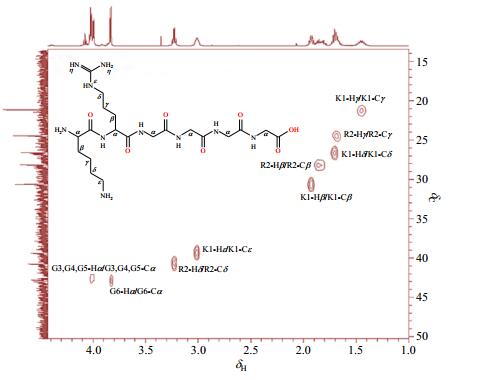
革兰氏阳性菌枯草芽孢杆菌(Bacillus subtilis)响应热刺激时,精氨酸激酶McsB磷酸化转录因子CtsR蛋白中clpC操纵子结合区域的Arg62(R)位点,使得CtsR与clpC操纵子解离,从而启动clpC相关基因的转录过程,以表达细菌应对热刺激所需的蛋白.本文以CtsR蛋白中结合clpC操纵子的区域(KRGGGG)为研究对象,通过对1H NMR、1H-1H COSY、1H-1H TOCSY、1H-15N HSQC和1H-13C HSQC等谱图的综合分析,对其1H、13C以及15N的化学位移进行归属,为该片段与clpC操纵子相互作用,以及精氨酸磷酸化调控机制的研究提供基础.
陈晓雯 , 黄碧玲 , 黄少华 , 赵玉芬 . Bacillus subtilis转录因子CtsR蛋白中clpC操纵子结合区域的NMR研究[J]. 波谱学杂志, 2021 , 38(2) : 155 -163 . DOI: 10.11938/cjmr20202854
When Gram-positive bacterium Bacillus subtilis responds to heat-shock, protein arginine kinase McsB phosphorylates Arg62 (R) in the clpC operon binding region of transcription factor CtsR, leading to dissociation of CtsR and clpC operon and initiation of stress-genes transcription for the ensuing expression of heat-shock proteins. This work investigated the clpC operon binding region (KRGGGG) of CtsR with NMR spectra (i.e., 1H NMR, 1H-1H COSY, 1H-1H TOCSY, 1H-15N HSQC and 1H-13C HSQC). The 1H, 13C and 15N chemical shifts of the protein segment were assigned. The interaction between CtsR and clpC operon and the regulatory mechanism of arginine phosphorylation were analyzed.
| 1 | HUNTER T . Signaling-2000 and beyond[J]. Cell, 2000, 100 (1): 113- 127. |
| 2 | HAUSER A , PENKERT M , HACKENBERGER C , et al. Chemical approaches to investigate labile peptide and protein phosphorylation[J]. Accounts Chem Res, 2017, 50 (8): 1883- 1893. |
| 3 | NI F , FU C , GAO X , LIU Y , et al. N-phosphoryl amino acid models for P-N bonds in prebiotic chemical evolution[J]. Science China-Chemistry, 2015, 58 (3): 374- 382. |
| 4 | JOHNSON L N , LEWIS R J . Structural basis for control by phosphorylation[J]. Chem Rev, 2001, 101 (8): 2209- 2242. |
| 5 | FERGUSON F M , GRAY N S . Kinase inhibitors: the road ahead[J]. Nat Rev Drug Discov, 2018, 17 (5): 353- 376. |
| 6 | FUHRMANN J , SCHMIDT A , SPIESS S , et al. McsB is a protein arginine kinase that phosphorylates and inhibits the heat-shock regulator CtsR[J]. Science, 2009, 324 (5932): 1323- 1327. |
| 7 | TRENTINI D B , SUSKIEWICZ M J , HEUCK A , et al. Arginine phosphorylation marks proteins for degradation by a Clp protease[J]. Nature, 2016, 539 (7627): 48. |
| 8 | ELSHOLZ A K W , TURGAY K , MICHALIK S , et al. Global impact of protein arginine phosphorylation on the physiology of Bacillus subtilis[J]. P Nat A Sci U S A, 2012, 109 (19): 7451- 7456. |
| 9 | SCHMIDT A , TRENTINI D B , SPIESS S , et al. Quantitative phosphoproteomics reveals the role of protein arginine phosphorylation in the bacterial stress response[J]. Mol Cell Proteomics, 2014, 13 (2): 537- 550. |
| 10 | OUYANG H , FU C , FU S S , et al. Development of a stable phosphoarginine analog for producing phosphoarginine antibodies[J]. Org Biomol Chem, 2016, 14 (6): 1925- 1929. |
| 11 | FUHRMANN J , SUBRAMANIAN V , THOMPSON P R . Synthesis and use of a phosphonate amidine to generate an anti-phosphoarginine- specific antibody[J]. Angew Chem Int Ed Engl, 2015, 54 (49): 14715- 14718. |
| 12 | JUNKER S , MAASS S , OTTO A , et al. Spectral library based analysis of arginine phosphorylations in staphylococcus aureus[J]. Mol Cell Proteomics, 2018, 17 (2): 335- 348. |
/
| 〈 |
|
〉 |