

T69E模拟磷酸化修饰对Bcl-2与Nur77相互作用的影响
收稿日期: 2021-03-24
网络出版日期: 2021-04-09
基金资助
国家重点研发计划专项(2017YFA0505400);国家自然科学基金资助项目(21991082);国家自然科学基金资助项目(21925406)
The Effect of T69E-mimicked Phosphorylation on the Interaction Between Bcl-2 and Nur77
Received date: 2021-03-24
Online published: 2021-04-09
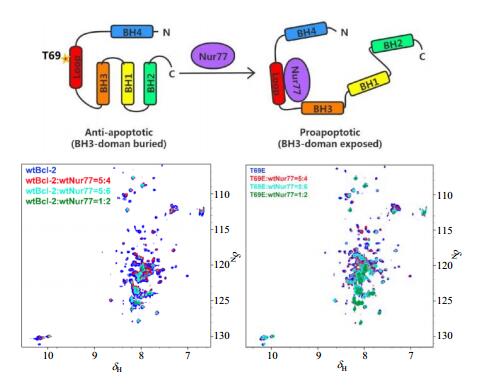
Bcl-2蛋白是Bcl-2家族中主要行使抗凋亡功能的蛋白质.核孤儿受体蛋白Nur77可出核定位至线粒体与其发生相互作用,促使Bcl-2的功能发生逆转,由细胞保护者转变为细胞杀手,从而促发细胞凋亡.Bcl-2的功能受翻译后修饰调控,如位于其BH3与BH4基序间无序loop区上T69位点的磷酸化.由于缺乏全长Bcl-2蛋白的结构信息,目前loop区T69的磷酸化修饰对两种蛋白相互作用的影响尚不清楚,缺乏原子水平的相关研究.因此,我们构建了含有loop区的胞内全长Bcl-2,并用T69E突变体模拟稳定的磷酸化修饰,综合运用圆二色谱(CD)、免疫印迹(Western Blot)、核磁共振(NMR)等技术手段对其相互作用进行研究.我们发现相比只含结构区的Bcl-2/xl嵌合体,胞内全长的Bcl-2和Nur77具有更强的相互作用,并且T69E模拟磷酸化修饰减弱了Bcl-2与Nur77的相互作用.该项研究对基于Bcl-2和Nur77信号转导通路和癌症细胞靶向凋亡的研究具有重要的参考意义.
徐倩 , 陈朗 , 胡翔颖 , 李从刚 , 刘乙祥 , 姜凌 . T69E模拟磷酸化修饰对Bcl-2与Nur77相互作用的影响[J]. 波谱学杂志, 2022 , 39(1) : 87 -95 . DOI: 10.11938/cjmr20212901
Bcl-2 mainly executes anti-apoptotic function in the Bcl-2 family. Nuclear orphan receptor Nur77 can be translocated from nucleus to mitochondria, then interact with Bcl-2 to reverse the function of Bcl-2 from a cell protector to a cell killer, thereby inducing cell apoptosis. The function of Bcl-2 is regulated by post-translational modification, such as the phosphorylation of T69 in the intrinsically disordered loop between BH3 and BH4 motifs. However, due to the lack of structural information of the full-length protein, the effect of phosphorylation modification of T69 in the loop region on the interaction of the two proteins is still unclear, and there is a lack of related research at the atomic level. Therefore, we constructed a full-length intracellular Bcl-2 containing loop region and T69E mutant to mimic stable phosphorylation modification, and investigated the interactions by combining circular dichroism (CD), Western blot and nuclear magnetic resonance (NMR) methods. It was observed that the full-length Bcl-2 had a stronger interaction with Nur77 compared to the Bcl-2/xl chimera, and the phosphorylation modification mimicked by T69E weakened the interaction between Bcl-2 and Nur77. The results will promote future research based on Bcl-2 and Nur77 signal transduction pathways and the apoptosis targeting cancer cells.
| 1 | JACOBSON M D , WEIL M , RAFF M C . Programmed cell death in animal development[J]. Cell, 1997, 88 (3): 347- 354. |
| 2 | CZABOTAR P E , LESSENE G , STRASSER A , et al. Control of apoptosis by the BCL-2 protein family: implications for physiology and therapy[J]. Nat Rev Mol Cell Biol, 2014, 15 (1): 49- 63. |
| 3 | LAVRIK I N . Systems biology of apoptosis signaling networks[J]. Curr Opin Biotechnol, 2010, 21 (4): 551- 555. |
| 4 | ZOU H , HENZEL W J , LIU X S , et al. Apaf-1, a human protein homologous to C. elegans CED-4, participates in cytochrome c-dependent activation of caspase-3[J]. Cell, 1997, 90 (3): 405- 413. |
| 5 | ELMORE S . Apoptosis: a review of programmed cell death[J]. Toxicol Pathol, 2007, 35 (4): 495- 516. |
| 6 | LEBER B , LIN J , ANDREWS D W . Embedded together: the life and death consequences of interaction of the Bcl-2 family with membranes[J]. Apoptosis, 2007, 12 (5): 897- 911. |
| 7 | YOULE R J , STRASSER A . The BCL-2 protein family: opposing activities that mediate cell death[J]. Nat Rev Mol Cell Biol, 2008, 9 (1): 47- 59. |
| 8 | CHIPUK J E , MOLDOVEANU T , LLAMBI F , et al. The BCL-2 family reunion[J]. Mol Cell, 2010, 37 (3): 299- 310. |
| 9 | PETROS A M , MEDEK A , NETTESHEIM D G , et al. Solution structure of the antiapoptotic protein bcl-2[J]. Proc Natl Acad Sci U S A, 2001, 98 (6): 3012- 3017. |
| 10 | LI H , KOLLURI S K , GU J , et al. Cytochrome c release and apoptosis induced by mitochondrial targeting of nuclear orphan receptor TR3[J]. Science, 2000, 289 (5482): 1159- 1164. |
| 11 | LIN B , KOLLURI S K , LIN F , et al. Conversion of Bcl-2 from protector to killer by interaction with nuclear orphan receptor Nur77/TR3[J]. Cell, 2004, 116 (4): 527- 540. |
| 12 | KOLLURI S K , ZHU X W , ZHOU X , et al. A short Nur77-derived peptide converts Bcl-2 from a protector to a killer[J]. Cancer Cell, 2008, 14 (4): 285- 298. |
| 13 | BREITSCHOPF K , HAENDELER J , MALCHOW P , et al. Posttranslational modification of Bcl-2 facilitates its proteasome-dependent degradation: molecular characterization of the involved signaling pathway[J]. Mol Cell Biol, 2000, 20 (5): 1886- 1896. |
| 14 | FURUKAWA Y , IWASE S , KIKUCHI J , et al. Phosphorylation of Bcl-2 protein by CDC2 kinase during G2/M phases and its role in cell cycle regulation[J]. J Biol Chem, 2000, 275 (28): 21661- 21667. |
| 15 | HALDAR S , BASU A , CROCE C M . Serine-70 is one of the critical sites for drug-induced Bcl2 phosphorylation in cancer cells[J]. Cancer Res, 1998, 58 (8): 1609- 1615. |
| 16 | HARADA H , QUEARRY B , RUIZ-VELA A , et al. Survival factor-induced extracellular signal-regulated kinase phosphorylates BIM, inhibiting its association with BAX and proapoptotic activity[J]. Proc Natl Acad Sci U S A, 2004, 101 (43): 15313- 15317. |
| 17 | YAMAMOTO K , ICHIJO H , KORSMEYER S J . BCL-2 is phosphorylated and inactivated by an ASK1/Jun N-terminal protein kinase pathway normally activated at G(2)/M[J]. Mol Cell Biol, 1999, 19 (12): 8469- 8478. |
| 18 | DENG X M , RUVOLO P , CARR B , et al. Survival function of ERK1/2 as IL-3-activated, staurosporine-resistant Bcl2 kinases[J]. Proc Natl Acad Sci U S A, 2000, 97 (4): 1578- 1583. |
| 19 | DENG X M , GAO F Q , FLAGG T , et al. Mono- and multisite phosphorylation enhances Bcl2's antiapoptotic function and inhibition of cell cycle entry functions[J]. Proc Natl Acad Sci U S A, 2004, 101 (1): 153- 158. |
| 20 | BLAGOSKLONNY M V . Unwinding the loop of Bcl-2 phosphorylation[J]. Leukemia, 2001, 15 (6): 869- 874. |
| 21 | ADEN J , MUSHTAQ A U , DINGELDEIN A , et al. A novel recombinant expression and purification approach for the full-length anti-apoptotic membrane protein Bcl-2[J]. Protein Expr Purif, 2020, 172105628. |
| 22 | LIAN L Y . NMR studies of weak protein-protein interactions[J]. Prog Nucl Magn Reson Spectrosc, 2013, 71, 59- 72. |
| 23 | 范玉丹. Bcl-2蛋白突变体(模拟磷酸化)的纯化和核磁研究[D]. 大连: 大连理工大学, 2017. |
| 24 | YU J B , ZHANG Z , ZHANG Z T , et al. The interaction of alpha-synuclein and intact mitochondria studied by NMR[J]. Chinese J Magn Reson, 2021, 38 (2): 164- 172. |
| 24 | 余锦波, 张偲, 张则婷, 等. Alpha-突触核蛋白与完整线粒体相互作用的NMR研究[J]. 波谱学杂志, 2021, 38 (2): 164- 172. |
| 25 | CHEN X W , HUANG B L , HUANG S H , et al. NMR research on the clpC operon binding region of transcription factor CtsR from Bacillus subtilis[J]. Chinese J Magn Reson, 2021, 38 (2): 155- 163. |
| 25 | 陈晓雯, 黄碧玲, 黄少华, 等. Bacillus subtilis转录因子CtsR蛋白中DNA结合区域的NMR研究[J]. 波谱学杂志, 2021, 38 (2): 155- 163. |
/
| 〈 |
|
〉 |