

主动型氢原子钟原子弛豫时间的测量和分析
收稿日期: 2021-12-31
网络出版日期: 2022-01-24
基金资助
中国科学院重点部署项目(E183051)
Measurement and Analysis of Atomic Relaxation Time in Active Hydrogen Atomic Clocks
Received date: 2021-12-31
Online published: 2022-01-24
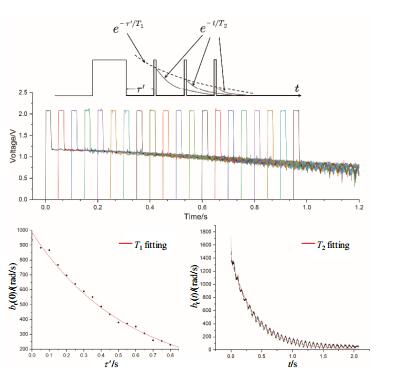
氢原子钟的原子弛豫时间是原子系统经过选态去除基态超精细能级(F = 0,mF = 0)态和(F = 1,mF = −1)态原子后,部分氢原子从(F = 1,mF = 0)态跃迁至(F = 0,mF = 0)态直至原子系统达到平衡状态所需的时间,该参数反映了原子的寿命,并直接影响氢原子钟的稳定度指标.为了测量主动型氢原子钟的弛豫时间,进而评估其性能,通过Raspberry Pi(RPI)产生时序信号,控制数字衰减器和电离源供电电路的继电器,从而控制微波探测信号的开启和原子束流的通断,并与数据采集等电路组成了氢原子自由感应衰减测试系统.通过对采集的自由感应衰减信号建模拟合,测算了氢原子钟的弛豫时间.该方法对于评估和优化原子线宽,改进主动型氢原子钟稳定度指标具有重要的参考意义.
关键词: 主动型氢原子钟; 原子弛豫时间; Raspberry Pi(RPI)
梁悦 , 谢勇辉 , 陈鹏飞 . 主动型氢原子钟原子弛豫时间的测量和分析[J]. 波谱学杂志, 2022 , 39(4) : 476 -482 . DOI: 10.11938/cjmr20212968
The atomic relaxation time of a hydrogen atomic clock is the time required for atomic system after the selected state removing the atoms of the ground state hyperfine energy level (F = 0, mF = 0) and (F = 1, mF = −1) state to change from the (F = 1, mF = 0) state to the (F = 0, mF = 0) state until the atomic system reaches equilibrium. This parameter reflects the lifetime of atoms and directly affects performance of hydrogen clock. In order to measure the relaxation time of active hydrogen atomic clock and thus evaluate its performance, hydrogen atomic relaxation test system was established, which was composed of a Raspberry Pi (RPI), signal generator, digital attenuation, microwave detection, and data acquisition circuits. RPI generates timing signal to control the relay of digital attenuator and ionization source power supply circuit, so as to control the opening of microwave detection signal and the on-off of atomic beam current. The relaxation time of the hydrogen atomic clock is measured by data fitting of the acquired free induction decay signals. This method is important for optimizing the atomic linewidth and improving the performance of the active hydrogen clock.
| 1 | KLEPPNER D, GOLDENBERG H M, RAMSEY N F Theory of the hydrogen maser[J]. Phys Rev, 1962, 126, 603-608. |
| 2 | VANIER J, TOMESCU C The quantum physics of atomic frequency standards: Recent developments[M]. Boca Raton: CRC Press, 2015, 53 |
| 3 | VANIER J, AUDOIN R. The quantum physics of atomic frequency standards[M]. IOP Publishing Ltd, 1989 |
| 4 | CRAMPTON S B, WANG H T M Duration of hydrogen-atom spin-exchange collisions[J]. Phys Rev A, 1975, 12 (4):1305- 1312. |
| 5 | VANIER J, BROUSSEAU R, LAROUCHE R Stimulated emission in the hydrogen maser and the H spin-exchange cross section[J]. Can J Phys, 1973, 51 (18):1901-1909. |
| 6 | 何克亮, 张为群, 林传富 小型化氢脉泽原子储存时间设计[J]. 波谱学杂志, 2020, 37 (2):200-208. |
| 6 | HE K L, ZHANG W Q, LIN C F Design of the atomic storage time of a miniaturized hydrogen maser[J]. Chinese J Magn Reson, 2020, 37 (2):200-208. |
| 7 | 梁悦, 谢勇辉. 一种氢原子钟原子弛豫时间测量系统[P]. 202210260667. X, 2022-4-19. |
| 8 | 陈鹏飞, 谢勇辉, 林传富 脉冲微波激发氢原子Ramsey干涉研究[J]. 波谱学杂志, 2013, 30 (3):361-370. |
| 8 | CHEN P F, XIE Y H, LIN C F Induction of hydrogen Ramsey interference with pulsed microwave[J]. Chinese J Magn Reson, 2013, 30 (3):361-370. |
| 9 | 王义遒 量子频标原理[M]. 北京: 科学出版社, 1986. |
/
| 〈 |
|
〉 |