

Pd-Sn双金属催化剂催化1, 3-丁二烯加氢反应的仲氢诱导极化研究
收稿日期: 2021-10-29
网络出版日期: 2022-05-28
基金资助
国家自然科学基金(21902181);国家自然科学基金(U1932218);国家自然科学基金(21733013);国家自然科学基金(22061130202);国家自然科学基金(21872170);湖北省自然科学基金(2021CFA021)
1, 3-Butadienen Hydrogenation on Supported Pd-Sn Bimetallic Catalysts Investigated by Parahydrogen-induced Polarization
Received date: 2021-10-29
Online published: 2022-05-28
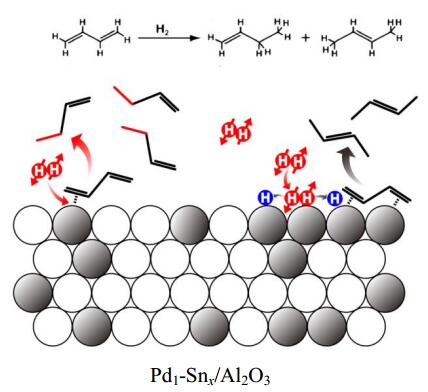
本文首先利用等体积共浸渍法合成了一系列Pd/Sn比(原子比)不同的Pd1-Snx/Al2O3双金属催化剂,然后通过多相催化仲氢诱导极化(PHIP)技术研究了Pd-Sn/Al2O3双金属催化剂上1, 3-丁二烯选择性加氢反应.结果发现催化剂的Pd/Sn比会影响1, 3-丁二烯反应活性和丁烯选择性:随着Pd/Sn比的下降,反应中1, 3-丁二烯转化率降低,丁烯选择性提高.利用PASADENA(parahydrogen and synthesis allow for dramatically enhanced nuclear alignment)技术,发现Pd/Sn比的变化影响了1-丁烯与2-丁烯之间的异构化过程:随着Pd/Sn比的下降,1-丁烯异构化率降低,这是由于Sn组分含量的提高减少了表面暴露的Pd组分,使得催化剂反应活性降低;Sn组分含量的提高同时导致了Pd电子密度的上升,使得选择性还原产物丁烯更易脱附,阻止其进一步加氢生成丁烷,并抑制了1-丁烯异构化反应过程.
关键词: 1,3-丁二烯加氢反应; 双金属催化剂; 核磁共振(NMR); 异构化过程; 仲氢诱导极化(PHIP)
胡涵 , 王伟宇 , 徐君 , 邓风 . Pd-Sn双金属催化剂催化1, 3-丁二烯加氢反应的仲氢诱导极化研究[J]. 波谱学杂志, 2022 , 39(2) : 133 -143 . DOI: 10.11938/cjmr20212952
The selective hydrogenation of 1, 3-butadiene over Pd-Sn/Al2O3 bimetallic catalysts was investigated by heterogeneous parahydrogen-induced polarization (PHIP). A series of Pd1-Snx/Al2O3 bimetallic catalysts with different Pd/Sn ratios were synthesized by incipient wetness co-impregnation method. It was observed that the Pd/Sn ratios of the catalysts had a significant effect on the reaction activity of 1, 3-butadiene and the selectivity to butene. A monotonic decrease of reaction conversion was observed as the Pd/Sn ratio decreased, while the selectivity to butene showed an opposite trend. This can be attributed to the ensemble effect and the ligand effect caused by the increasing tin component content: as the Pd/Sn ratio decreases, less palladium component was exposed on the surface, leading to low activity. The electronic properties of the Pd atoms were altered, which led to a weaker adsorption strength of the semi-hydrogenation product butene and an increased selectivity. Smaller Pd ensembles were exposed on Sn-rich catalysts surface, which favored a higher ratio of pairwise addition process, leading to a stronger PHIP effect. The isomerization measurements by PASADENA (parahydrogen and synthesis allow for dramatically enhanced nuclear alignment) showed that the isomerization process between 1-butene and 2-butene decreased with the increase of Sn content. This can be accounted for by the easier desorption of 1-butene on Sn-rich catalysts.
| 1 | MANTINGH J, KISS A A Enhanced process for energy efficient extraction of 1, 3-butadiene from a crude C4 cut[J]. Sep Purif Technol, 2021, 267, 118656. |
| 2 | CHEN H J, XU H S, WANG C F Research progress in preparation of the catalysts for selective hydrogenation of butadiene[J]. Journal of Xi'an Petroleum Institute, 2002, 17 (3):41-45. |
| 2 | 陈红娟, 徐海升, 王长发 丁二烯选择性加氢催化剂制备因素研究进展[J]. 西安石油学院学报(自然科学版), 2002, 17 (3):41-45. |
| 3 | WHITE W C Butadiene production process overview[J]. Chem-Biol Interact, 2007, 166 (1-3):10-14. |
| 4 | ZBIEG J R, YAMAGUCHI E, MCINTURFF E L, et al Enantioselective C-H crotylation of primary alcohols via hydrohydroxyalkylation of butadiene[J]. Science, 2012, 336 (6079):324-327. |
| 5 | SARKANY A Semi-hydrogenation of 1, 3-butadiene on adspecies modified Pd-Ni, Co and Cu catalysts[J]. Appl Catal A-Gen, 1997, 149 (1):207-223. |
| 6 | LIU C Q, XU Y, LIAO S J, et al Mono- and bimetallic catalytic hollow-fiber reactors for the selective hydrogenation of butadiene in 1-butene[J]. Appl Catal A-Gen, 1998, 172 (1):23-29. |
| 7 | VALCARCEL A, CLOTET A, RICART J M, et al Selectivity control for the catalytic 1, 3-butadiene hydrogenation on Pt(111) and Pd(111) surfaces: Radical versus closed-shell intermediates[J]. J Phys Chem B, 2005, 109 (29):14175-14182. |
| 8 | BOITIAUX J P, COSYNS J, ROBERT E Liquid-phase hydrogenation of unsaturated-hydrocarbons on palladium, platinum and rhodium catalysts. 1. Kinetic-study of 1-butene, 1, 3-butadiene and 1-butyne hydrogenation on platinum[J]. Appl Catal, 1987, 32 (1-2):145-168. |
| 9 | LEE K, ZAERA F Thermal chemistry of C-4 hydrocarbons on Pt(111): Mechanism for double-bond isomerization[J]. J Phys Chem B, 2005, 109 (7):2745-2753. |
| 10 | LINDLAR H A new catalyst for selective hydrogenations[J]. Helv Chim Acta, 1952, 35, 446-450. |
| 11 | KUAI L, CHEN Z, LIU S J, et al Titania supported synergistic palladium single atoms and nanoparticles for room temperature ketone and aldehydes hydrogenation[J]. Nat Commun, 2020, 11, 48. |
| 12 | DIMAS-RIVERA G L, DE LA ROSA J R, LUCIO-ORTIZ C J, et al Bimetallic Pd-Fe supported on gamma-Al2O3 catalyst used in the ring opening of 2-methylfuran to selective formation of alcohols[J]. Appl Catal A-Gen, 2017, 543, 133-140. |
| 13 | ZHANG Y, LIAO Y L, SHI G C, et al Preparation, characterization, and catalytic performance of Pd-Ni/AC bimetallic nano-catalysts[J]. Green Process Synth, 2020, 9 (1):760-769. |
| 14 | LIU L L, ZHOU X J, GUO L X, et al Bimetallic Au-Pd alloy nanoparticles supported on MIL-101(Cr) as highly efficient catalysts for selective hydrogenation of 1, 3-butadiene[J]. Rsc Adv, 2020, 10 (55):33417-33427. |
| 15 | LU F F, SUN D H, JIANG X Plant-mediated synthesis of AgPd/gamma-Al2O3 catalysts for selective hydrogenation of 1, 3-butadiene at low temperature[J]. New J Chem, 2019, 43 (35):13891-13898. |
| 16 | GOMEZ G, BELELLI P G, CABEZA G F, et al A theoretical view of 1, 3-butadiene selective hydrogenation toward cis-2-butene on Pd-Ni layered catalyst[J]. Appl Surf Sci, 2015, 353820-828. |
| 17 | SARKANY A, ZSOLDOS Z, STEFLER G, et al Promoter effect of Pd in hydrogenation of 1, 3-butadiene over Co-Pd catalysts[J]. J Catal, 1995, 157 (1):179-189. |
| 18 | VERDIER S, DIDILLON B, MORIN S, et al Pd-Sn/Al2O3 catalysts from colloidal oxide synthesis - Ⅱ. Surface characterization and catalytic properties for buta-1, 3-diene selective hydrogenation[J]. J Catal, 2003, 218 (2):288-295. |
| 19 | BOWERS C R, WEITEKAMP D P Transformation of symmetrization order to nuclear-spin magnetization by chemical-reaction and nuclear-magnetic-resonance[J]. Phys Rev Lett, 1986, 57 (21):2645-2648. |
| 20 | WANG W Y, XU J, ZHAO Y X, et al Facet dependent pairwise addition of hydrogen over Pd nanocrystal catalysts revealed via NMR using para-hydrogen-induced polarization[J]. Phys Chem Chem Phys, 2017, 19 (14):9349-9353. |
| 21 | WANG W Y, HU H, XU J, et al Hydrogenation reaction on Pd-Cu bimetallic catalysts: A parahydrogen-induced polarization study[J]. Chinese J Magn Reson, 2018, 35 (3):269-279. |
| 21 | 王伟宇, 胡涵, 徐君, 等 Pd-Cu双金属催化剂上加氢反应的仲氢诱导超极化研究[J]. 波谱学杂志, 2018, 35 (3):269-279. |
| 22 | WANG W Y, HU H, XU J, et al Tuning Pd-Au bimetallic catalysts for heterogeneous parahydrogen-induced polarization[J]. J Phys Chem C, 2018, 122 (2):1248-1257. |
| 23 | SALNIKOV O G, KOVTUNOVA L M, SKOVPIN I V, et al Mechanistic insight into the heterogeneous hydrogenation of furan derivatives with the use of parahydrogen[J]. Chemcatchem, 2018, 10 (5):1178-1183. |
| 24 | WANG W Y, WANG Q, CHU Y Y, et al Pairwise stereoselective hydrogenation of propyne on supported Pd-Ag catalysts investigated by parahydrogen-induced polarization[J]. J Phys Chem C, 2021, 125 (31):17144-17154. |
| 25 | BARSKIY D A, KOVTUNOV K V, PRIMO A, et al Selective hydrogenation of 1, 3-butadiene and 1-butyne over a Rh/Chitosan catalyst investigated by using parahydrogen-induced polarization[J]. Chemcatchem, 2012, 4 (12):2031-2035. |
| 26 | CORMA A, SALNIKOV O G, BARSKIY D A, et al Single-atom gold catalysis in the context of developments in parahydrogen-induced polarization[J]. Chem-Eur J, 2015, 21 (19):7012-7015. |
| 27 | PATTAMAKOMSAN K, EHRET E, MORFIN F, et al Selective hydrogenation of 1, 3-butadiene over Pd and Pd-Sn catalysts supported on different phases of alumina[J]. Catal Today, 2011, 164 (1):28-33. |
| 28 | SALES E A, BUGLI G, ENSUQUE A, et al Palladium catalysts in the selective hydrogenation of hexa-1, 5-diene and hexa-1, 3-diene in the liquid phase. Effect of tin and silver addition - Part 1. Preparation and characterization: From the precursor species to the final phases[J]. Phys Chem Chem Phys, 1999, 1 (3):491-498. |
| 29 | SALES E A, MENDES M D, BOZON-VERDURAZ F Liquid-phase selective hydrogenation of hexa-1, 5-diene and hexa-1, 3-diene on palladium catalysts. Effect of tin and silver addition[J]. J Catal, 2000, 195 (1):96-105. |
| 30 | POKOCHUEVA E V, BURUEVA D B, KOVTUNOVA L M, et al Mechanistic in situ investigation of heterogeneous hydrogenation over Rh/TiO2 catalysts: selectivity, pairwise route and catalyst nature[J]. Faraday Discussions, 2021, 229, 161-175. |
| 31 | SA J, GASPAROVICOVA D, HAYEK K, et al Water denitration over a Pd-Sn/Al2O3 catalyst[J]. Catal Lett, 2005, 105 (3-4):209-217. |
| 32 | LIU M M, TANG W Q, XU Y S, et al Pd-SnO2/Al2O3 heteroaggregate nanocatalysts for selective hydrogenations of p-nitroacetophenone and p-nitrobenzaldehyde[J]. Appl Catal A-Gen, 2018, 549273-279. |
| 33 | JBIR I, COUBLE J, KHADDAR-ZINE S, et al Individual heat of adsorption of adsorbed CO species on palladium and Pd-Sn nanoparticles supported on Al2O3 by using temperature-programmed adsorption equilibrium methods[J]. Acs Catal, 2016, 6 (4):2545-2558. |
| 34 | ORELLANA F, PECCHI G, REYES P Selective hydrodechlorination of 1, 2-dichloroethane over Pd-Sn/SiO2 catalysts[J]. J Chil Chem Soc, 2005, 50 (1):431-434. |
| 35 | PICK S Density-functional study of the CO chemisorption on bimetallic Pd-Sn(110) surfaces[J]. Surf Sci, 2009, 603 (16):2652-2657. |
| 36 | HAMMOUDEH A, MAHMOUD S Selective hydrogenation of cinnamaldehyde over Pd/SiO2 catalysts: selectivity promotion by alloyed Sn[J]. J Mol Catal A-Chem, 2003, 203 (1-2):231-239. |
| 37 | HORIUTI I, POLANYI M Exchange reactions of hydrogen on metallic catalysts[J]. Trans Faraday Soc, 1934, 30, 1164-1172. |
| 38 | YAN H, CHENG H, YI H, et al Single-atom Pd-1/graphene catalyst achieved by atomic layer deposition: Remarkable performance in selective hydrogenation of 1, 3-butadiene[J]. J Am Chem Soc, 2015, 137 (33):10484-10487. |
/
| 〈 |
|
〉 |