

低场核磁共振仪器振铃抑制新方法及其电路实现
收稿日期: 2022-05-12
网络出版日期: 2022-08-26
基金资助
中国博士后科学基金资助项目(2021M700172)
A New Method and Circuit of Ringing Suppression for Low-field NMR Instruments
Received date: 2022-05-12
Online published: 2022-08-26
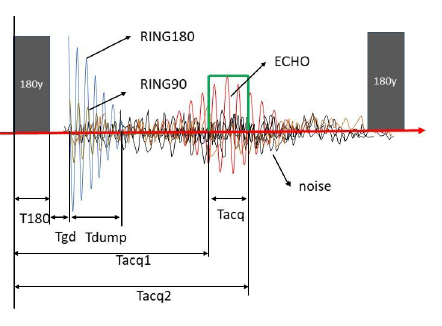
加快天线残余能量释放以减弱天线振铃信号有利于缩短低场核磁共振仪器的回波间隔(TE),从而提高快弛豫组分的测量分辨率和信噪比(SNR).而天线Q值对能量的发射效率和泄放速度起着相反的作用.为此,我们首先设计了一种新型Q转换电路,在保证发射效率的同时,可以大大缩短能量泄放时间.在此基础上,应用了一种优化的脉冲序列以弥补传统相位交替对脉冲序列(PAPs)不能消除90°脉冲振铃的缺陷,通过相位循环的方法进一步提高了信噪比.最后,在2 MHz岩心分析仪上测试了新型Q转换电路,当天线Q值降为发射期间的约1/5时,天线恢复时间由280.0 μs降为18.2 μs;而且,使用新型Q转换电路和优化的脉冲序列后,TE=60 μs时,可以有效获得快弛豫组分的T2信号.
关键词: 低场核磁共振(low-field NMR); Q转换; 振铃; 信噪比(SNR); 脉冲序列
师光辉 , 肖立志 , 廖广志 , 罗嗣慧 , 侯学理 , 卢亚普 . 低场核磁共振仪器振铃抑制新方法及其电路实现[J]. 波谱学杂志, 2023 , 40(1) : 68 -78 . DOI: 10.11938/cjmr20223002
Accelerating the release of the antenna residual energy to weaken the antenna ringing signal is beneficial to shorten the echo time (TE) of low-field nuclear magnetic resonance (NMR) instruments, thus improving the measurement resolution and signal-to-noise ratio (SNR) of fast relaxation components. The antenna Q value has an opposite effect on the energy emission efficiency and discharge speed. For this reason, we first designed a new Q-switch circuit, which can greatly shorten the energy discharge time while ensuring the transmission efficiency. On this basis, an optimized pulse sequence was applied to overcome the defect that traditional phase alternated pair stacking (PAPs) cannot eliminate 90° pulse ringing, and the SNR was further improved by the method of phase cycling. Finally, the new Q-switch circuit was tested on a 2 MHz core analyzer, the Q value of the antenna was reduced to about 1/5 of the transmit period, and the antenna recovery time was reduced from 280.0 μs to 18.2 μs. Moreover, with the new Q-switch circuit and optimized pulse sequence, the T2 signal of the fast relaxation component can be effectively obtained when TE=60 μs.
| [1] | XIAO L Z. Design and implementation of NMR system in downhole extreme conditions[J]. J China U Petrol (Edition of Natural Science), 2013, 37(5): 44-56. |
| [1] | 肖立志. 井下极端条件下核磁共振探测系统研制[J]. 中国石油大学学报(自然科学版), 2013, 37(5): 44-56. |
| [2] | 肖立志, 谢然红, 廖广志. 中国复杂油气藏核磁共振测井理论与方法[M]. 北京: 科学出版社, 2012. |
| [3] | ANDREW E R, JURGA K. NMR probe with short recovery time[J]. J Magn Reson, 1987, 73(2): 268-276. |
| [4] | SHI G H, XIAO L Z, LUO S H, et al. Optimization of shaped pulses for radio frequency excitation in NMR logging[J]. Rev Sci Instrum, 2021, 92(11): 114502. |
| [5] | FENG T, CHEN J F, ZHANG Z, et al. A design of short dead-time RF coil and RF switch for low-field NMR[J]. Chinese J Magn Reson, 2021, 38(1): 1-11. |
| [5] | 冯涛, 陈俊飞, 张震, 等. 低场核磁共振短死时间射频线圈与射频开关的设计[J]. 波谱学杂志, 2021, 38(1): 1-11. |
| [6] | 于慧俊. 核磁共振测井仪电子线路的设计与验证[D]. 北京: 中国石油大学(北京), 2012. |
| [7] | SUN B Q, REZA T. Method for eliminating ringing during a nuclear magnetic resonance measurement[P]. US, 6,121,774. 2000-9-19. |
| [8] | MANFRED G P. Pulse sequence and method for suppression of magneto-acoustic artifacts in NMR data[P]. US, 6,204,663 B1. 2001-3-20. |
| [9] | FUKUSHIMA E, ROEDER S B W. Spurious ringing in pulse NMR[J]. J Magn Reson, 1979, 33: 199-203. |
| [10] | PESHKOVSKY A S, FORGUEZ J, CERIONI L, et al. RF probe recovery time reduction with a novel active ringing suppression circuit[J]. J Magn Reson, 2005, 177(1): 67-73. |
| [11] | HOULT D I. Fast recovery, high sensitivity NMR probe and preamplifier for low frequencies[J]. Rev Sci Instrum, 1979, 50(2): 193-200. |
| [12] | MITCHELL J, CHANDRASEKERA T C, JOHNS M L, et al. Nuclear magnetic resonance relaxation and diffusion in the presence of internal gradients: the effect of magnetic field strength[J]. Phys Rev E, 2010, 81(2): 026101. |
| [13] | CASANOVA F, PERLO J, BLüMICH B. Single-sided NMR[M]. Springer Berlin Heidelberg, 2011: 1-10. |
| [14] | NACHER P J, KUMARAGAMAGE S, TASTEVIN G, et al. A fast MOSFET RF switch for low-field NMR and MRI[J]. J Magn Reson, 2019, 310(2): 106638 |
| [15] | ZHEN J Z, O’NEILL K T, FRIDJONSSON E O, et al. A resistive Q-switch for low-field NMR systems[J]. J Magn Reson, 2017, 287(1): 33-40 |
| [16] | HOPPER T, MANDAL S, CORY D, et al. Low-frequency NMR with a non-resonant circuit[J]. J Magn Reson, 2011, 210(2): 69-74. |
| [17] | 肖立志. 井下极端环境下核磁共振科学仪器[M]. 北京: 科学出版社, 2016. |
| [18] | LUO S H, XIAO L Z, ZONG F R, et al. Inside-out azimuthally selective NMR tool using array coil and capacitive decoupling[J]. J Magn Reson, 2020, 315: 106735. |
| [19] | SIGAL R F, MILLER D L, GALFORD J E, et al. A method for enhancing the vertical resolution of NMR logs[C]. SPE Annu Tech Conf Exhib, Dallas, Texas, 1-4 October 2000. |
| [20] | XIAO L Z, LIAO G Z, DENG F, et al. Development of an NMR system for down-hole porous rocks[J]. Micro Meso Mater, 2015, 205: 16-20. |
| [21] | 中国石油大学北京. 消除振铃的核磁共振回波串获取方法[P]. 中国, 10404043.2, 2014-06-18. |
| [22] | MENG K, WANG S J, XUE Z A, et al. Quantitative evaluation of shape pore structure using nuclear magnetic resonance data[J]. Chinese J Magn Reson, 2021, 38(2): 215-226. |
| [22] | 孟昆, 王胜建, 薛宗安, 等. 利用核磁共振资料定量评价页岩孔隙结构[J]. 波谱学杂志, 2021, 38(2): 215-226. |
| [23] | YAO S Q, XU J C, SHEN M, et al. Design of broadband T/R switch for magnetic resonance[J]. Chinese J Magn Reson, 2022, 39(1): 115-122. |
| [23] | 姚守权, 徐俊成, 沈明, 等. 宽带磁共振T/R开关的设计与实现[J]. 波谱学杂志, 2022, 39(1): 115-122. |
/
| 〈 |
|
〉 |