

固体NMR研究MOFs吸附和分离过程中的主客体相互作用
收稿日期: 2022-10-10
网络出版日期: 2022-11-03
基金资助
中国科学院磁共振技术联盟功能开发项目(2020gz1007)
Solid-state NMR Investigation of the Host-guest Interactions in Gas Adsorption and Chemical Separation Using MOFs as Adsorbents
Received date: 2022-10-10
Online published: 2022-11-03
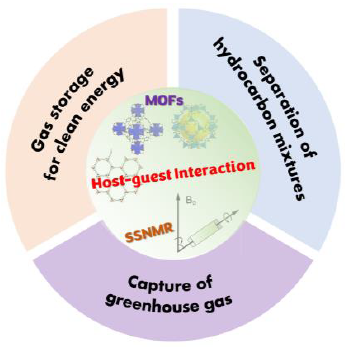
固体核磁共振(NMR)因对结构和化学环境敏感,已广泛应用于研究金属有机框架材料(MOFs)在吸附分离应用上的主客体相互作用机制.多核、多维、变温固体NMR实验可以用来研究低碳碳氢化合物、CO2在MOFs孔道内的吸附行为(包括优先吸附位点、动力学性质、扩散快慢等).固体NMR也可用来直接测定低碳烷烃/烯烃在MOFs中的分离选择性,并观测低碳烷烃/烯烃在MOFs孔道内的竞争优先吸附.此外,固体NMR还可用来揭示常见化学品与MOFs的主客体相互作用模式.这些研究的开展将有助于人们理解MOFs在吸附和分离过程中存在的内在构效关系.
贺彩艳 , 肖宇情 , 李申慧 , 徐君 , 邓风 . 固体NMR研究MOFs吸附和分离过程中的主客体相互作用[J]. 波谱学杂志, 2023 , 40(2) : 192 -206 . DOI: 10.11938/cjmr20223027
Due to its sensitivity to the local geometries and chemical environments, solid-state nuclear magnetic resonance (NMR) is widely applied to investigate the host-guest interactions between metal-organic frameworks (MOFs) and guest molecules in the studies of gas adsorption and chemical separation. Multi-nuclear, multi-dimensional and variable temperature solid-state NMR is employed to investigate the adsorption behavior, primary adsorption sites, dynamic property, and self-diffusion coefficients of light hydrocarbons and carbon dioxide inside the MOFs channels. Moreover, solid-state NMR spectroscopy is utilized to determine the adsorption selectivity, visualize the preferential adsorption and uncover the separation mechanism of light alkane/alkene mixtures inside MOFs. Furthermore, solid-state NMR is used to explore the detailed host-guest interaction mechanism between common chemicals and MOFs adsorbents. All these findings provide insights into deep understanding of the structure-property relationship for the application of functional MOFs in gas adsorption and chemical separation.
| [1] | FURUKAWA H, CORDOVA K E, O’KEEFFE M, et al. The chemistry and applications of metal-organic frameworks[J]. Science, 2013, 341(6149): 1230444. |
| [2] | ZHOU H C, LONG J R, YAGHI O M. Introduction to metal-organic frameworks[J]. Chem Rev, 2012, 112(2): 673-674. |
| [3] | QI G D, WANG Q, XU J, et al. Solid-state NMR studies of internuclear correlations for characterizing catalytic materials[J]. Chem Soc Rev, 2021, 50(15): 8382-8399. |
| [4] | MARCHETTI A, CHEN J, PANG Z, et al. Understanding surface and interfacial chemistry in functional nanomaterials via solid-state NMR[J]. Adv Mater, 2017, 29(14): 1605895. |
| [5] | FAN B H, XU S T, WEI Y X, et al. Progresses of hyperpolarized 129Xe NMR application in porous materials and catalysis[J]. Magn Reson Lett, 2021, 1(1): 11-27. |
| [6] | YANG W J, HUANG J. Analysis of local structure, acidic property and activity of solid acids by solid-state nuclear magnetic resonance spectroscopy[J]. Chinese J Magn Reson, 2021, 38(4): 460-473. |
| [6] | 杨文杰, 黄骏. 基于固体核磁共振技术的固体酸结构、酸性及活性分析[J]. 波谱学杂志, 2021, 38(4): 460-473. |
| [7] | XIAO Y, XIA C J, YI X F, et al. Progress in the studies on Sn-zeolites by solid-state nuclear magnetic resonance[J]. Chinese J Magn Reson, 2021, 38(4): 571-584. |
| [7] | 肖瑶, 夏长久, 易先锋, 等. 固体核磁共振技术在锡硅分子筛表征中的应用[J]. 波谱学杂志, 2021, 38(4): 571-584. |
| [8] | XU J, LIU Y M, LIPTON A S, et al. Amine dynamics in diamine-appended Mg2 (dobpdc) metal-organic frameworks[J]. J Phys Chem Lett, 2019, 10(22): 7044-7049. |
| [9] | LI X, SHEN W L, SUN H. Solid-state NMR studies of sulfonated SBA-15 and the synergistic catalysis of fructose into 5-hydroxymethylfurfural with dimethyl sulfoxide[J]. Magn Reson Lett, 2022, 2(1): 38-47. |
| [10] | WANG C, DAI W L, WU G J, et al. Application of ammonia probe-assisted solid-state NMR technique in zeolites and catalysis[J]. Magn Reson Lett, 2022, 2(1): 28-37. |
| [11] | GAO X Z, ZHANG Y, WANG X M, et al. Structure and acidity changes in ultra-stable Y zeolites during hydrothermal aging: A solid-state NMR spectroscopy study[J]. Chinese J Magn Reson, 2020, 37(1): 95-103. |
| [11] | 高秀枝, 张翊, 王秀梅, 等. NMR研究超稳Y分子筛水热老化过程中结构与酸性的变化[J]. 波谱学杂志, 2020, 37(1): 95-103. |
| [12] | WANG Y X, WANG Q, XU J, et al. The effects of ammonium hexafluorosilicate post-treatment on the acidity of H-ZSM-5 zeolite studied by solid-state NMR spectroscopy[J]. Chinese J Magn Reson, 2021, 38(4): 514-522. |
| [12] | 王永祥, 王强, 徐君, 等. 六氟硅酸铵后处理对H-ZSM-5分子筛酸性影响的固体NMR研究[J]. 波谱学杂志, 2021, 38(4): 514-522. |
| [13] | WONG Y T A, MARTINS V, LUCIER B E, et al. Solid-state NMR spectroscopy: A powerful technique to directly study small gas molecules adsorbed in metal-organic frameworks[J]. Chem - Eur J, 2019, 25(8): 1848-1853. |
| [14] | BRUNNER E, RAUCHE M. Solid-state NMR spectroscopy: an advancing tool to analyse the structure and properties of metal-organic frameworks[J]. Chem Sci, 2020, 11(17): 4297-4304. |
| [15] | BERTMER M. Solid-state NMR of small molecule adsorption in metal-organic frameworks (MOFs)[M]. ATTAURRAHMAN Ed Annu Rep NMR Spectrosc, 2020: 1-64. |
| [16] | FU Y, GUAN H X, YIN J L, et al. Probing molecular motions in metal-organic frameworks with solid-state NMR[J]. Coord Chem Rev, 2021, 427: 213563. |
| [17] | JAEGERS N R, MUELLER K T, WANG Y, et al. Variable temperature and pressure operando MAS NMR for catalysis science and related materials[J]. Acc Chem Res, 2020, 53(3): 611-619. |
| [18] | WITHERSPOON V J, XU J, REIMER J A. Solid-state NMR investigations of carbon dioxide gas in metal-organic frameworks: Insights into molecular motion and adsorptive behavior[J]. Chem Rev, 2018, 118(20): 10033-10048. |
| [19] | LUCIER B E, CHEN S S, HUANG Y N. Characterization of metal-organic frameworks: Unlocking the potential of solid-state NMR[J]. Acc Chem Res, 2018, 51(2): 319-330. |
| [20] | UR REHMAN S, XU S, XU H T, et al. The role of NMR in metal organic frameworks: deep insights into dynamics, structure and mapping of functional groups[J]. Mater Today Adv, 2022, 16: 100287. |
| [21] | HE C Y, LI S H, XIAO Y Q, et al. Application of solid-state NMR techniques for structural characterization of metal-organic frameworks[J]. Solid State Nucl Magn Reson, 2022, 117: 101772. |
| [22] | LI Y X, ZHANG W L, HUANG Y N. Two open metal sites on the same metal: Dynamics of CO2 in MOF UTSA-74[J]. Magn Reson Lett, 2021, 1(2): 121-130. |
| [23] | LI S H, LAFON O, WANG W Y, et al. Recent advances of solid-state NMR spectroscopy for microporous materials[J]. Adv Mater, 2020, 32(44): 2002879. |
| [24] | ASHBROOK S E, DAVIS Z H, MORRIS R E, et al. O-17 NMR spectroscopy of crystalline microporous materials[J]. Chem Sci, 2021, 12(14): 5016-5036. |
| [25] | PAUL G, BISIO C, BRASCHI I, et al. Combined solid-state NMR, FT-IR and computational studies on layered and porous materials[J]. Chem Soc Rev, 2018, 47(15): 5684-5739. |
| [26] | DING S Y, DONG M, WANG Y W, et al. Thioether-based fluorescent covalent organic framework for selective detection and facile removal of mercury(II)[J]. J Am Chem Soc, 2016, 138(9): 3031-3037. |
| [27] | COMOTTI A, BRACCO S, BEN T, et al. Molecular rotors in porous organic frameworks[J]. Angew Chem, 2014, 53(4): 1043-1047. |
| [28] | LUCIER B E, ZHANG Y, LEE K J, et al. Grasping hydrogen adsorption and dynamics in metal-organic frameworks using 2H solid-state NMR[J]. Chem Commun, 2016, 52(48): 7541-7544. |
| [29] | ZHANG Y, LUCIER B E, FISCHER M, et al. A multifaceted study of methane adsorption in metal-organic frameworks by using three complementary techniques[J]. Chem - Eur J, 2018, 24(31): 7866-7881. |
| [30] | CHEN M S, CHEN S S, CHEN W, et al. Analyzing gas adsorption in an amide-functionalized metal organic framework: are the carbonyl or amine groups responsible?[J]. Chem Mater, 2018, 30(11): 3613-3617. |
| [31] | KHUDOZHITKOV A E, ARZUMANOV S S, KOLOKOLOV D I, et al. UiO-66 (Zr) MOF as a promising material for butane isomers separation: Evidence based on the analysis of the adsorbed alkanes mobility by 2H NMR and molecular dynamics simulation[J]. J Phys Chem C, 2021, 125(24): 13391-13400. |
| [32] | LI J, LI S H, ZHENG A M, et al. Solid-state NMR studies of host-guest interaction between UiO-67 and light alkane at room temperature[J]. J Phys Chem C, 2017, 121(26): 14261-14268. |
| [33] | XIAO Y Q, CHU Y Y, LI S H, et al. Primary adsorption sites of light alkanes in multivariate UiO-66 at room temperature as revealed by solid-state NMR[J]. J Phys Chem C, 2020, 124(6): 3738-3746. |
| [34] | DVOYASHKINA N, FREUDE D, ARZUMANOV S S, et al. Monitoring the diffusivity of light hydrocarbons in a mixture by magic angle spinning pulsed field gradient NMR: methane/ethane/ethene in ZIF-8[J]. J Phys Chem C, 2017, 121(45): 25372-25376. |
| [35] | CHMELIK C, FREUDE D, BUX H, et al. Ethene/ethane mixture diffusion in the MOF sieve ZIF-8 studied by MAS PFG NMR diffusometry[J]. Microporous Mesoporous Mater, 2012, 147(1): 135-141. |
| [36] | BANIANI A, CHMELIK C, FORMAN E M, et al. Anomalous relationship between molecular size and diffusivity of ethane and ethylene inside crystals of zeolitic imidazolate framework-11[J]. J Phys Chem C, 2019, 123(27): 16813-16822. |
| [37] | FREUDE D, DVOYASHKINA N, ARZUMANOV S S, et al. NMR study of the host structure and guest dynamics investigated with alkane/alkene mixtures in metal organic frameworks ZIF-8[J]. J Phys Chem C, 2018, 123(3): 1904-1912. |
| [38] | WEHRING M, GASCON J, DUBBELDAM D, et al. Self-diffusion studies in CuBTC by PFG NMR and MD simulations[J]. J Phys Chem C, 2010, 114(23): 10527-10534. |
| [39] | KONG X Q, SCOTT E, DING W, et al. CO2 dynamics in a metal-organic framework with open metal sites[J]. J Am Chem Soc, 2012, 134(35): 14341-14344. |
| [40] | WANG W D, LUCIER B E, TERSKIKH V V, et al. Wobbling and hopping: studying dynamics of CO2 adsorbed in metal-organic frameworks via 17O solid-state NMR[J]. J Phys Chem Lett, 2014, 5(19): 3360-3365. |
| [41] | LU Y J, LUCIER B E, ZHANG Y, et al. Sizable dynamics in small pores: CO2 location and motion in the α-Mg formate metal-organic framework[J]. Phys Chem Chem Phys, 2017, 19(8): 6130-6141. |
| [42] | ZHANG Y, LUCIER B E, HUANG Y N. Deducing CO2 motion, adsorption locations and binding strengths in a flexible metal-organic framework without open metal sites[J]. Phys Chem Chem Phys, 2016, 18(12): 8327-8341. |
| [43] | WU B W, WONG Y A, LUCIER B E, et al. Exploring host-guest interactions in the α-Zn3 (HCOO)6 metal-organic framework[J]. ACS Omega, 2019, 4(2): 4000-4011. |
| [44] | CHEN S S, LUCIER B E, BOYLE P D, et al. Understanding the fascinating origins of CO2 adsorption and dynamics in MOFs[J]. Chem Mater, 2016, 28(16): 5829-5846. |
| [45] | GUL-E-NOOR F, MENDT M, MICHEL D, et al. Adsorption of small molecules on Cu3(btc)2 and Cu3-xZnx(btc)2 metal-organic frameworks (MOF) as studied by solid-state NMR[J]. J Phys Chem C, 2013, 117(15): 7703-7712. |
| [46] | DESVEAUX B E, WONG Y A, LUCIER B E, et al. CO2 behavior in a highly selective ultramicroporous framework: insights from single-crystal X-ray diffraction and solid-state nuclear magnetic resonance spectroscopy[J]. J Phys Chem C, 2019, 123(29): 17798-17807. |
| [47] | MILNER P J, SIEGELMAN R L, FORSE A C, et al. A diaminopropane-appended metal-organic framework enabling efficient CO2 capture from coal flue gas via a mixed adsorption mechanism[J]. J Am Chem Soc, 2017, 139(38): 13541-13553. |
| [48] | FORSE A C, MILNER P J, LEE J-H, et al. Elucidating CO2 chemisorption in diamine-appended metal-organic frameworks[J]. J Am Chem Soc, 2018, 140(51): 18016-18031. |
| [49] | SIEGELMAN R L, MILNER P J, FORSE A C, et al. Water enables efficient CO2 capture from natural gas flue emissions in an oxidation-resistant diamine-appended metal-organic framework[J]. J Am Chem Soc, 2019, 141(33): 13171-13186. |
| [50] | DINAKAR B, FORSE A C, JIANG H Z, et al. Overcoming metastable CO2 Adsorption in a bulky diamine-appended metal-organic framework[J]. J Am Chem Soc, 2021, 143(37): 15258-15270. |
| [51] | XIAO Y Q, CHU Y Y, LI S H, et al. Host-guest interaction in ethylene and ethane separation on zeolitic imidazolate frameworks as revealed by solid-state NMR spectroscopy[J]. Chem - Eur J, 2021, 27(44): 11303-11308. |
| [52] | XIAO Y Q, CHU Y Y, LI S H, et al. Preferential adsorption sites for propane/propylene separation on ZIF-8 as revealed by solid-state NMR spectroscopy[J]. Phys Chem Chem Phys, 2022, 24(11): 6535-6543. |
| [53] | SIN M, KAVOOSI N, RAUCHE M, et al. In situ 13C NMR spectroscopy study of CO2/CH4 mixture adsorption by metal-organic frameworks: does flexibility influence selectivity?[J]. Langmuir, 2019, 35(8): 3162-3170. |
| [54] | ROZTOCKI K, RAUCHE M, BON V, et al. Combining in situ techniques (XRD, IR, and 13C NMR) and gas adsorption measurements reveals CO2-induced structural transitions and high CO2/CH4 selectivity for a flexible metal-organic framework JUK-8[J]. ACS Appl Mater Interfaces, 2021, 13(24): 28503-28513. |
| [55] | LI S H, LI J, TANG J, et al. Host-guest interaction of styrene and ethylbenzene in MIL-53 studied by solid-state NMR[J]. Solid State Nucl Magn Reson, 2018, 90: 1-6. |
| [56] | XU J, TERSKIKH V V, HUANG Y N. 25Mg solid-state NMR: a sensitive probe of adsorbing guest molecules on a metal center in metal-organic framework CPO-27-Mg[J]. J Phys Chem Lett, 2013, 4(1): 7-11. |
| [57] | GUL-E-NOOR F, JEE B, P?PPL A, et al. Effects of varying water adsorption on a Cu3(BTC)2 metal-organic framework (MOF) as studied by 1H and 13C solid-state NMR spectroscopy[J]. Phys Chem Chem Phys, 2011, 13(17): 7783-7788. |
| [58] | GIOVINE R, POURPOINT F, DUVAL S, et al. The surprising stability of Cu3(btc)2 metal-organic framework under steam flow at high temperature[J]. Cryst Growth Des, 2018, 18(11): 6681-6693. |
| [59] | GUL-E-NOOR F, MICHEL D, KRAUTSCHEID H, et al. Time dependent water uptake in Cu3(btc)2 MOF: Identification of different water adsorption states by 1H MAS NMR[J]. Microporous Mesoporous Mater, 2013, 180: 8-13. |
| [60] | MCHUGH L N, MCPHERSON M J, MCCORMICK L J, et al. Hydrolytic stability in hemilabile metal-organic frameworks[J]. Nat Chem, 2018, 10(11): 1096-1102. |
| [61] | GUL-E-NOOR F, JEE B, MENDT M, et al. Formation of mixed metal Cu3-xZnx(btc)2 frameworks with different zinc contents: Incorporation of Zn2+ into the metal-organic framework structure as studied by solid-state NMR[J]. J Phys Chem C, 2012, 116(39): 20866-20873. |
| [62] | NANDY A, FORSE A C, WITHERSPOON V J, et al. NMR spectroscopy reveals adsorbate binding sites in the metal-organic framework UiO-66 (Zr)[J]. J Phys Chem C, 2018, 122(15): 8295-8305. |
| [63] | TANG J, CHU Y Y, LI S H, et al. Breathing effect via solvent inclusions on the linker rotational dynamics of functionalized MIL-53[J]. Chem - Eur J, 2021, 27(59): 14711-14720. |
| [64] | XU J, TERSKIKH V V, CHU Y Y, et al. 13C chemical shift tensors in MOF α-Mg3(HCOO)6: Which component is more sensitive to host-guest interaction?[J]. Magn Reson Chem, 2020, 58(11): 1082-1090. |
| [65] | HOSSAINá KHAN A, AMANZADEHá SALOUT S, SHUPLETSOV L, et al. Solid-state NMR insights into alcohol adsorption by metal-organic frameworks: adsorption state, selectivity, and adsorption-induced phase transitions[J]. Chem Commun, 2022, 58(28): 4492-4495. |
| [66] | XU X H, LI S H, LIU Q, et al. Isolated π-interaction sites in mesoporous MOF backbone for repetitive and reversible dynamics in water[J]. ACS Appl Mater Interfaces, 2018, 11(1): 973-981. |
| [67] | WITTMANN T, MONDAL A, TSCHENSE C B, et al. Probing interactions of N-donor molecules with open metal sites within paramagnetic Cr-MIL-101: a solid-state NMR spectroscopic and density functional theory study[J]. J Am Chem Soc, 2018, 140(6): 2135-2144. |
| [68] | VENEL F, VOLKRINGER C, LAFON O, et al. Probing adsorption of water and DMF in UiO-66 (Zr) using solid-state NMR[J]. Solid State Nucl Magn Reson, 2022, 120: 101797-101797. |
| [69] | BAE J, CHOI J S, HWANG S, et al. Multiple coordination exchanges for room-temperature activation of open-metal sites in metal-organic frameworks[J]. ACS Appl Mater Interfaces, 2017, 9(29): 24743-24752. |
/
| 〈 |
|
〉 |