

顺磁核磁共振技术研究蛋白质遭遇复合物的动态结构
收稿日期: 2022-11-14
网络出版日期: 2023-01-13
基金资助
国家自然科学基金面上项目(31971155)
Investigation of Dynamic Structure of Protein Encountering Complex with Paramagnetic NMR
Received date: 2022-11-14
Online published: 2023-01-13
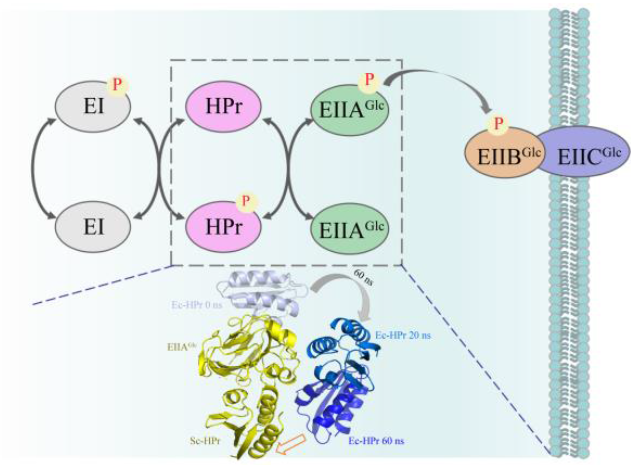
蛋白质依靠短程相互作用识别配体蛋白进而行使生物学功能,其相互作用界面仅占据蛋白质总表面积的一部分.因此,蛋白质与配体蛋白需要形成一系列遭遇复合物系综结构来减少构象搜索空间以加快结合速度.由于遭遇复合物在溶液体系中存在时间短、丰度低,因而很难被传统结构生物学技术捕捉到.本文选用组氨酸磷酸载体蛋白(HPr)和酶II(EIIAGlc)复合物为研究体系,采用顺磁弛豫增强(Paramagnetic Relaxation Enhancement,PRE)技术对遭遇复合物的系综结构及动力学性质进行表征,并用分子动力学模拟方法对实验结果进行验证,发现HPr在溶液体系中首先与EIIAGlc在3个方向上形成遭遇复合物,进而促进特异性复合物的形成.该方法不仅能够在溶液体系中观察遭遇复合物系综结构,还有望应用于生物大分子领域,揭示蛋白质在复杂生理网络中的相互作用机制及动力学行为.
赵昶 , 龚洲 . 顺磁核磁共振技术研究蛋白质遭遇复合物的动态结构[J]. 波谱学杂志, 2023 , 40(2) : 148 -157 . DOI: 10.11938/cjmr20223035
Proteins recognize partner proteins and take function through short-range interaction at a small interface area. Therefore, protein and its partner form a series of encounter complex ensembles on the pathway to simplify conformational searching and facilitate protein-protein association. The encounter complex is hard to detect by traditional structural-biology methods due to its short life and low population. This paper chose histidine phosphate carrier protein (HPr) and enzyme II (EIIAGlc) complex as the research target, combining paramagnetic relaxation enhancement (PRE) with molecular dynamics simulation to characterize the encounter complex structure and dynamics. We found that the HPr first formed encounter complexes with EIIAGlc in three directions, and then compelled the formation of the specific complex. The methods utilized in this paper can visualize the encounter complex ensembles, and help understand the mechanism of bio-molecule interaction and protein function pathway in cell.
| [1] | TANG C, IWAHARA J, CLORE G M. Visualization of transient encounter complexes in protein-protein association[J]. Nature, 2006, 444(7117): 383-386. |
| [2] | IWAHARA J, CLORE G M. Detecting transient intermediates in macromolecular binding by paramagnetic NMR[J]. Nature, 2006, 440(7088): 1227-1230. |
| [3] | XING Q, HUANG P, YANG J, et al. Visualizing an ultra-weak protein-protein interaction in phosphorylation signaling[J]. Angew Chem Int Ed Engl, 2014, 53(43): 11501-11505. |
| [4] | GABDOULLINE R R, WADE R C. Biomolecular diffusional association[J]. Curr Opin Struct Biol, 2002, 12(2): 204-213. |
| [5] | SCHREIBER G, HARAN G, ZHOU H X. Fundamental aspects of protein-protein association kinetics[J]. Chem Rev, 2009, 109(3): 839-860. |
| [6] | UBBINK M. The courtship of proteins: understanding the encounter complex[J]. FEBS Lett, 2009, 583(7): 1060-1066. |
| [7] | VAN SON M, SCHILDER J T, DI SAVINO A, et al. The transient complex of cytochrome c and cytochrome c peroxidase: Insights into the encounter complex from multifrequency EPR and NMR spectroscopy[J]. Chemphyschem, 2020, 21(10): 1060-1069. |
| [8] | NORTHRUP S H, BOLES J O, REYNOLDS J C. Brownian dynamics of cytochrome c and cytochrome c peroxidase association[J]. Science, 1988, 241(4861): 67-70. |
| [9] | SCHREIBER G, FERSHT AR. Rapid, electrostatically assisted association of proteins[J]. Nat Struct Biol, 1996, 3(5): 427-431. |
| [10] | VIJAYAKUMAR M, WONG KY, SCHREIBER G, et al. Electrostatic enhancement of diffusion-controlled protein-protein association: comparison of theory and experiment on barnase and barstar[J]. J Mol Biol, 1998, 278(5): 1015-1024. |
| [11] | SELZER T, ALBECK S, SCHREIBER G. Rational design of faster associating and tighter binding protein complexes[J]. Nat Struct Biol, 2000, 7(7): 537-541. |
| [12] | ZHOU H X, SZABO A. Enhancement of association rates by nonspecific binding to DNA and cell membranes[J]. Phys Rev Lett, 2004, 93(17): 178101. |
| [13] | HAREL M, COHEN M, SCHREIBER G. On the dynamic nature of the transition state for protein-protein association as determined by double-mutant cycle analysis and simulation[J]. J Mol Biol, 2007, 371(1): 180-196. |
| [14] | GENET J P. Asymmetric catalytic hydrogenation. Design of new Ru catalysts and chiral ligands: from laboratory to industrial applications[J]. Acc Chem Res, 2003, 36(12): 908-918. |
| [15] | WORRALL J A, LIU Y, CROWLEY P B, et al. Myoglobin and cytochrome b5: a nuclear magnetic resonance study of a highly dynamic protein complex[J]. Biochemistry, 2002, 41(39): 11721-11730. |
| [16] | UBBINK M, BENDALL D S. Complex of plastocyanin and cytochrome c characterized by NMR chemical shift analysis[J]. Biochemistry, 1997, 36(21): 6326-6335. |
| [17] | WORRALL J A, REINLE W, BERNHARDT R, et al. Transient protein interactions studied by NMR spectroscopy: the case of cytochrome C and adrenodoxin[J]. Biochemistry, 2003, 42(23): 7068-7076. |
| [18] | BASHIR Q, SCANU S, UBBINK M. Dynamics in electron transfer protein complexes[J]. FEBS J, 2011, 278(9): 1391-1400. |
| [19] | HU Y F, LI C G, HE L C, et al. Mechanisms of chaperones as active assistant/protector for proteins: Insights from NMR studies[J]. Chinese J Chem, 2019, 38(4): 406-413. |
| [20] | TOLMAN J R, FLANAGAN J M, KENNEDY M A, et al. NMR evidence for slow collective motions in cyanometmyoglobin[J]. Nat Struct Biol, 1997, 4(4): 292-297. |
| [21] | WANG J N, LIN Y L, ZHU Q J, et al. NMR assignments and characterization of the DNA-binding domain of Arabidopsis transcription factor WRKY11[J]. Magn Reson Lett, 2021, 1(2): 112-120. |
| [22] | BRUCE N J, GANOTRA G K, KOKH D B, et al. New approaches for computing ligand-receptor binding kinetics[J]. Curr Opin Struct Biol, 2018, 49: 1-10. |
| [23] | DICKSON A, TIWARY P, VASHISTH H. Kinetics of ligand binding through advanced computational approaches: A review[J]. Curr Top Med Chem, 2017, 17(23): 2626-2641. |
| [24] | DE VIVO M, MASETTI M, BOTTEGONI G, et al. Role of molecular dynamics and related methods in drug discovery[J]. J Med Chem, 2016, 59(9): 4035-4061. |
| [25] | BERNETTI M, CAVALLI A, MOLLICA L. Protein-ligand (un)binding kinetics as a new paradigm for drug discovery at the crossroad between experiments and modelling[J]. Medchemcomm, 2017, 8(3): 534-550. |
| [26] | SHAN Y, KIM E T, EASTWOOD M P, et al. How does a drug molecule find its target binding site?[J]. J Am Chem Soc, 2011, 133(24): 9181-9183. |
| [27] | DROR R O, PAN A C, ARLOW D H, et al. Pathway and mechanism of drug binding to G-protein-coupled receptors[J]. Proc Natl Acad Sci U S A, 2011, 108(32): 13118-13123. |
| [28] | TRAN D P, KITAO A. Dissociation process of a MDM2/p53 complex investigated by parallel cascade selection molecular dynamics and the markov state model[J]. J Phys Chem B, 2019, 123(11): 2469-2478. |
| [29] | DICKSON A. Mapping the ligand binding landscape[J]. Biophys J, 2018, 115(9): 1707-1719. |
| [30] | PLATTNER N, NOé F. Protein conformational plasticity and complex ligand-binding kinetics explored by atomistic simulations and Markov models[J]. Nat Commun, 2015, 6: 7653. |
| [31] | SILVA D A, BOWMAN G R, SOSA-PEINADO A, et al. A role for both conformational selection and induced fit in ligand binding by the LAO protein[J]. PLoS Comput Biol, 2011, 7(5): e1002054. |
| [32] | REIZER J, SAIER JR M H, DEUTSCHER J, et al. The phosphoenolpyruvate:sugar phosphotransferase system in gram-positive bacteria: properties, mechanism, and regulation[J]. Crit Rev Microbiol, 1988, 15(4): 297-338. |
| [33] | HERZBERG O, KLEVIT R. Unraveling a bacterial hexose transport pathway[J]. Curr Opin Struct Biol, 1994, 4(6): 814-822. |
| [34] | WANG G, LOUIS J M, SONDEJ M, et al. Solution structure of the phosphoryl transfer complex between the signal transducing proteins HPr and IIA(glucose) of the Escherichia coli phosphoenolpyruvate: sugar phosphotransferase system[J]. EMBO J, 2000, 19(21): 5635-5649. |
| [35] | GONG Z, DING Y H, DONG X, et al. Visualizing the ensemble structures of protein complexes using chemical cross-linking coupled with mass spectrometry[J]. Biophys Rep, 2015, 1: 127-138. |
| [36] | FAWZI N L, DOUCLEFF M, SUH J Y, et al. Mechanistic details of a protein-protein association pathway revealed by paramagnetic relaxation enhancement titration measurements[J]. Proc Natl Acad Sci U S A, 2010, 107(4): 1379-1384. |
| [37] | DING Y H, GONG Z, DONG X, et al. Modeling protein excited-state structures from “over-length” chemical cross-links[J]. J Biol Chem, 2017, 292(4): 1187-1196. |
| [38] | WANG G, LOUIS J M, SONDEJ M, et al. Solution structure of the phosphoryl transfer complex between the signal transducing proteins HPr and IIA(glucose) of the Escherichia coli phosphoenolpyruvate:sugar phosphotransferase system[J]. EMBO J, 2000, 19(21): 5635-5649. |
| [39] | AN Y, CHEN L, SUN S, et al. QuikChange shuffling: a convenient and robust method for site-directed mutagenesis and random recombination of homologous genes[J]. N Biotechnol, 2011, 28(4): 320-325. |
| [40] | SCHWIETERS C D, KUSZEWSKI J J, TJANDRA N, et al. The Xplor-NIH NMR molecular structure determination package[J]. J Magn Reson, 2003, 160(1): 65-73. |
| [41] | CHEN R, LI L, WENG Z. ZDOCK: an initial-stage protein-docking algorithm[J]. Proteins, 2003, 52(1): 80-87. |
| [42] | IWAHARA J, SCHWIETERS C D, CLORE G M. Ensemble approach for NMR structure refinement against (1)H paramagnetic relaxation enhancement data arising from a flexible paramagnetic group attached to a macromolecule[J]. J Am Chem Soc, 2004, 126(18): 5879-5896. |
/
| 〈 |
|
〉 |