

磁共振指纹成像技术及临床应用的进展
收稿日期: 2022-11-14
网络出版日期: 2023-03-02
基金资助
湖北省自然科学基金资助项目(2020CFB837);中央高校基本科研业务费专项资金资助项目(CZZ21006)
Progress of Magnetic Resonance Fingerprinting Technology and Its Clinical Application
Received date: 2022-11-14
Online published: 2023-03-02
黄敏 , 李思怡 , 陈军波 , 周到 . 磁共振指纹成像技术及临床应用的进展[J]. 波谱学杂志, 2023 , 40(2) : 207 -219 . DOI: 10.11938/cjmr20223034
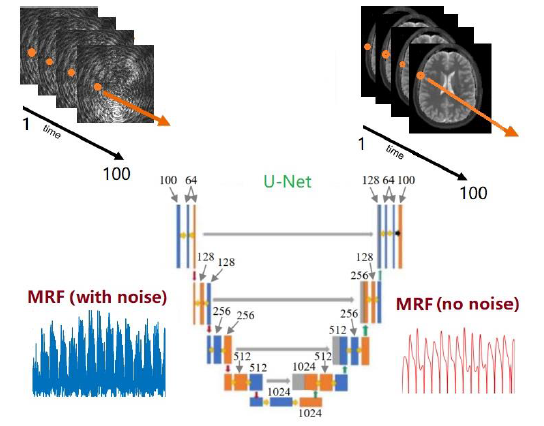
Magnetic resonance fingerprinting (MRF) is a revolutionary new technique for rapid quantitative magnetic resonance imaging. We reviewed the imaging technology and clinical application of MRF in an all-round way. We focus on three technical aspects: data collection, dictionary generation, and pattern recognition from traditional quantitative framework to deep learning quantitative framework. We also analyzed the technical challenges and limitations of MRF. The clinical applications of MRF in various human body regions were summarized, and the current status of MRF technology verification in terms of repeatability and reproducibility was introduced. Finally, we discussed the potential barriers and opportunities for MRF to enter clinical application and envision the future development direction of MRF technology.
| [1] | PANDA A, MEHTA B B, COPPO S, et al. Magnetic resonance fingerprinting-An overview[J]. Curr Opin Biomed Eng, 2017, 3: 56-66. |
| [2] | MA D, GULANI V, SEIBERLICH N, et al. Magnetic resonance fingerprinting[J]. Nature, 2013, 495: 187-192. |
| [3] | BIPIN MB, COPPO S, FRANCES M D, et al. Magnetic resonance fingerprinting: a technical review[J]. Magn Reson Med, 2019, 81: 25-46. |
| [4] | MCGIVNEY D F, BOYACIOGLU R, JIANG Y, et al. Magnetic resonance fingerprinting review part 2: technique and directions[J]. J Magn Reson Imaging, 2020, 51(4): 993-1007. |
| [5] | LI M, DONG Z C, ZHANG X W. Magnetic resonance fingerprinting imaging technology and its progress[J]. Scientia Sinica Vitae, 2019, 49(1): 28-40. |
| [5] | 李敏, 董正超, 张学武, 等. 磁共振指纹成像技术及其最新进展[J]. 中国科学: 生命科学, 2019, 49(1): 28-40. |
| [6] | DENG W, LI X H. Research progress of cardiac magnetic resonance fingerprint technology[J]. Int J Med Radiol, 2022, 45(2): 189-191+204. |
| [6] | 邓炜, 李小虎. 心脏磁共振指纹技术研究进展[J]. 国际医学放射学杂志, 2022, 45(2): 189-191+204. |
| [7] | JIANG Y, MA D, GRISWOLD M, et al. mr fingerprinting using fast imaging with steady state precession (FISP) with spiral readout[J]. Magn Reson Med, 2015, 74(6): 1621-1631. |
| [8] | BUONINCONTRI G, SAWIAK S J. MR fingerprinting with simultaneous B1 estimation[J]. Magn Reson Med, 2016, 76(4): 1127-1135. |
| [9] | RIEGER B, ZIMMER F, ZAPP J, et al. Magnetic resonance fingerprinting using echo-planar imaging: joint quantification of T1 and T2* relaxation times[J]. Magn Reson Med, 2017, 78(5): 1724-1733. |
| [10] | KARA D, FAN M, HAMILTON J, et al. Parameter map error due to normal noise and aliasing artifacts in MR fingerprinting[J]. Magn Reson Med, 2019, 81: 3108-3123. |
| [11] | SOMMER K, AMTHOR T, DONEVA M, et al. Towards predicting the encoding capability of MR fingerprinting sequences[J]. Magn Reson Imaging, 2017, 41: 7-14. |
| [12] | ZHAO B, HALDAR J P, CONGYU L, et al. Optimal experiment design for magnetic resonance fingerprinting: Cramer-Rao bound meets spin dynamics[J]. IEEE Trans Med Imaging, 2019, 38: 844-861. |
| [13] | HEESTERBEEK D G J, KOOLSTRA K, OSCH M J P, et al. Sequence optimization mitigating undersampling errors in magnetic resonance fingerprinting[C]// Joint Annual Meeting ISMRM-ESMRMB ISMRT 31st Annual Meeting, London, UK, 2022, 0561. |
| [14] | JORDAN S P, HU S Y, ROZADA I, et al. Automated design of pulse sequences for magnetic resonance fingerprinting using physics-inspired optimization[J]// Proc Natl Acad Sci U S A, 2021, 118(40): e2020516118. |
| [15] | SUBASHI E, YU V, COHEN O, et al. Motion-robust free-breathing abdominal MR fingerprinting (MRF) using radial acquisition and temporal compressed sensing reconstruction: initial results[J]. Medical Physics, 2021, 48(6): 25-29. |
| [16] | YANG M, JIANG Y, MA D, et al. Game of learning bloch equation simulations for mr fingerprinting[OL]. ArXiv, 2020, https://arxiv.org/abs/2004.02270. |
| [17] | VELASCO C, FLETCHER T J, BOTNAR R M, et al. Artificial intelligence in cardiac magnetic resonance fingerprinting[J]. Front Cardiovasc Med, 2022, 9: 1009131. |
| [18] | SAYBASILI H, GRISWOLD M A, MA D, et al. SVD compression for magnetic resonance fingerprinting in the time domain[J]. IEEE Trans Med Imaging, 2014, 33(12): 2311-2322. |
| [19] | MA D, MCGIVNEY D, GRISWOLD M A, et al. Low rank approximation methods for MR fingerprinting with large scale dictionaries[J]. Magn Reson Med, 2018, 79(4): 2392-2400. |
| [20] | MA D, WALD L L, GRISWOLD M A, et al. Fast group matching for MR fingerprinting reconstruction[J]. Magn Reson Med, 2015, 74(2): 523-528. |
| [21] | CHRISTOPHER C C, XIAO C, BORIS M, et al. AIR-MRF: Accelerated iterative reconstruction for magnetic resonance fingerprinting[J], Magn Reson Imaging, 2017, 41: 29-40. |
| [22] | WANG Z, ZHANG J, CUI D, et al. Magnetic resonance fingerprinting using a fast dictionary searching algorithm: MRF-ZOOM[J]. IEEE Trans Biomed Eng, 2019, 66(6): 1526-1535. |
| [23] | CRUZ G, QI H, JAUBERT O, et al. Generalized low-rank non-rigid motion-corrected reconstruction for MR fingerprinting[J]. Magn Reson Med, 2022, 87: 746-763. |
| [24] | CHEN Y, FANG Z, HUNG S C, et al. High-resolution 3D MR Fingerprinting using parallel imaging and deep learning[J]. Neuroimage, 2020, 206: 116329. |
| [25] | HOPPE E, K?RZD?RFER G, WüRFL T, et al. Deep learning for magnetic resonance fingerprinting: A new approach for predicting quantitative parameter values from time series[J]. Stud Health Technol Inform, 2017, 243: 202-206. |
| [26] | PENG C, DI C, VINCE V, et al. Development of fast deep learning quantification for magnetic resonance fingerprinting in vivo[J]. Magn Reson Imaging, 2020, 70: 81-90. |
| [27] | HAMILTON J I, CURREY D, RAJAGOPALAN S, et al. Deep learning reconstruction for cardiac magnetic resonance fingerprinting T1 and T2 mapping[J]. Magn Reson Med, 2021, 85: 2127-2135. |
| [28] | COHEN O, ZHU B, ROSEN M S. MR fingerprinting deep reconstruction network (DRONE)[J]. Magn Reson Med, 2018, 80: 885-894. |
| [29] | HOPPE E, K?RZD?RFER G, NITTKA M, et al. Deep learning for magnetic resonance fingerprinting: Accelerating the reconstruction of quantitative relaxation maps[C]// Proceedings of the 26th Annual Meeting of ISMRM, Paris, France, 2018: 1-5. |
| [30] | SONG P, ELDAR Y C, MAZOR G, et al. HYDRA. Hybrid deep magnetic resonance fingerprinting[J]. Med Phys. 2019, 46: 4951-4969. |
| [31] | BALSIGER F, JUNGO A, SCHEIDEGGER O, et al. Spatially regularized parametric map reconstruction for fast magnetic resonance fingerprinting[J]. Med Image Anal, 2020, 64: 101741. |
| [32] | VIRTUE P, YU S X, LUSTIG M. Better than real: complex-valued neural nets for MRI fingerprinting[C]// IEEE International Conference on Image Processing (ICIP), 2017: 00070. |
| [33] | HOPPE E, THAMM F, K?RZD?RFER G, et al. RinQ fingerprinting: recurrence-informed quantile networks for magnetic resonance fingerprinting[C]// Medical Image Computing and Computer Assisted Intervention-MICCAI 2019: 22nd International Conference, Shenzhen, China, 2019: 92-100. |
| [34] | XU Y L, HOPPE E, SPEIER P, et al. Learning how to clean fingerprints -- deep learning based separated artefact reduction and regression for mr fingerprinting[C]// 2020 ISMRM & SMRT Virtual Conference & Exhibition, Paris, France, 2020. |
| [35] | FANG Z, CHEN Y, LIU M, et al. Deep learning for fast and spatially constrained tissue quantification from highly accelerated data in magnetic resonance fingerprinting[J]. IEEE Trans Med Imaging, 2019, 38(10): 2364-2374. |
| [36] | HSIEH J J L, SVALBE I. Magnetic resonance fingerprinting: from evolution to clinical applications[J]. J Med Radiat Sci, 2020, 67(4): 333-344. |
| [37] | BADVE C, YU A, DASTMALCHIAN S, et al. MR fingerprinting of adult brain tumors: Initial experience[J]. AJNR Am J Neuroradiol, 2017, 38 (3): 492-499. |
| [38] | MA D, JONES S E, DESHMANE A, et al. Development of high-resolution 3D MR fingerprinting for detection and characterization of epileptic lesions[J]. J Magn Reson Imaging, 2019, 49(5): 1333-1346. |
| [39] | CHEN Y, JIANG Y, PAHWA S, et al. MR fingerprinting for rapid quantitative abdominal imaging[J]. Radiology, 2016, 279(1): 278-286. |
| [40] | CHEN Y, PANDA A, PAHWA S, et al. Three-dimensional MR fingerprinting for quantitative breast imaging[J]. Radiology, 2019, 290(1): 33-40. |
| [41] | CAO X, LIAO C, LYER S S, et al. Optimized multi-axis spiral projection MR fingerprinting with subspace reconstruction for rapid whole-brain high-isotropic-resolution quantitative imaging[J]. Magn Reson Med, 2022, 88(1): 133-150. |
| [42] | LIAO C, WANG K, CAO X, et al. Detection of lesions in mesial temporal lobe epilepsy by using MR fingerprinting[J]. Radiology, 2018, 288: 804-812. |
| [43] | RIEL M V, YU Z, HODONO S, et al. Free-breathing abdominal T1 mapping using an optimized MR fingerprinting sequence[J]. NMR Biomed, 2021, 34(7): e4531. |
| [44] | JAUBERT O, ARRIETA C, CRUZ G, et al. Multi-parametric liver tissue characterization using MR fingerprinting: Simultaneous T1, T2, T2*, and fat fraction mapping[J]. Magn Reson Med, 2020, 84(5): 2625-2635. |
| [45] | SERRAO E M, KESSLER D A, CARMO B, et al. Magnetic resonance fingerprinting of the pancreas at 1.5 T and 3.0 T[J]. Sci Rep, 2020, 10: 17563. |
| [46] | NOLTE T, SCHOLTEN H, GROSS N, et al. Confounding factors in breast magnetic resonance fingerprinting: B1+, slice profile, and diffusion effects[J]. Magn Reson Med, 2021, 85(4): 1865-1880. |
| [47] | ECK B L, FLAMM S D, KWON D H, et al. Cardiac magnetic resonance fingerprinting: trends in technical development and potential clinical applications[J]. Prog Nucl Magn Reson Spectrosc, 2021, 122: 11-22. |
| [48] | LIU Y, HAMILTON J, RAJAGOPALAN S, et al. Cardiac magnetic resonance fingerprinting: technical overview and initial results[J]. JACC Cardiovasc Imaging, 2018, 11: 1837-1853. |
| [49] | HAMILTON J I, JIANG Y, CHEN Y, et al. MR fingerprinting for rapid quantification of myocardial T1, T2, and proton spin density[J]. Magn Reson Med, 2017, 77: 1446-1458. |
| [50] | HAMILTON J I, JIANG Y, MA D, et al. Simultaneous multislice cardiac magnetic resonance fingerprinting using low rank reconstruction[J]. NMR Biomed, 2019, 32: e4041. |
| [51] | HAMILTON J I, PAHWA S, ADEDIGBA J, et al. Simultaneous mapping of T1 and T2 using cardiac magnetic resonance fingerprinting in a cohort of healthy subjects at 1.5T[J]. J Magn Reson Imaging, 2020, 52: 1044-1052. |
| [52] | VELASCO C, FLETCHER T J, BOTNAR R M, et al. Artificial intelligence in cardiac magnetic resonance fingerprinting[J]. Front Cardiovasc Med, 2022, 9: 1009131 |
| [53] | JAUBERT O, CRUZ G, BUSTIN A, et al. Free-running cardiac magnetic resonance fingerprinting: joint T1/T2 map and cine imaging[J]. Magn Reson Imaging, 2020, 68: 173-182. |
| [54] | CRUZ G, JAUBERT O, QI H, et al. 3D free-breathing cardiac magnetic resonance fingerprinting[J]. NMR Biomed, 2020, 33: e4370. |
| [55] | BARKHOF F, PARKER G J M. Reproducing Fingerprints: a step toward clinical adoption[J]. Radiology, 2019, 292: 438-439. |
| [56] | KEENAN K E, JIANG Y, MA D, et al. Repeatability of magnetic resonance fingerprinting T1 and T2 estimates assessed using the ISMRM/NIST MRI system phantom[J]. Magn Reson Med, 2017, 78(4): 1452-1457. |
| [57] | K?RZD?RFER G, KIRSCH R, LIU K, et al. Reproducibility and repeatability of MR fingerprinting relaxometry in the human brain[J]. Radiology, 2019, 292: 429-437. |
| [58] | YOKOTA Y, OKADA T, FUSHIMI Y, et al. Acceleration of 2D-MR fingerprinting by reducing the number of echoes with increased in-plane resolution: a volunteer study[J]. Magn Reson Mater Phy, 2020, 33: 783-791. |
| [59] | BUONINCONTRI G, BIAGI L, RETICO A, et al. Multi-site repeatability and reproducibility of MR fingerprinting of the healthy brain at 1.5 and 3.0 T[J]. NeuroImage, 2019, 195: 362-372. |
| [60] | BUONINCONTRI G, KURZAWSKI J W, KAGGIE J D, et al. Three dimensional MRF obtains highly repeatable and reproducible multi-parametric estimations in the healthy human brain at 1.5 T and 3 T[J]. NeuroImage, 2021, 226: 117573. |
| [61] | WANG Z Y, WANG Y S, MAO J L, et al. Magnetic resonance images segmentation of synovium based on Dense-UNet++[J]. Chinese J Magn Reson, 2022, 39(2): 208-219. |
| [61] | 王振宇, 王颖珊, 毛瑾玲, 等. 基于Dense-UNet++的关节滑膜磁共振图像分割[J]. 波谱学杂志, 2022, 39(2): 208-219. |
| [62] | YANG Q, WANG Z, GUO K, et al. Physics-driven synthetic data learning for biomedical magnetic resonance[J]. IEEE Signal Process Mag, 2022, https://doi.org/10.48550/arXiv.2203.11178. |
/
| 〈 |
|
〉 |