

一种带外部锁场通道的小型化核磁共振射频探头设计
收稿日期: 2022-12-16
网络出版日期: 2023-03-13
基金资助
中国科学院磁共振技术联盟项目(E0290301);山东省自然科学基金青年项目(ZR2021QA091)
A Miniaturised NMR RF Probe Design with External Field-locking Channel
Received date: 2022-12-16
Online published: 2023-03-13
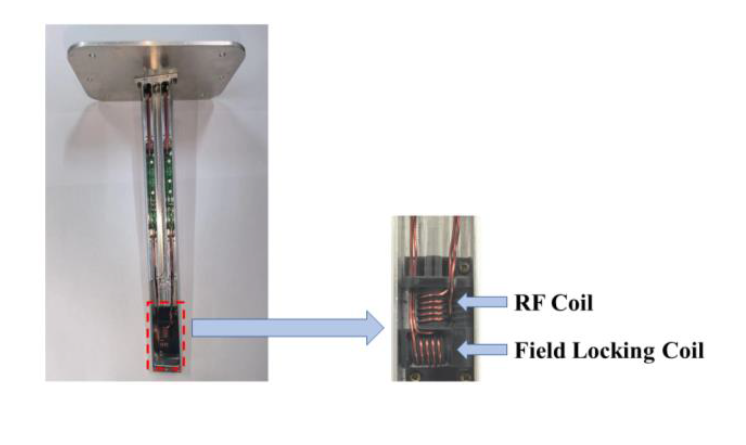
温度漂移是影响桌面式核磁共振波谱仪测量精度的一个重要因素,在探头中添加锁场线圈实现场频联锁是抑制温度漂移的常用手段.本文基于实验室紧凑型Halbach磁体,设计了一套带有外部锁场功能的双通道探头.针对目标区域,使用COMSOL仿真对比了螺线管线圈、鞍形线圈和亥姆霍兹线圈的磁场均匀性、信噪比和品质因数,发现螺线管线圈具有最佳综合性能.进一步针对螺线管线圈结构,对线圈直径、高度、匝数、匝间距以及漆包线半径进行了仿真优化,得到漆包线半径为0.4 mm、线圈直径和高度为8.2 mm、匝间距为1.6 mm、匝数为5是最优螺线管尺寸.基于仿真结果,制作了探头实物,并配合外围电路进行测试.结果表明,两个线圈通道之间串扰较小,信号检测通道信噪比达到50以上,锁场通道信噪比达到20以上.锁场实验结果表明,添加锁场后整体系统的频率漂移约为0.2 ppm/h(1 ppm=10-6),验证了此探头设计可用于基于紧凑型Halbach磁体的磁共振设备.
王峰 , 刘庭伟 , 徐雅洁 , 郁朋 , 王亚 , 彭博文 , 杨晓冬 . 一种带外部锁场通道的小型化核磁共振射频探头设计[J]. 波谱学杂志, 2023 , 40(3) : 332 -340 . DOI: 10.11938/cjmr20223044
Temperature drift is an important factor affecting the measurement accuracy of desktop NMR spectrometers, and adding a field-locking coil to the probe to achieve field-frequency interlocking is a common means of suppressing temperature drift. In this paper, a dual-channel miniaturised RF probe with an external field-locking channel is designed based on a laboratory compact Halbach magnet. The coil diameter, height, number of turns, turn spacing and enamelled wire radius were optimized based on the solenoid structure. The optimum solenoid size was obtained with an enameled wire radius of 0.4 mm, a coil diameter and height of 8.2 mm, a turn spacing of 1.6 mm and a number of turns of 5. Based on the simulation results, the detection and field-locking coils were fabricated, and tested in conjunction with the peripheral circuitry. The results show that the crosstalk between the two coils is low, the signal-to-noise ratio of the detection channel is above 50 and the signal-to-noise ratio of the locking channel is above 20. Final field locking experiments were performed and the frequency drift of the overall system after equipping the locking field was approximately 0.2 ppm/h (1 ppm=10-6), verifying that this probe design can be applied in compact Halbach magnet-based NMR analysis facilities.
| [1] | GUJAR S K, MAHESHWARI S, BJ?RKMAN-BURTSCHER I, et al. Magnetic resonance spectroscopy[J]. J Neuro-Ophthalmol, 2005, 25(3): 217-226. |
| [2] | BECKER W, BHATTIPROLU K C, GUBENS?K N, et al. Investigating protein-ligand interactions by solution nuclear magnetic resonance spectroscopy[J]. Chem Phys Chem, 2018, 19(8): 895-906. |
| [3] | NEAR J, HARRIS A D, JUCHEM C, et al. Preprocessing, analysis and quantification in single-voxel magnetic resonance spectroscopy: experts’ consensus recommendations[J]. NMR Biomed, 2021, 34(5): e4257. |
| [4] | VIGNALI C, CALIGIANI A, PALLA G. Quantitative 2H NMR spectroscopy with 1H lock extender[J]. J Magn Reson, 2007, 187(1): 120-125. |
| [5] | WANG Y, XU Y, WANG F, et al. A passive shimming method for Halbach magnet based on magnetic sheet arrays[J]. J Magn Reson, 2022, 339: 107210. |
| [6] | XU Y, WANG F, WANG Y, et al. Active shim coils design for Halbach magnet based on inverse boundary element method[J]. Magn Reson Lett, 2022, 2(3): 159-169. |
| [7] | XU Y, YU P, JIA F, et al. A spherical harmonics decomposition method (SHDM) for irregular matrix coils design[J]. IEEE T Biomed Eng, 2021, 69(4): 1292-1301. |
| [8] | CHEN S, XU L, WANG H, et al. Field-frequency lock approach for 21.3-MHz high-performance NMR relaxation analyzer[J]. Aip Adv, 2018, 8(7): 075327. |
| [9] | VAN BEEK T A. Low-field benchtop NMR spectroscopy: status and prospects in natural product analysis[J]. Phytochem Analysis, 2021, 32(1): 24-37. |
| [10] | SINGH K, BLüMICH B. NMR spectroscopy with compact instruments[J]. TrAC Trend Anal Chem, 2016, 83: 12-26. |
| [11] | HALBACH K. Design of permanent multipole magnets with oriented rare earth cobalt material[J]. Nucl Instrum Meth, 1980, 169(1): 1-10. |
| [12] | TROUT S R. Use of Helmholtz coils for magnetic measurements[J]. IEEE T Magn, 1988, 24(4): 2108-2111. |
| [13] | HOULT D I, LAUTERBUR P C. The sensitivity of the zeugmatographic experiment involving human samples[J]. J Magn Reson, 1979, 34(2): 425-433. |
| [14] | MINARD K R, WIND R A. Solenoidal microcoil design—Part I: Optimizing RF homogeneity and coil dimensions[J]. Concept Magn Reson, 2001, 13(2): 128-142. |
| [15] | MINARD K R, WIND R A. Solenoidal microcoil design—Part II: Optimizing winding parameters for maximum signal-to-noise performance[J]. Concept Magn Reson, 2001, 13(3): 190-210. |
| [16] | HOULT D I, RICHARDS R E. The signal-to-noise ratio of the nuclear magnetic resonance experiment[J]. J Magn Reson, 1976, 24(1): 71-85. |
| [17] | MEDHURST R. High frequency resistance and self-capacitance of single-layer solenoids[J]. Wireless Engineer, 1947, 35-43. |
| [18] | GRUBER B, FROELING M, LEINER T, et al. RF coils: A practical guide for nonphysicists[J]. J Magn Reson Imaging, 2018, 48(3): 590-604. |
| [19] | MISPELTER J, LUPU M, BRIGUET A. NMR probeheads for biophysical and biomedical experiments: theoretical principles and practical guidelines[M]. World Scientific Publishing Company, 2015. |
| [20] | WANG Y, XU Y, WANG F, et al. A passive shimming method for Halbach magnet based on magnetic sheet arrays[J]. J Magn Reson, 2022, 339: 107210. |
| [21] | KANG K, XU Y J, ZHANG W W, et al. Low noise pre-amplifier design for low-field magnetic resonance systems[J]. Chinese J Magn Reson, 2017, 34(3): 383-395. |
| [21] | 亢科, 徐雅洁, 张闻文, 等. 低场磁共振系统的低噪声前置放大器研究设计[J]. 波谱学杂志, 2017, 34(3): 383-395. |
/
| 〈 |
|
〉 |