

基于CNN-SVM的多维度信息融合半月板撕裂分类方法
收稿日期: 2023-07-24
网络出版日期: 2023-09-15
基金资助
国家自然科学基金(62066003);国家留学基金项目(CSC202208360143)
Multidimensional Information Fusion Method for Meniscal Tear Classification Based on CNN-SVM
Received date: 2023-07-24
Online published: 2023-09-15
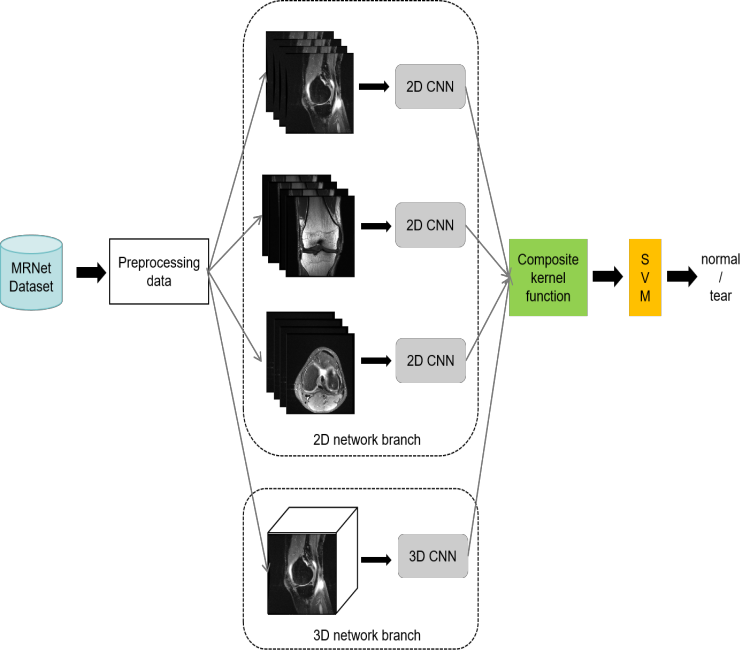
针对半月板计算机辅助诊断(CAD)系统中半月板撕裂形态各异带来的分类准确率低的问题,提出一种多维度信息融合网络(Multi-Dimensional Information Fusion Network,MDIFNet)模型的半月板撕裂分类方法.首先,使用由四个子网络所构成的卷积神经网络(Convolutional Neural Network,CNN)架构以获取不同视角、不同维度的半月板特征信息;同时,提出了多尺度注意力机制,丰富细粒度特征;最后,构建了基于支持向量机(Support Vector Machines,SVM)的多核模型作为最终的分类器.在MRNet数据集上的实验结果表明,本文提出方法的分类准确率达0.782,较现有先进的基于深度学习的半月板撕裂分类方法有一定提升.
赖嘉雯 , 汪宇玲 , 蔡晓宇 , 周丽华 . 基于CNN-SVM的多维度信息融合半月板撕裂分类方法[J]. 波谱学杂志, 2023 , 40(4) : 423 -434 . DOI: 10.11938/cjmr20233076
Aiming to address the problem of low classification accuracy caused by the different shapes of meniscus tears in the computer-aided diagnosis (CAD) system for meniscus, a multidimensional information fusion network (MDIFNet) model for menissus tear classification was proposed. Firstly, a convolutional neural network (CNN) architecture consisting of four sub-networks was used to obtain meniscus feature information from different perspectives and dimensions. Simultaneously, multi-scale attention mechanism was proposed to enrich fine-grained features. Finally, a multi kernel model based on support vector machines (SVM) was constructed as the final classifier. The experimental results on the MRNet dataset show that the proposed method has a meniscal tear classification accuracy of 0.782, which has promotion compared to the existing state-of-the-art meniscus tear classification methods based on deep learning.
| [1] | GHOSH P, TAYLOR T K F. The Knee joint meniscus: a fibrocartilage of some distinction[J]. Clin Orthop Relat R, 1987, 224: 52-63. |
| [2] | MARKES A R, HODAX J D, MA C B. Meniscus form and function[J]. Clin Sport Med, 2020, 39(1): 1-12. |
| [3] | HUTCHINSON I D, MORAN C J, POTTER H G, et al. Restoration of the meniscus: form and function[J]. Am J Sport Med, 2014, 42(4): 987-998. |
| [4] | BEAUFILS P, PUJOL N. Management of traumatic meniscal tear and degenerative meniscal lesions. Save the meniscus[J]. Orthop Traumatol-Sur, 2017, 103(8): S237-S244. |
| [5] | OZEKI N, KOGA H, SEKIYA I. Degenerative meniscus in knee osteoarthritis: from pathology to treatment[J]. Life, 2022, 12(4): 603. |
| [6] | OAKDEN-RAYNER L, CARNEIRO G, BESSEN T, et al. Precision radiology: predicting longevity using feature engineering and deep learning methods in a radiomics framework[J]. Sci Rep, 2017, 7(1): 1648. |
| [7] | JIN W, LI X, FATEHI M, et al. Guidelines and evaluation of clinical explainable AI in medical image analysis[J]. Med Image Anal, 2023, 84: 102684. |
| [8] | FARUCH-BILFELD M, LAPèGUE F, CHIAVASSA H, et al. Imaging of meniscus and ligament injuries of the knee[J]. Diagn Interv Imag, 2016, 97(7-8): 749-765. |
| [9] | NGUYEN J C, DE SMET A A, GRAF B K, et al. MR imaging-based diagnosis and classification of meniscal tears[J]. Radiographics, 2014, 34(4): 981-999. |
| [10] | BONIATIS I, PANAYIOTAKIS G, PANAGIOTOPOULOS E. A computer-based system for the discrimination between normal and degenerated menisci from magnetic resonance images[C]// 2008 IEEE International Workshop on Imaging Systems and Techniques, Chania, Greece: IEEE, 2008: 335-339. |
| [11] | K?SE C, GEN?ALIO?LU O, ?EVIK U. An automatic diagnosis method for the knee meniscus tears in MR images[J]. Expert Syst Appl, 2009, 36(2): 1208-1216. |
| [12] | FU J C, LIN C C, WANG C N, et al. Computer-aided diagnosis for knee meniscus tears in magnetic resonance imaging[J]. J Ind Prod Eng, 2013, 30(2): 67-77. |
| [13] | MA Y, XING C J, XIAO L. Knee joint image segmentation and model construction based on cascaded network[J]. Chinese J Magn Reson, 2022, 39(2): 184-195. |
| [13] | 马岩, 邢藏菊, 肖亮. 基于级联网络的膝关节图像分割与模型构建[J]. 波谱学杂志, 2022, 39(02): 184-195. |
| [14] | LECUN Y, BENGIO Y, HINTON G. Deep learning[J]. Nature, 2015, 521(7553): 436-444. |
| [15] | ZEILER M D, FERGUS R. Visualizing and understanding convolutional networks[C]// Computer Vision-ECCV 2014: 13th European Conference, Zurich, Switzerland: Springer International Publishing, 2014: 818-833. |
| [16] | HU Y W, SU X Y, KE X T, et al. The research progress of diagnosing meniscus injury in MRI based on deep learning[J]. Chin J Magn Reson Imaging, 2022, 13(05):167-170. |
| [16] | 胡伟艺, 苏娴彦, 柯晓婷, 等. 基于深度学习的MRI诊断半月板损伤的研究进展[J]. 磁共振成像, 2022, 13(05): 167-170. |
| [17] | BIEN N, RAJPURKAR P, BALL R L, et al. Deep-learning-assisted diagnosis for knee magnetic resonance imaging: development and retrospective validation of MRNet[J]. PLoS Med, 2018, 15(11): e1002699. |
| [18] | TSAI C H, KIRYATI N, KONEN E, et al. Knee injury detection using MRI with efficiently-layered network (ELNet)[C]// Medical Imaging with Deep Learning. Montréel, Canada: PMLR, 2020: 784-794. |
| [19] | FRITZ B, MARBACH G, CIVARDI F, et al. Deep convolutional neural network-based detection of meniscus tears: comparison with radiologists and surgery as standard of reference[J]. Skeletal Radiol, 2020, 49: 1207-1217. |
| [20] | RIZK B, BRAT H, ZILLE P, et al. Meniscal lesion detection and characterization in adult knee MRI: a deep learning model approach with external validation[J]. Phys Medica, 2021, 83: 64-71. |
| [21] | LU L X, ZHOU J Z, GUO Y C, et al. Prediction of knee injury based on multimodal fusion[J]. Comput Eng Appl, 2021, 57(09): 225-232. |
| [21] | 陆莉霞, 邹俊忠, 郭玉成, 等. 多模态融合的膝关节损伤预测[J]. 计算机工程与应用, 2021, 57(09): 225-232. |
| [22] | MA Y, QIN Y, LIANG C, et al. Visual cascaded-progressive convolutional neural network (C-PCNN) for diagnosis of meniscus injury[J]. Diagnostics, 2023, 13(12): 2049. |
| [23] | HUNG T N K, VY V P T, TRI N M, et al. Automatic detection of meniscus tears using backbone convolutional neural networks on knee MRI[J]. J Magn Reson Imaging, 2023, 57(3): 740-749. |
| [24] | HE K, ZHANG X, REN S, et al. Deep residual learning for image recognition[C]// Proceedings of the IEEE conference on computer vision and pattern recognition, Las Vegas, NV, USA: IEEE, 2016: 770-778. |
| [25] | BACH F R, LANCKRIET G R G, JORDAN M I. Multiple kernel learning, conic duality, and the SMO algorithm[C]// Proceedings of the twenty-first international conference on Machine learning. Banff, Alberta, Canada: ICML, 2004: 6. |
| [26] | SUBRAHMANYA N, SHIN Y C. Sparse multiple kernel learning for signal processing applications[J]. IEEE T Pattern Anal, 2009, 32(5): 788-798. |
| [27] | DUNNHOFER M, MARTINEL N, MICHELONI C. Improving MRI-based knee disorder diagnosis with pyramidal feature details[C]// Medical Imaging with Deep Learning. Lübeck, Germany: PMLR, 2021: 131-147. |
| [28] | SHIN H, CHOI G S, SHON O J, et al. Development of convolutional neural network model for diagnosing meniscus tear using magnetic resonance image[J]. BMC Musculoskel Dis, 2022, 23(1): 1-9. |
/
| 〈 |
|
〉 |