

利用单边核磁共振研究樟子松木材干燥水分迁移规律
收稿日期: 2023-09-13
网络出版日期: 2023-11-20
基金资助
国家自然科学基金资助项目(31860185);国家自然科学基金资助项目(31160141);国家自然科学基金资助项目(30800866)
Water Migration Characteristics of Pinus Sylvestris During the Drying Process Studied by Single-sided Nuclear Magnetic Resonance
Received date: 2023-09-13
Online published: 2023-11-20
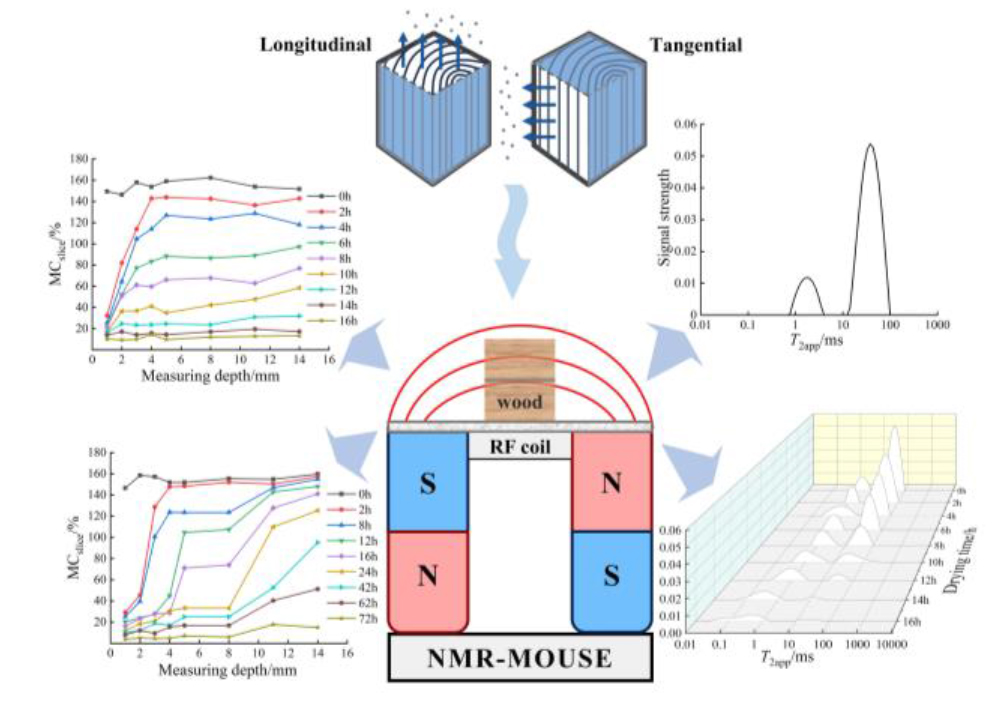
研究木材干燥过程中水分迁移可以更高效的利用木材.利用单边核磁共振技术(single-sided NMR)可沿木材不同方向进行一维测量的优势来探究木材在干燥过程中水分沿着轴向和弦向传递过程中不同测量深度的变化规律.本文以樟子松木材为研究对象,对其进行封胶处理使水分只沿着轴向或弦向传递,利用表观横向弛豫时间(T2app)来探究其在干燥过程中不同测量深度位置处的含水率变化.结果表明:樟子松木材在干燥过程的前2 h其接近蒸发面处存在少部分自由水,之后在干燥过程中基本上不存在自由水,且靠近蒸发面存在明显的含水率梯度;水分沿轴向传递时越远离蒸发面,水分分布相对均匀,弦向传递时越远离蒸发面,每层水分差异越明显.单边核磁共振技术可以检测木材不同测量深度位置的含水率,可为研究水分在木材中的迁移机理提供理论依据.
关键词: 单边核磁共振; 木材干燥; 水分迁移; 表观横向弛豫时间(T2app); 迁移机理
朱晓风 , 赵芝弘 , 谭蕊 , 周龙 , 王一川 , 刘文静 , 张明辉 , 刘化冰 . 利用单边核磁共振研究樟子松木材干燥水分迁移规律[J]. 波谱学杂志, 2024 , 41(2) : 173 -183 . DOI: 10.11938/cjmr20233083
Investigating the moisture migration during the wood drying process can help improve wood utilization. Single-sided nuclear magnetic resonance (NMR) technology facilitates such investigation with its advantage in conducting one-dimensional measurements along different directions of wood, allowing for the detection of moisture transfer at different depths along the axial and transverse directions during the wood drying process. This research focused on Pinus sylvestris var.mongolica wood, on which a glue sealing technique was employed to ensure that the moisture only transfers along the axial or transverse axis, and the apparent transverse relaxation time (T2app) was utilized to delve into the changes of moisture content at various depths during the drying process. The results showed that at the first 2 hours of the drying process, there was a little free water near the evaporation surface of Pinus sylvestris var.mongolica wood, followed by a scarcity of free water during the drying process, and a noticeable moisture content gradient was observed near the evaporation surface. When the moisture transferred along the axial direction, the farther the moisture was away from the evaporation surface, the more uniform the moisture distribution was. When the moisture transferred along the tangential direction, the farther the moisture was away from the evaporation surface, the more obvious the moisture difference in each layer was. By single-sided NMR technology, it is possible to ascertain the moisture content of wood at various depths, thereby offering a theoretical framework for revealing the migration mechanism of water within wood.
| [1] | WU Y Y. Research progress of wood science and technology[J]. Journal of Central South University of Forestry & Technology, 2021, 41(1): 1-28. |
| 吴义强. 木材科学与技术研究新进展[J]. 中南林业科技大学学报, 2021, 41(1): 1-28. | |
| [2] | CHEN C, KUANG Y, ZHU S, et al. Structure-property-function relationships of natural and engineered wood[J]. Nat Rev Mater, 2020, 5(9): 642-666. |
| [3] | XIAO L Z, LUO S H, LONG Z H. The development history and prospects of well site nuclear magnetic resonance technology and its applications[J]. Petroleum Drilling Technology, 2023, 51(4): 1-9. |
| 肖立志, 罗嗣慧, 龙志豪. 井场核磁共振技术及其应用的发展历程与展望[J]. 石油钻探技术, 2023, 51(4): 1-9. | |
| [4] | LI Y, XIAO L Z, SUN H F. The influencing factors of nuclear magnetic resonance logging TDA for identifying oil and gas[J]. Chinese J Magn Reson, 2012, 29(1): 21-31. |
| 李洋, 肖立志, 孙华峰. 核磁共振测井TDA识别油气的影响因素[J]. 波谱学杂志, 2012, 29(1): 21-31. | |
| [5] | WANG Z L, ZHANG R, ZHANG N, et al. A high-precision processing method for two-dimensional nuclear magnetic resonance logging data based on component compensation[J]. Chinese J Magn Reson, 2022, 39(2): 174-183. |
| 王振林, 张融, 张妮, 等. 一种基于组分补偿的二维核磁共振测井数据高精度处理方法[J]. 波谱学杂志, 2022, 39(2): 174-183. | |
| [6] | LIANG C, JIA Z, XIAO L, et al. A potential NMR-based wettability index using free induction decay for rocks[J]. Magn Reson Lett, 2023, 3(3): 266-275. |
| [7] | MORAES T B, COLNAGO L A. Noninvasive analyses of food products using low-field time-domain NMR: a review of relaxometry methods[J]. Brazilian J Phys, 2022, 52(2): 43. |
| [8] | NIU X X, BAI Z J, YANG Y, et al. Quantitative monitoring of photocatalytic Cr(VI) reduction reaction using in-situ low field nuclear magnetic resonance relaxation method[J]. Chinese J Magn Reson, 2021, 38(3): 403-413. |
| 牛星星, 白志杰, 杨翼, 等. 原位低场核磁共振弛豫法定量监测光催化Cr(VI)还原反应[J]. 波谱学杂志, 2021, 38(3): 403-413. | |
| [9] | ROBINSON N, D’AGOSTINO C, JOHNS M L. Functional group resolved NMR relaxation of 3-carbon adsorbates in mesoporous alumina[J]. Magn Reson Lett, 2023, 3(3): 248-255. |
| [10] | LI J, MA E. Characterization of water in wood by time-domain nuclear magnetic resonance spectroscopy (TD-NMR): a review[J]. Forests, 2021, 12(7): 886. |
| [11] | GAO Y L, LI X Y, LEI P, et al. Using TD-NMR technology to study the moisture distribution of poplar during high-temperature drying process[J]. Chinese J Magn Reson, 2016, 33(3): 479-490. |
| 高玉磊, 李新宇, 雷鹏, 等. 利用TD-NMR技术研究杨木高温干燥过程水分分布[J]. 波谱学杂志, 2016, 33(3): 479-490. | |
| [12] | ZHOU F D, GAO X, CAI J B, et al. Using low-temperature NMR technology to determine the fiber saturation point of wood and its heat treated wood[J]. Chinese J Magn Reson, 2017, 34(1): 108-114. |
| 周凡丁, 高鑫, 蔡家斌, 等. 利用低温NMR技术测定木材及其热处理材纤维饱和点[J]. 波谱学杂志, 2017, 34(1): 108-114. | |
| [13] | MA E N, WANG W, LI X, et al. Changes of water state during wood drying based on LFNMR[J]. Sci Silvae Sin, 2017, 53(6): 111-117. |
| 马尔妮, 王望, 李想, 等. 基于LFNMR的木材干燥过程中水分状态变化[J]. 林业科学, 2017, 53(6): 111-117. | |
| [14] | ZHANG M H, LI X Y, ZHOU Y J, et al. Study on changes of water state in wood drying process using time-domain nuclear magnetic resonance[J]. Sci Silvae Sin, 2014, 50(12): 109-113. |
| 张明辉, 李新宇, 周云洁, 等. 利用时域核磁共振研究木材干燥过程水分状态变化[J]. 林业科学, 2014, 50(12): 109-113. | |
| [15] | CASANOVA F, PERLO J, BLüMICH B. Single-sided NMR[M]. Springer Berlin Heidelberg, 2011. |
| [16] | CASIERI C, SENNI L, ROMAGNOLI M, et al. Determination of moisture fraction in wood by mobile NMR device[J]. J Magn Reson, 2004, 171(2): 364-372. |
| [17] | SENNI L, CASIERI C, BOVINO A, et al. A portable NMR sensor for moisture monitoring of wooden works of art, particularly of paintings on wood[J]. Wood Sci Technol, 2009, 43: 167-180. |
| [18] | SENNI L, CAPONERO M, CASIERI C, et al. Moisture content and strain relation in wood by Bragg grating sensor and unilateral NMR[J]. Wood Sci Technol, 2010, 44: 165-175. |
| [19] | DVINSKIKH S V, FURó I, SANDBERG D, et al. Moisture content profiles and uptake kinetics in wood cladding materials evaluated by a portable nuclear magnetic resonance spectrometer[J]. Wood Mater Sci Eng, 2011, 6(3): 119-127. |
| [20] | JOHANSSON J, BLOM ?, DVINSKIKH S. NMR-measurements for determination of local moisture content of coated wood[J]. J Coat Technol Res, 2013, 10: 601-607. |
| [21] | 闫越. 利用单边核磁共振研究木材的分层吸湿性[D]. 呼和浩特: 内蒙古农业大学, 2015. |
| [22] | YU D J, GUO P, WU J M, et al. Design of single-side NMR sensor for wood moisture detection[J]. Chinese J Magn Reson, 2017, 34(4): 508-518. |
| 余登洁, 郭盼, 吴嘉敏, 等. 用于木材水分检测的单边核磁共振传感器设计[J]. 波谱学杂志, 2017, 34(4): 508-518. | |
| [23] | STAGNO V, MAILHIOT S, CAPUANI S, et al. Testing 1D and 2D single-sided NMR on Roman age waterlogged woods[J]. J Cult Herit, 2021, 50: 95-105. |
| [24] | STAGNO V, CAPUANI S. Decay of a Roman age pine wood studied by micro magnetic resonance imaging, diffusion nuclear magnetic resonance and portable nuclear magnetic resonance[J]. Acta IMEKO, 2022, 11(1): 10. |
| [25] | VENKATARAMANAN L, SONG Y Q, HURLIMANN M D. Solving Fredholm integrals of the first kind with tensor product structure in 2 and 2.5 dimensions[J]. IEEE T Signal Proces, 2002, 50(5): 1017-1026. |
| [26] | BAIAS M, BLüMICH B. Nondestructive testing of objects from cultural heritage with NMR. In Webb G., Modern Magnetic Resonance[M]// Webb G. Modern Magnetic Resonance. Cham: Springer, 2018: 293-304. |
| [27] | TELKKI V V, ZHIVONITKO V V. Ultrafast NMR diffusion and relaxation studies[J]. Annu Rep NMR Spectro, 2019, 97: 83-119. |
| [28] | CARR H Y, PURCELL E M. Effects of diffusion on free precession in nuclear magnetic resonance experiments[J]. Phys Rev, 1954, 94(3): 630-638. |
| [29] | GAO X, CAI J B, JIN J W, et al. Determination of water content and pore size distribution of wood swelling cell wall by nuclear magnetic resonance[J]. Journal of Nanjing Forestry University(Natural Science Edition), 2017, 41(2): 150-156. |
| 高鑫, 蔡家斌, 金菊婉, 等. 利用核磁共振测定木材润胀细胞壁的水分含量与孔径分布[J]. 南京林业大学学报(自然科学版), 2017, 41(2): 150-156. | |
| [30] | TELKKI V V, YLINIEMI M, JOKISAARI J. Moisture in softwoods: fiber saturation point, hydroxyl site content, and the amount of micropores as determined from NMR relaxation time distributions[J]. Holzforschung, 2013, 67(3): 291-300. |
| [31] | ARAUJO C D, MACKAY A L, Hailey J R T, et al. Proton magnetic resonance techniques for characterization of water in wood: application to white spruce[J]. Wood Sci Technol, 1992, 26: 101-113. |
| [32] | MERELA M, OVEN P, SER?A I, et al. A single point NMR method for an instantaneous determination of the moisture content of wood[J]. Holzforschung, 2009, 63(3): 348-351. |
| [33] | LI X, ZHAO Z. Time domain-NMR studies of average pore size of wood cell walls during drying and moisture adsorption[J]. Wood Sci Technol, 2020, 54(5): 1241-1251. |
| [34] | 周云洁. 基于时域核磁共振技术的木材孔径分布研究[D]. 呼和浩特: 内蒙古农业大学, 2015. |
| [35] | PING L J, WANG X M, YAN Y, et al. Study on unsteady water diffusion and drying energy consumption of Pinus camphor wood during high temperature drying[J]. China Forest Products Industry, 2018, 45(9): 28-32+51. |
| 平立娟, 王喜明, 颜燕, 等. 樟子松木材高温干燥过程中水分的非稳态扩散和干燥能耗的研究[J]. 林产工业, 2018, 45(9): 28-32+51. | |
| [36] | LIU L B. Water movement in wood during drying[J]. Heilongjiang Science and Technology Information, 2013 (27): 264. |
| 刘鲁滨. 干燥过程中木材内水分的移动[J]. 黑龙江科技信息, 2013(27): 264. | |
| [37] | SIAU J F. Transport processes in wood[M]. Springer Science & Business Media, 2012. |
| [38] | KULASINSKI K, GUYER R, DEROME D, et al. Water diffusion in amorphous hydrophilic systems: a stop and go process[J]. Langmuir, 2015, 31(39): 10843-10849. |
| [39] | XU H L. Activation of adsorbed water in wood[J]. Journal of Forest and Environment, 1988, 8(1): 95-101. |
| 许洪林. 木材中吸附水的活化[J]. 福建林学院学报, 1988, 8(1): 95-101. | |
| [40] | 马尔妮, 赵广杰. 木材物理学专论[M]. 北京: 中国林业出版社, 2012. |
/
| 〈 |
|
〉 |