

二氧化硅颗粒堆积空隙中氢气分子的核磁共振谱学特征研究
收稿日期: 2024-03-25
网络出版日期: 2024-05-06
基金资助
上海市科委“科技创新行动计划”项目(22142200800)
Studies on the 1H NMR Spectral Features of Hydrogen Molecules in the Interstices of SiO2 Particles
Received date: 2024-03-25
Online published: 2024-05-06
王行乐 , 邵正泽 , 董洪春 , 魏达秀 , 陈群 , 姚叶锋 . 二氧化硅颗粒堆积空隙中氢气分子的核磁共振谱学特征研究[J]. 波谱学杂志, 2024 , 41(3) : 315 -321 . DOI: 10.11938/cjmr20243104
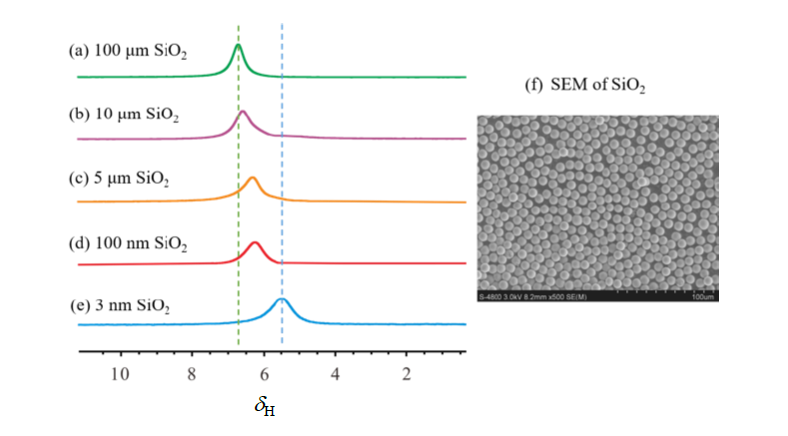
1H NMR spectral features of hydrogen molecules in the stacking interstices of silicon dioxide (SiO2) microspheres with different sizes are studied in the present article. The chemical shift of hydrogen molecules is observed to gradually shift towards higher fields as the size of the stacking interstices decreases. Combined with experimental results of variable temperature hydrogen spectroscopy, self-diffusion coefficients measurement, and scanning electron microscopy, the observed phenomenon is attributed to two factors, namely, 1) the microsphere size-dependent local magnetic field inhomogeneity in the stacking interstices caused by the diamagnetic SiO2 microspheres; and 2) the rapid exchange among hydrogen molecules experiencing different local fields within the microsphere interstices. The results of this study demonstrate the potential of hydrogen gas as a probe molecule for measuring micro- and nano-scale pore sizes.
Key words: hydrogen gas; silicon dioxide; stacking interstices; NMR; chemical shift
| [1] | ZDRAVKOV B, ?ERMáK J, ?EFARA M, et al. Pore classification in the characterization of porous materials: A perspective[J]. Cent Eur J Chem, 2007, 5(2): 385-395. |
| [2] | KUWABARA H, SUZUKI T, KANEKO K. Ultramicropores in microporous carbon fibres evidenced by helium adsorption at 4.2 K[J]. J Chem Soc, Faraday Trans, 1991, 87(12): 1915-1916. |
| [3] | DEBYE P, ANDERSON H R, BRUMBERGER H. Scattering by an inhomogeneous solid. II. The correlation function and its application[J]. J Appl Phys, 1957, 28(6): 679-683. |
| [4] | PFEIFER P, AVNIR D. Chemistry in noninteger dimensions between two and three. I. Fractal theory of heterogeneous surfaces[J]. J Chem Phys, 1983, 79(7): 3558-3565. |
| [5] | QUINSON J F, DUMAS J, SERUGHETTI J. Alkoxide silica gel: Porous structure by thermoporometry[J]. J Non·Cryst Solids, 1986, 79(3): 397-404. |
| [6] | CHEN X M, ZHAO X C, SUN X P, et al. Study on the automatic accumulation-thawing device of hyperpolarized 129Xe[J]. Chinese J Magn Reson, 2022, 39(3): 316-326. |
| 陈小明, 赵修超, 孙献平, 等. 超极化129Xe自动收集-升华装置研究[J]. 波谱学杂志, 2022, 39(3): 316-326. | |
| [7] | ITO T, FRAISSARD J. 129Xe nuclear magnetic resonance study of xenon adsorbed on zeolite NaY exchanged with alkali-metal and alkaline-earth cations[J]. J Am Chem Soc, 1987, 83(2): 451-462. |
| [8] | KUETHE D O, MONTA?O R, PIETRA? T. Measuring nanopore size from the spin-lattice relaxation of CF4 gas[J]. J Magn Reson, 2007, 186(2): 243-251. |
| [9] | ANDERSON R J, MCNICHOLAS T P, KLEINHAMMES A, et al. NMR methods for characterizing the pore structures and hydrogen storage properties of microporous carbons[J]. J Am Chem Soc, 2010, 132(25): 8618-8626. |
| [10] | CONTE G, SIMARI C, PUTZ A-M, et al. Hydrogen storage and mobility determined by NMR to various organically functionalized porous silica synthetized by using the post-grafting method[J]. Int J Hydrogen Energ, 2023, 48(70): 27319-27329. |
| [11] | FUJIWARA H, YAMABE J, NISHIMURA S. Determination of chemical shift of gas-phase hydrogen molecules by 1H nuclear magnetic resonance[J]. Chem Phys Lett, 2010, 498(1): 42-44. |
| [12] | LI H W, YUAN Z L, XIA B. Determination of apparent protein molecular weight in solution by diffusion ordered NMR spectroscopy[J]. Chinese J Magn Reson, 2018, 35(3): 280-286. |
| 李红卫, 袁志良, 夏斌. 扩散序谱 (DOSY) 实验测定缓冲体系中蛋白质表观分子量[J]. 波谱学杂志, 2018, 35(3) :280-286. | |
| [13] | CHEN W H, LIN H P, WU J F, et al. Effect of pore size on the adsorption of xenon on mesoporous MCM-41 and on the 129Xe NMR chemical shifts: A variable temperature study[J]. Stud Surf Sci Catal, 2000, 129: 517-524. |
| [14] | JONG S J, WU J F, PRADHAN A R, et al. Variable temperature 129Xe NMR studies of xenon adsorbed on mesoporous MCM-41 molecular sieves[J]. Stud Surf Sci Catal, 1998, 117: 543-550. |
| [15] | MUGIRANEZA S, HALLAS A M. Tutorial: a beginner’s guide to interpreting magnetic susceptibility data with the Curie-Weiss law[J]. Commun Phys, 2022, 5(1): 95. |
| [16] | CHO H J, SIGMUND E E, SONG Y. Magnetic resonance characterization of porous media using diffusion through internal magnetic fields[J]. Materials, 2012, 5(4): 590-616. |
| [17] | MAZITOV R K, DIEHL P, SEYDOUX R. Nuclear magnetic resonance of 3He dissolved in vitreous silica[J]. Chem Phys Lett, 1993, 201(5): 543-549. |
/
| 〈 |
|
〉 |