

原位固体核磁共振转子插件的设计及其在催化反应中的应用研究
收稿日期: 2024-05-20
网络出版日期: 2024-06-21
基金资助
国家重点基础研究发展计划资助项目(2022YFB3504000);中国科学院磁共振技术联盟科研仪器设备研制/功能开发项目(2021gzl004);中国科学院前瞻战略科技先导专项(XDB0540000);国家自然科学基金(22272185);国家自然科学基金(22225205);国家自然科学基金(22320102002);国家自然科学基金(22127801)
Design of in situ Solid-State NMR Rotor Inserts and Their Application to Catalytic Reactions
Received date: 2024-05-20
Online published: 2024-06-21
沈雪媛 , 王瑞琛 , 齐国栋 , 徐君 , 邓风 . 原位固体核磁共振转子插件的设计及其在催化反应中的应用研究[J]. 波谱学杂志, 2025 , 42(1) : 13 -21 . DOI: 10.11938/cjmr20243118
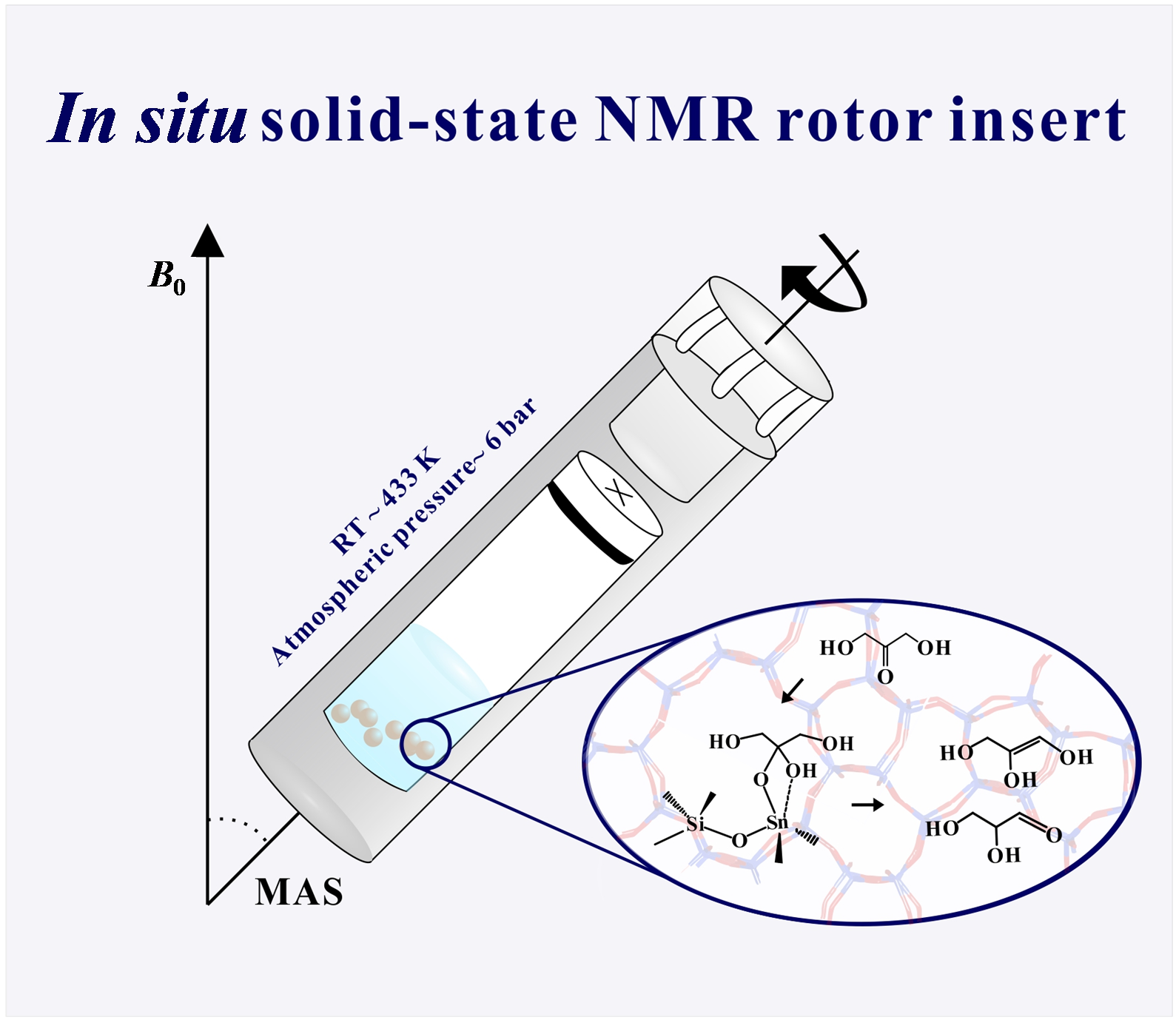
In situ solid-state nuclear magnetic resonance (NMR) serves as a powerful means to study catalytic reactions under operating conditions. Standard solid-state NMR rotors typically struggle to match the pressure and temperature of active reactions during sampling. Here, we introduce specialized inserts for commercial solid-state NMR rotors capable of withstanding pressures from atmospheric to 618.3 kPa and temperatures ranging from room temperature up to 433 K. With this innovative design, we examine the isomerization of dihydroxyacetone (DHA) on Sn-MFI zeolite catalyst using in situ 1H MAS NMR, revealing the presence of a gem-diols-type intermediate during the transformation of DHA into glyceraldehyde.
| [1] | QI G D, YE X D, XU J, et al. Progress in NMR studies of carbohydrates conversion on zeolites[J]. Chem J Chinese Universities, 2021, 42(1): 148-164. |
| 齐国栋, 叶晓栋, 徐君, 等. 分子筛上糖类催化转化的核磁共振研究[J]. 高等学校化学学报, 2021, 42(1): 148-164. | |
| [2] | QI G D, WANG Q, XU J, et al. Solid-state NMR studies of internuclear correlations for characterizing catalytic materials[J]. Chem Soc Rev, 2021, 50(15): 8382-8399. |
| [3] | XU J, WANG Q, LI S H, et al. Solid-state NMR in zeolite catalysis[M]. Springer, 2019. |
| [4] | He H Y, Zou Y, Ma Z N, et al. In situ MAS NMR spectroscopy study on catalytic reaction mechanism of light alkanes[J]. Acta Phys-Chim Sin, 2004, 20(08S): 1024-1031. |
| 贺鹤勇, 邹艳, 马卓娜, 等. 低碳烷烃催化反应机理的固体核磁共振研究[J]. 物理化学学报, 2004, 20(08S): 1024-1031. | |
| [5] | DENG T Y, HE X H, LIU H C. Insights into the active acid sites for isosorbide synthesis from renewable sorbitol and cellulose on solid acid catalysts[J]. Chem Res Chin Univ, 2022, 38(1): 257-264. |
| [6] | ROMMENS K T, SAEYS M. Molecular views on Fischer-Tropsch synthesis[J]. Chem Rev, 2023, 123(9): 5798-5858. |
| [7] | ZHANG W P, XU S T, HAN X W, et al. In situ solid-state NMR for heterogeneous catalysis: a joint experimental and theoretical approach[J]. Chem Soc Rev, 2012, 41(1): 192-210. |
| [8] | HUNGER M, WEITKAMP J. In situ IR, NMR, EPR, and UV/Vis spectroscopy: Tools for new insight into the mechanisms of heterogeneous catalysis[J]. Angew Chem Int Ed, 2001, 40(16): 2954-2971. |
| [9] | GOGUEN P W, XU T, BARICH D H, et al. Pulse-quench catalytic reactor studies reveal a carbon-pool mechanism in methanol-to-gasoline chemistry on zeolite HZSM-5[J]. J Am Chem Soc, 1998, 120(11): 2650-2651. |
| [10] | ZHOU X, WANG C, CHU Y Y, et al. Mechanistic insight into ethanol dehydration over SAPO-34 Zeolite by solid-state NMR spectroscopy[J]. Chem Res Chin Univ, 2022, 38(1): 155-160. |
| [11] | WANG X M, QI G D, XU J, et al. NMR-spectroscopic evidence of intermediate-dependent pathways for acetic acid formation from methane and carbon monoxide over a ZnZSM-5 zeolite catalyst[J]. Angew Chem Int Ed, 2012, 51(16): 3850-3853. |
| [12] | HUNGER M, HORVATH T. A new MAS NMR probe for in-situ investigations of hydrocarbon conversion on solid catalysts under continuous-flow conditions[J]. J Chem Soc, Chem Commun, 1995, (14): 1423-1424. |
| [13] | ADRIAN CARPENTER T, KLINOWSKI J, TILAK D, et al. Sealed capsules for convenient acquisition of variable-temperature controlled-atmosphere magic-angle-spinning NMR spectra of solids[J]. J Magn Reson, 1986, 68(3): 561-563. |
| [14] | HAW J F, GOGUEN P W, XU T, et al. In situ NMR investigations of heterogeneous catalysis with samples prepared under standard reaction conditions[J]. Angew Chem Int Ed, 1998, 37(7): 948-949. |
| [15] | HU J Z, HU M Y, ZHAO Z C, et al. Sealed rotors for in situ high temperature high pressure MAS NMR[J]. Chem Commun, 2015, 51(70): 13458-13461. |
| [16] | ZHAO Z C, YAO X L, HOU G J. Reaction pathways of methanol reforming over Pt/α-MoC catalysts revealed by in situ high-pressure MAS NMR[J]. ACS Catalysis, 2023, 13(12): 7978-7986. |
| [17] | IVANOVA I I, KOLYAGIN Y G, KASYANOV I A, et al. Time-resolved in situ MAS NMR monitoring of the nucleation and growth of zeolite BEA catalysts under hydrothermal conditions[J]. Angew Chem Int Ed, 2017, 56(48): 15344-15347. |
| [18] | IVANOVA I I, ANDRIAKO E P. In situ MAS NMR at the service of catalysis by zeolites: From the unraveling catalytic mechanisms towards the elucidation of the mechanisms of synthesis and rational design of zeolite catalysts[J]. Microporous Mesoporous Mater, 2023, 358: 112363. |
| [19] | WEHRLE B, AGUILAR-PARRILLA F, LIMBACH H-H. A novel is N chemical-shift NMR thermometer for magic angle spinning experiments[J]. J Magn Reson, 1990, 87(3): 584-591. |
| [20] | CAMPBELL G C, CROSBY R C, HAW J F. 13C chemical shifts which obey the Curie law in CP/MAS NMR spectra. The first CP/MAS NMR chemical-shift thermometer[J]. J Magn Reson, 1986, 69(1): 191-195. |
| [21] | KEMP T F, BALAKRISHNAN G, PIKE K J, et al. Thermometers for low temperature magic angle spinning NMR[J]. J Magn Reson, 2010, 204(1): 169-172. |
| [22] | TAKAHASHI T, KAWASHIMA H, SUGISAWA H, et al. 207Pb chemical shift thermometer at high temperature for magic angle spinning experiments[J]. Solid State Nucl Magn Reson, 1999, 15(2): 119-123. |
| [23] | THURBER K R, TYCKO R. Measurement of sample temperatures under magic-angle spinning from the chemical shift and spin-lattice relaxation rate of 79Br in KBr powder[J]. J Magn Reson, 2009, 196(1): 84-87. |
| [24] | PAN H, GERSTEIN B C. NMR of 31P in (VO)2P2O7 as an internal temperature standard in high-temperature NMR[J]. J Magn Reson, 1991, 92(3): 618-619. |
| [25] | DE CLIPPEL F, DUSSELIER M, VAN ROMPAEY R, et al. Fast and selective sugar conversion to alkyl lactate and lactic acid with bifunctional carbon-silica catalysts[J]. J Am Chem Soc, 2012, 134(24): 10089-10101. |
| [26] | CHO H J, CHANG C C, FAN W. Base free, one-pot synthesis of lactic acid from glycerol using a bifunctional Pt/Sn-MFI catalyst[J]. Green Chem, 2014, 16(7): 3428-3433. |
| [27] | LI L, STROOBANTS C, LIN K F, et al. Selective conversion of trioses to lactates over Lewis acid heterogeneous catalysts[J]. Green Chem, 2011, 13(5): 1175-1181. |
| [28] | QI G D, WANG Q, XU J, et al. Direct observation of tin sites and their reversible interconversion in zeolites by solid-state NMR spectroscopy[J]. Commun Chem, 2018, 1(1): 22. |
| [29] | WISHART D S, KNOX C, GUO A C, et al. HMDB: a knowledgebase for the human metabolome[J]. Nucleic Acids Res, 2008, 37(suppl_1): D603-D610. |
/
| 〈 |
|
〉 |