

基于物理模型的ISTAVS-Net多线圈MRI图像重建
收稿日期: 2024-04-15
网络出版日期: 2024-06-28
基金资助
湖北省自然科学基金资助项目(2020CFB837);中央高校基本科研业务费专项资金资助项目(CZZ21006);中央高校基本科研业务费专项资金资助项目(CZQ23032)
Multi-Coil MRI Image Reconstruction Based on ISTAVS-Net of Physical Model
Received date: 2024-04-15
Online published: 2024-06-28
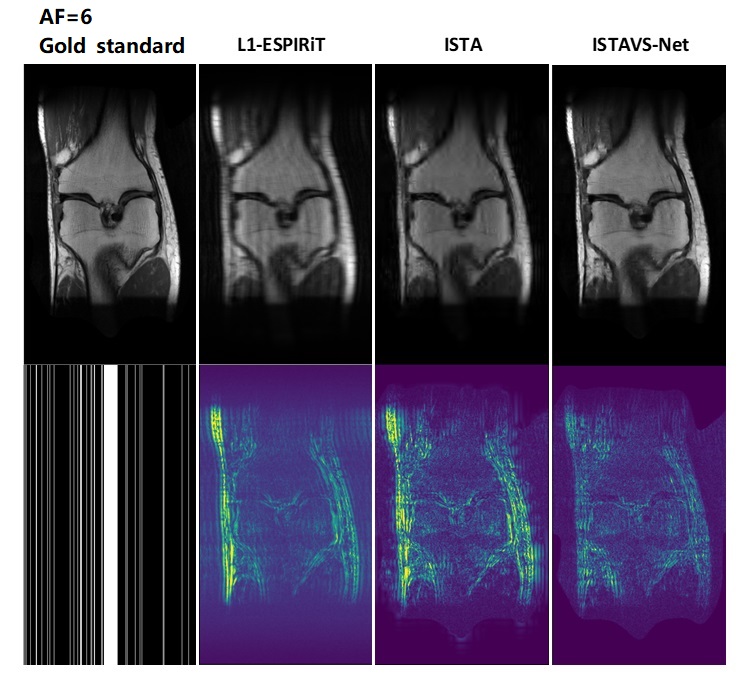
提高磁共振成像速度是磁共振领域待解决的问题,采用多线圈扫描是一种常用加速方式.但在加速因子大于4时,传统压缩感知磁共振(CS-MRI)重建算法得到的图像质量不高.为此,本文提出一种基于物理模型的ISTAVS-Net多线圈MRI图像重建方法.将ISTA算法与VS-Net网络拆分思想相结合,提出ISTAVS算法,并展开成ISTAVS-Net网络.将每步迭代与网络模块结合,比黑盒U-Net网络的可解释性更强.网络中引入残差机制,增加了网络的非线性表达能力和稳定性. 稀疏变换、收缩阈值以及正则化参数在训练中自动学习,提高了重建的灵活性.采用Globus膝关节数据集的测试结果表明不同加速因子下ISTAVS-Net网络效果均优于传统的 L1-ESPIRiT和ISTA迭代算法,图像质量和性能指标比U-Net、ISTA-Net+和VS-Net网络提升明显,在高加速因子下对组织细节恢复能力更强.该网络鲁棒性强,更适合对临床扫描数据进行快速高质量重建,可拓宽MRI应用范围.
黄敏 , 朱俊琳 , 考宇辰 , 周到 , 唐奇伶 . 基于物理模型的ISTAVS-Net多线圈MRI图像重建[J]. 波谱学杂志, 2024 , 41(4) : 418 -429 . DOI: 10.11938/cjmr20243109
How to improve the speed of MRI is a standing problem in the field of magnetic resonance. A commonly used approach for acceleration is multi-coil scan. However, when the acceleration factor exceeds 4, the image quality obtained by traditional compressed sensing magnetic resonance imaging (CS-MRI) reconstruction algorithms becomes unsatisfactory. In this study, we propose a multi-coil MRI image reconstruction method named as ISTAVS algorithm based on physical model. It combines the ISTA algorithm with the splitting idea of VS-Net, and is expanded into an ISTAVS-Net. Each iteration step is combined with the network module, which has higher interpretability than black box U-Net. The residual mechanism is introduced into the ISTAVS-Net to increase the non-linear expression ability and accuracy. Sparse transformation, shrinkage threshold and regularization parameter are automatically learned during training, which increases the flexibility of reconstruction. The test results of the Globus knee dataset show that the ISTAVS-Net outperforms traditional L1-ESPIRiT and ISTA algorithm by multiple indicators, including the improvement of image quality and performance metrics over U-Net, ISTA-Net+ and VS-Net at different acceleration factors, and the ability to recover tissue details at high acceleration factors. The proposed network demonstrates good robustness and is more suitable for fast and high-quality reconstruction of data acquired on clinical MR scanners, thereby can expand the application range of MRI.
| [1] | LUSTIG M, DONOHO D, PAULY J M. Sparse MRI: The application of compressed sensing for rapid MR imaging[J]. Magn Reson Med, 2007, 58(6): 1182-1195. |
| [2] | SONG Y, SHEN L, XING L, et al. Solving inverse problems in medical imaging with score-based generative models[J]. arXiv preprint, arXiv: 2111.08005, 2021. |
| [3] | GENG C H, JIANG M F, FANG X, et al. HFIST-Net: High-throughput fast iterative shrinkage thresholding network for accelerating MR image reconstruction[J]. Comput Meth Prog Bio, 2023, 232: 107440. |
| [4] | PAL A, RATHI Y. A review and experimental evaluation of deep learning methods for MRI reconstruction[J]. J Mach Learn Biomed Imaging, 2022, 1: 001. |
| [5] | WANG S, SU Z, YING L, et al. Accelerating magnetic resonance imaging via deep learning[C]// 2016 IEEE 13th International Symposium on Biomedical Imaging (ISBI), Prague, Czech Republic: IEEE, 2016: 514-517. |
| [6] | JIN K H, MCCANN M T, FROUSTEY E, et al. Deep convolutional neural network for inverse problems in imaging[J]. IEEE Trans Image Process, 2017, 26(9): 4509-4522. |
| [7] | ELIZABETH C, JOSEPH C, JOHN P, et al. Analysis of deep complex-valued convolutional neural networks for MRI reconstruction and phase-focused applications[J]. Magn Reson Med, 2021, 86(2):1093-1109. |
| [8] | ZHAO X, YANG T, LI B, et al. SwinGAN: A dual-domain swin transformer-based generative adversarial network for MRI reconstruction[J]. Comput Biol Med, 2023, 153: 106513. |
| [9] | LI Y J, YANG X Y, YANG X M. Magnetic resonance image reconstruction of multi-scale residual Unet fused with attention mechanism[J]. Chinese J Magn Reson, 2023, 40(3): 307-319. |
| 李奕洁, 杨馨雨, 杨晓梅. 融合注意力机制的多尺度残差Unet的磁共振图像重建[J]. 波谱学杂志, 2023, 40(3): 307-319. | |
| [10] | SHI W C, JIN Z Y, YE Z. Fast multi-channel magnetic resonance imaging based on PCAU-Net[J]. Chinese J Magn Reson, 2023, 40(1): 39-51. |
| 施伟成, 金朝阳, 叶铮. 基于PCAU-Net的快速多通道磁共振成像方法[J]. 波谱学杂志, 2023, 40(1): 39-51. | |
| [11] | YANG Y, SUN J, LI H B, et al. Deep ADMM-Net for compressive sensing MRI[C]// Advances in neural information processing systems, Barcelona, Spain, 2016: 10-18. |
| [12] | HAMMERNIK K, KLATZER T, KOBLER E, et al. Learning a variational network for reconstruction of accelerated MRI data[J]. Magn Reson Med, 2018, 79(6): 3055-3071. |
| [13] | SRIRAM A, ZBONTAR J, MURRELL T, et al. End-to-end variational networks for accelerated MRI reconstruction[J]. arXiv preprint, arxiv: 2004.06688, 2020. |
| [14] | CHEN E Z, WANG P, CHEN X, et al. Pyramid convolutional RNN for MRI image reconstruction[J]. IEEE Trans Med Imag, 2022, 41(8): 2033-2047. |
| [15] | QIAO X, HUANG Y, LI W. MEDL-Net: A model-based neural network for MRI reconstruction with enhanced deep learned regularizers[J]. Magn Reson Med, 2023, 89(5): 2062-2075. |
| [16] | BECK A, TEBOULLE M. A fast iterative shrinkage-thresholding algorithm for linear inverse problems[J]. SIAM J Imaging Sci, 2009, 2(1): 183-202. |
| [17] | ZHANG J, GHANEM B. ISTA-Net: Interpretable optimization-inspired deep network for image compressive sensing[C]// IEEE conference on computer vision and pattern recognition, Salt Lake City, USA: IEEE, 2018: 1828-1837. |
| [18] | YOU D, XIE J, ZHANG J. ISTA-NET++: Flexible deep unfolding network for compressive sensing[C]// IEEE International Conference on Multimedia and Expo, Shenzhen, China: IEEE, 2021: 1-6. |
| [19] | DUAN J, SCHLEMPER J, QIN C, et al. VS-Net: variable splitting network for accelerated parallel MRI reconstruction[C]// International Conference on Medical Image Computing and Computer-Assisted Intervention, Shenzhen, China: Springer, 2019: 713-722. |
| [20] | YE J C. Compressed sensing MRI: A review from signal processing perspective[J]. BMC Biomedical Engineering, 2019, 1(1): 1-17. |
| [21] | ARGHYA P, YOGESH R. A review and experimental evaluation of deep learning methods for MRI reconstruction[J]. J Mach Learn Biomed Imaging, 2022, 3: 1-55. |
| [22] | CHEN Q, SHAH N J, WORTHOFF W A. Compressed sensing in sodium magnetic resonance imaging: techniques, applications, and future prospects[J]. J Magn Reson Imaging, 2022, 55(5): 1340-1356. |
| [23] | JURE Z, FLORIAN K, ANUROOP S, et al. FastMRI: an open dataset and benchmarks for accelerated MRI[J]. arXiv preprint, arXiv: 1811.08839, 2019. |
| [24] | PENG L, MARK J, MICHAEL L, et al. ESPIRiT-an eigenvalue approach to autocalibrating parallel MRI: where SENSE meets GRAPPA[J]. Magn Reson Med, 2014, 71(3): 990-1001. |
| [25] | HONG G, WEI Y, MORLEY W, et al. Dual-domain accelerated MRI reconstruction using transformers with learning-based undersampling[J]. Comput Med Imag Graph, 2023, 106: 102206. |
/
| 〈 |
|
〉 |