

磁共振测井传感器磁体结构的拓扑优化方法
收稿日期: 2024-09-19
网络出版日期: 2024-11-18
基金资助
中海油田服务股份有限公司测录试关键技术与装备项目(KJGG-2022-1401)
Topology Optimization Method of Magnetic Resonance Logging Sensor Magnet Structure
Received date: 2024-09-19
Online published: 2024-11-18
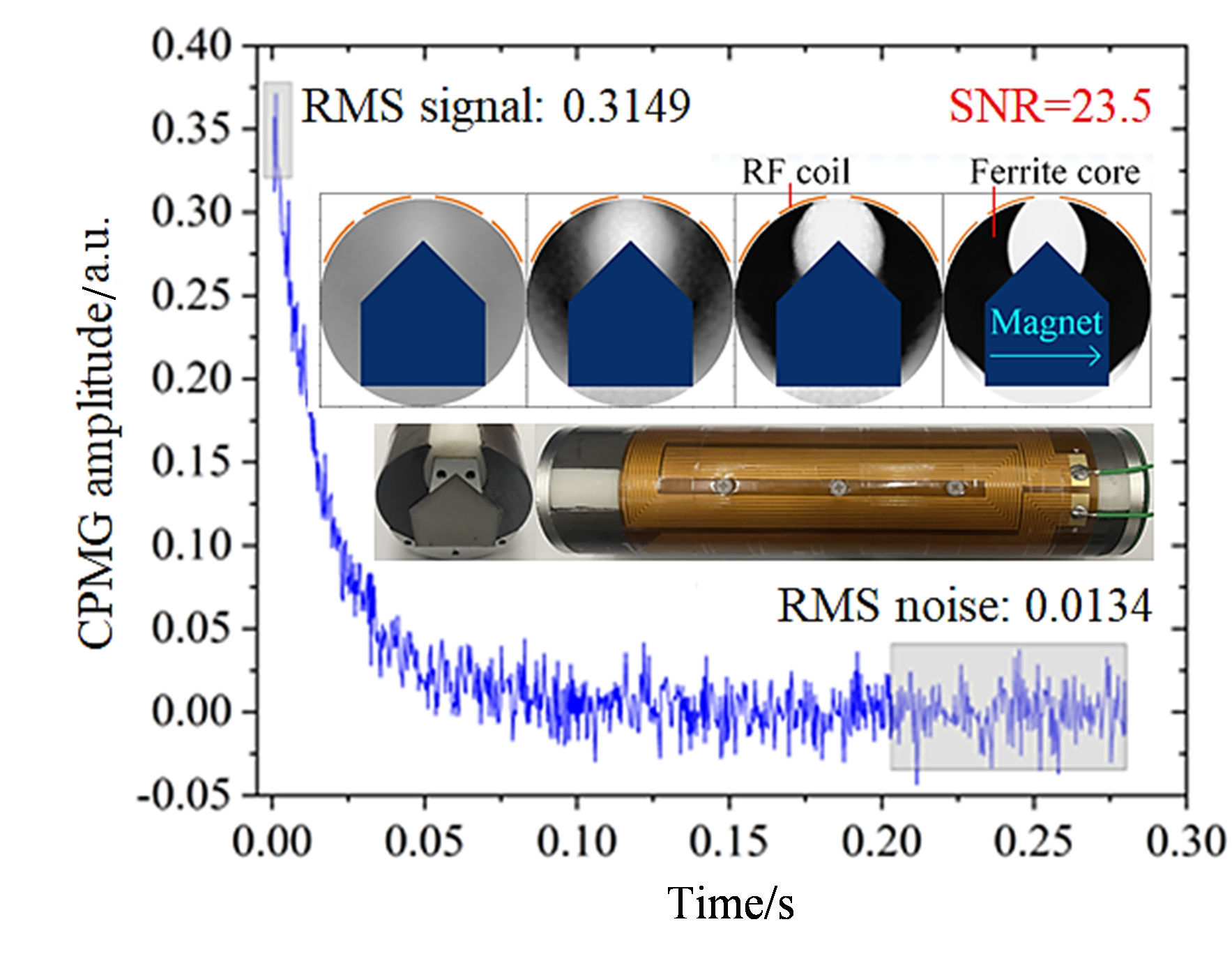
磁共振测井在石油探测中扮演着关键角色.磁体系统是磁共振测井传感器的一个重要组成部分.然而,目前的磁体系统设计通常依赖于经验结构,缺乏对最优结构的理论研究.本研究提出了一种基于变密度法拓扑优化的单侧磁共振测井传感器磁心结构设计方法,将测井探头二维截面模型的磁心设计域剖分为N个密度在0 ~ 1之间的小单元,应用梯度下降的移动渐近线法,基于目标函数对密度的梯度信息更新单元密度,迭代逐步逼近最优解.本文基于优化结果,制作了缩小比例的磁共振传感器样机,进行实验验证.传感器的外半径为2.5 cm,能够在远端感兴趣区域(ROI)内生成强度为641.0 ~ 1 108.6 G(1 G=10-4 T),梯度为303.0 ~ 683.6 G/cm的静态磁场.实测磁场分布数据与仿真优化设计的结果一致.在此基础上,对设计的磁共振测井传感器进行了水模测量实验,实验测得传感器的信噪比为23.5.
宋彦佐 , 于会媛 , 陈敬智 , 沈玥 , 徐显能 , 徐征 . 磁共振测井传感器磁体结构的拓扑优化方法[J]. 波谱学杂志, 2025 , 42(1) : 80 -88 . DOI: 10.11938/cjmr20243131
Magnetic resonance logging plays a pivotal role in petroleum exploration. The magnet system serves as a crucial component of the magnetic resonance logging sensor. However, current designs of magnet systems often rely on empirical structures and lack theoretical research on optimal configurations. This paper proposes a design method for the magnetic core structure of a single-side magnetic resonance logging sensor based on topology optimization using the variable density method. The design domain of the magnetic core in the two-dimensional cross-section model of the logging probe is divided into N small units with densities ranging from 0 to 1. The moving asymptote method of gradient descent is employed to update the density based on gradient information from the objective function, leading to an iterative approach for achieving an optimal solution. Based on these optimization results, a scaled-down prototype of the magnetic resonance sensor is fabricated for experimental verification. With an external radius of 2.5 cm, this sensor can generate a static magnetic field with intensities ranging from 641.0 G (1 G=10-4 T) to 1108.6 G and gradients from 303.0 G/cm to 683.6 G/cm within the remote region of interest (ROI). The measured data regarding magnetic field distribution aligns with simulation-based optimization results. Subsequently, water mode measurement experiments are conducted using this designed magnetic resonance logging sensor, yielding a signal-to-noise ratio of 23.5.
| [1] | KUANG L, LIU H, REN Y L, et al. Application and development trend of artificial intelligence in petroleum exploration and development[J]. Pet Explor Dev, 2021, 48(1): 1-14. |
| [2] | 肖立志, 谢然红, 廖广志. 中国复杂油气藏核磁共振测井理论与方法[M]. 北京: 科学出版社, 2012. |
| [3] | XIAO L Z, LUO S H, LONG Z H. Development history and prospect of wellsite nuclear magnetic resonance technology and its application[J]. Petroleum Drilling Techniques, 2023, 51(4): 1-9. |
| 肖立志, 罗嗣慧, 龙志豪. 井场核磁共振技术及其应用的发展历程与展望[J]. 石油钻探技术, 2023, 51(4): 1-9. | |
| [4] | HU H T, XIAO L Z, WU X L. Numerical method for probe design of nuclear magnetic resonance logging tool[J]. Acta Physica Sinica, 2012, 61(14): 580-587. |
| 胡海涛, 肖立志, 吴锡令. 核磁共振测井仪探头设计中的数值方法[J]. 物理学报, 2012, 61(14): 580-587. | |
| [5] | 罗嗣慧. 井周扫描核磁共振探头关键技术研究[D]. 北京: 中国石油大学(北京), 2020. |
| [6] | 朱金宝. 浅地表水文地质参数高分辨率磁共振测井系统关键技术研究[D]. 吉林: 吉林大学, 2022. |
| [7] | ASADI B, MOHAMADIAN M, SANI V E, et al. Magnet design of nuclear magnetic resonance system for well logging and geoscience applications[J]. Arab J Geosci, 2019, 12(24): 785. |
| [8] | LI Y, YANG S, REN Z. A methodology based on quantum evolutionary algorithm for topology optimization of electromagnetic devices[J]. IEEE Trans Magn, 2019, 55(6): 1-4. |
| [9] | LEE C, JANG I G. Topology optimization of the IPMSMsconsidering both the MTPA and FW controls under the voltage and current limitations[J]. IEEE Trans Ind Electron, 2023, 7(8): 8244-8253. |
| [10] | SATO H, IGARASHI H. Fast topology optimization for PM motors using variational autoencoder and neural networks with dropout[J]. IEEE Trans Magn, 2023, 59(5): 1-4. |
| [11] | WANG Q, GAO R, LIU S. Topology optimization based design of unilateral NMR for generating a remote homogeneous field[J]. J Magn Reson, 2017, 279: 51-59. |
| [12] | SHI G H, XIAO L Z, LIAO G Z, et al. A new method and circuit of ringing suppression for low-field NMR instruments[J]. Chinese J Magn Reso, 2023, 40(1): 68-78. |
| 师光辉, 肖立志, 廖广志, 等. 低场核磁共振仪器振铃抑制新方法及其电路实现[J]. 波谱学杂志, 2023, 40(1): 68-78. | |
| [13] | XU X, KONG X, XU Z. Topology optimization-based design of magnet system in unilateral NMR logging sensor considering coil efficiency[J]. IEEE Sens J, 2024, 24(15): 24006-24014. |
| [14] | GEUZAINE C, REMACLE J F. Gmsh: A 3-D finite element mesh generator with built-in pre- and post-processing facilities[J]. Int J Numer Meth Eng, 2009, 79(11): 1309-1331. |
| [15] | LEE H-B, IDA N. Interpretation of adjoint sensitivity analysis for shape optimal design of electromagnetic systems[J]. IET Sci Meas Technol, 2015, 9(8): 1039-1042. |
| [16] | SVANBERG K. The method of moving asymptotes—a new method for structural optimization[J]. Int J Numer Meth Eng, 1987, 24(2): 359-373. |
| [17] | DU Y, YAN S, ZHANG Y, et al. A modified interpolation approach for topology optimization[J]. Acta Mechanica Solida Sinica, 2015, 28(4): 420-430. |
| [18] | ZHANG Y, SONG Y Q, LUO S H, et al. Core analysis using nuclear magnetic resonance. petrophysics[J]. Petrophysics, 2024, 65(2): 173-193. |
| [19] | WANG Z L, ZHANG R, ZHANG N, et al. A high-precision processing method of two-dimensional NMR logging data based on component compensation[J]. Chinese J Magn Reson, 2022, 39(2): 174-183. |
| 王振林, 张融, 张妮, 等. 一种基于组分补偿的二维核磁共振测井数据高精度处理方法[J]. 波谱学杂志, 2022, 39(2): 174-183. |
/
| 〈 |
|
〉 |