

混合注意力和多尺度模块的阿尔茨海默病分类方法
收稿日期: 2024-10-14
网络出版日期: 2025-01-14
基金资助
上海市自然科学基金资助项目(18ZR1426900)
Hybrid Attention and Multiscale Module for Alzheimer's Disease Classification
Received date: 2024-10-14
Online published: 2025-01-14
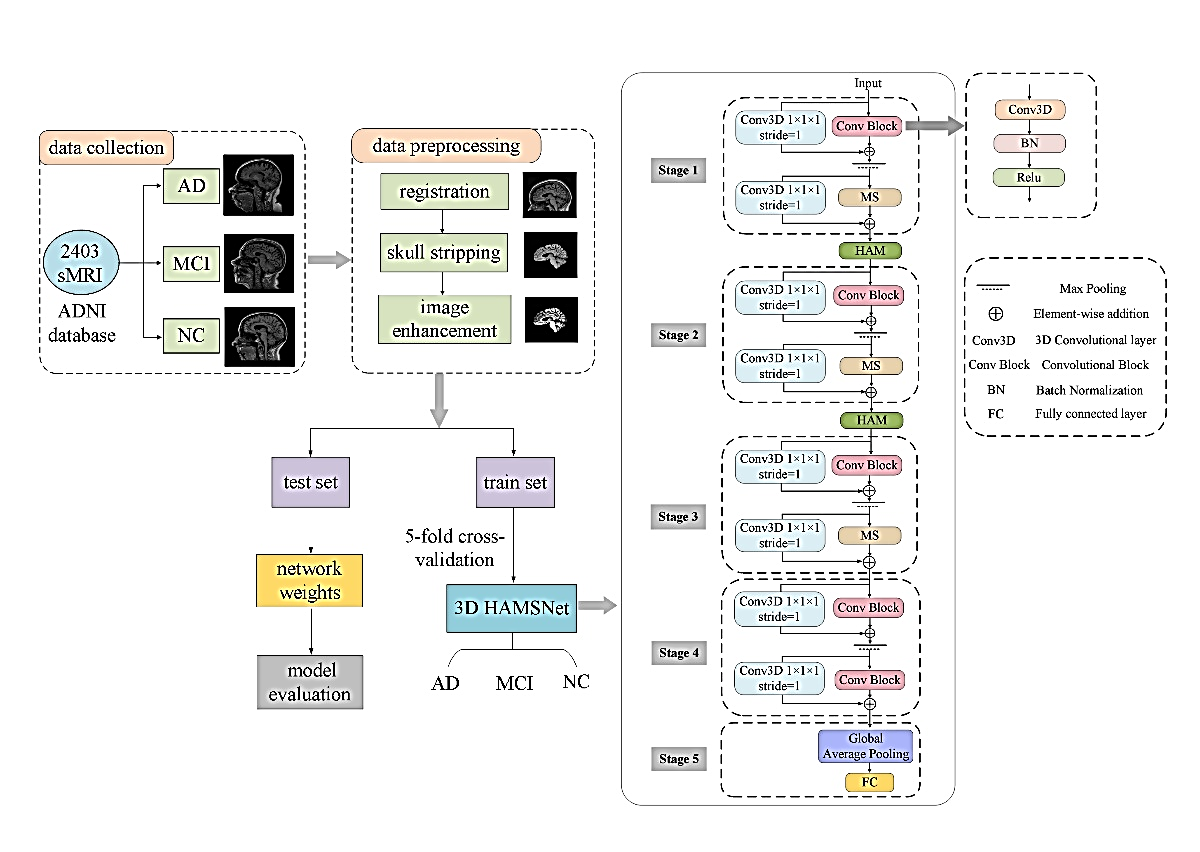
阿尔茨海默病是痴呆症中最常见的一种神经退行性疾病,其病程进展慢、影像学特征复杂多样,传统影像的阅片诊断过程非常耗时且准确率判断差异大.针对这一问题,本文提出了一种基于混合注意力和多尺度信息融合的分类方法(3D HAMSNet).该方法基于影像数据,利用卷积神经网络,通过引入混合注意力机制增强模型对海马体、杏仁核和颞叶等区域的关注,并利用基于空洞卷积和软注意力的多尺度信息融合模块有效融合阿尔茨海默病的多种空间尺度特征,从而提高对阿尔茨海默病的早期诊断和预测能力.在198名阿尔茨海默病患者、200名轻度认知障碍患者和139名健康对照组的三分类任务中,所提出的方法分类准确率、特异性和F1分数分别达到了 94.14%、97.07%和94.17%,相较于基线网络分别提升了9.88%、4.94%和10.17%.该方法相较现有分类方法表现突出,为阿尔茨海默病的早期诊断提供了新的方法.
顾佳佳 , 王远军 . 混合注意力和多尺度模块的阿尔茨海默病分类方法[J]. 波谱学杂志, 2025 , 42(2) : 103 -116 . DOI: 10.11938/cjmr20243132
Alzheimer's disease is the most common neurodegenerative disorder among dementia, characterized by slow disease progression and complex imaging features. Traditional image-based diagnostic processes are time-consuming and vary in accuracy. To address these challenges, this study proposes a novel classification method based on hybrid attention and multi-scale information fusion (3D HAMSNet). The method leverages image data and a convolutional neural network to enhance the model's attention to the hippocampus, amygdala, and temporal lobe through the introduction of a hybrid attention mechanism. Additionally, it integrates multiscale spatial scale features of Alzheimer's disease by using a multiscale information fusion module based on dilated convolution and soft attention, enhancing early diagnosis and prediction. Finally, tested on 198 Alzheimer's patients, 200 individuals with mild cognitive impairment, and 139 healthy controls, it achieved 94.14% accuracy, 97.07% specificity, and 94.17% F1 score—represented improvements of 9.88%, 4.94%, and 10.17% over the baseline. The method outperforms existing classification methods and provides a new approach for early Alzheimer's diagnosis.
| [1] | WANG Y Q, LIANG J H, JIA R X, et al. Alzheimer disease in China (2015-2050) estimated using the 1% population sampling survey in 2015[J]. Chinese Journal of Alzheimer's Disease and Related Disorders, 2019, 2(1): 289-298. |
| 王英全, 梁景宏, 贾瑞霞, 等. 2020-2050年中国阿尔茨海默病患病情况预测研究[J]. 阿尔茨海默病及相关病, 2019, 2(1): 289-298. | |
| [2] | XIA Z, YUE G, XU Y, et al. A novel end-to-end hybrid network for Alzheimer's disease detection using 3D CNN and 3D CLSTM[C]// 2020 IEEE 17th international symposium on biomedical imaging (ISBI). IEEE, 2020: 1-4. |
| [3] | QIAN C Y, WANG Y J. Research progress on imaging classification of Alzheimer’s disease based on deep learning[J]. Chinese J Magn Reson, 2023, 40(2): 220-238. |
| 钱程一, 王远军. 基于深度学习的阿尔兹海默症影像学分类研究进展[J]. 波谱学杂志, 2023, 40(2): 220-238. | |
| [4] | ZHANG F, TIAN S, CHEN S, et al. Voxel-based morphometry: improving the diagnosis of Alzheimer’s disease based on an extreme learning machine method from the ADNI cohort[J]. Neuroscience, 2019, 414: 273-279. |
| [5] | HUA X, LEOW A D, PARIKSHAK N, et al. Tensor-based morphometry as a neuroimaging biomarker for Alzheimer's disease: an MRI study of 676 AD, MCI, and normal subjects[J]. NeuroImage, 2008, 43(3): 458-469. |
| [6] | LIU M, ZHANG D, ADELI E, et al. Inherent structure-based multiview learning with multitemplate feature representation for Alzheimer's disease diagnosis[J]. IEEE T Biomed Eng, 2015, 63(7): 1473-1482. |
| [7] | ZHAO X, ZHANG X, LI X J, et al. Multimodal glioma segmentation with fusion of multiple self-attention and deformable convolutions[J]. Chinese J Magn Reson, 2023, 40(3): 280-292. |
| 赵欣, 张鑫, 李鑫杰, 等. 融合多重自注意力和可变形卷积的多模态脑胶质瘤分割[J]. 波谱学杂志, 2023, 40(3): 280-292. | |
| [8] | LI W, WANG Y, LIU Y. DMAF-Net: deformable multi-scale adaptive fusion network for dental structure detection with panoramic radiographs[J]. Dentomaxillofac Rad, 2024, 57(5):296-307. |
| [9] | DAI Z, YI J, YAN L, et al. Pfemed: Few-shot medical image classification using prior guided feature enhancement[J]. Pattern Recognit, 2023, 134: 109108. |
| [10] | JAIN R, JAIN N, AGGARWAL A, et al. Convolutional neural network based Alzheimer’s disease classification from magnetic resonance brain images[J]. Cogn Syst Res, 2019, 57: 147-159. |
| [11] | KANG W, LIN L, ZHANG B, et al. Multi-model and multi-slice ensemble learning architecture based on 2D convolutional neural networks for Alzheimer's disease diagnosis[J]. Comput Biol Med, 2021, 136: 104678. |
| [12] | PAYAN A, MONTANA G. Predicting Alzheimer's disease: a neuroimaging study with 3D convolutional neural networks[J]. arXiv preprint arXiv:1502.02506, 2015. |
| [13] | BAKKOURI I, AFDEL K, BENOIS-PINEAU J, et al. Recognition of Alzheimer's disease on sMRI based on 3D multi-scale CNN features and a gated recurrent fusion unit[C]// 2019 international conference on content-based multimedia indexing (CBMI), IEEE, 2019: 1-6. |
| [14] | YEE E, MA D, POPURI K, et al. Construction of MRI-based Alzheimer’s disease score based on efficient 3D convolutional neural network: Comprehensive validation on 7,902 images from a multi-center dataset[J]. J Alzheimer's Dis, 2021, 79(1): 47-58. |
| [15] | YU S, LIAO W H. An Alzheimer’s disease classification algorithm based on 3D-ResNet[J]. Comput Eng & Sci, 2020, 42(6): 1068-1075. |
| 郁松, 廖文浩. 基于3D-ResNet的阿尔兹海默症分类算法研究[J]. 计算机工程与科学, 2020, 42(6): 1068-1075. | |
| [16] | WOO S, PARK J, LEE J Y, et al. CBAM: convolutional block attention module[C]// Proceedings of the European conference on computer vision (ECCV), 2018: 3-19. |
| [17] | HE K, ZHANG X, REN S, et al. Deep residual learning for image recognition[C]// Proceedings of the IEEE conference on computer vision and pattern recognition, 2016: 770-778. |
| [18] | KWAK K, STANFORD W, DAYAN E, et al. Identifying the regional substrates predictive of Alzheimer's disease progression through a convolutional neural network model and occlusion[J]. Hum Brain Mapp, 2022, 43(18): 5509-5519. |
| [19] | RAJU M, THIRUPALANI M, VIDHYABHARATHI S, et al. Deep learning based multilevel classification of Alzheimer’s disease using MRI scans[C]// IOP Conference Series: Materials Science and Engineering. IOP Publishing, 2021, 1084(1): 012017. |
| [20] | QIU S, JOSHI P S, MILLER M I, et al. Development and validation of an interpretable deep learning framework for Alzheimer’s disease classification[J]. Brain, 2020, 143(6): 1920-1933. |
| [21] | HU J, SHEN L, SUN G. Squeeze-and-excitation networks[C]// Proceedings of the IEEE conference on computer vision and pattern recognition, 2018: 7132-7141. |
| [22] | WANG Q, WU B, ZHU P, et al. ECA-Net: Efficient channel attention for deep convolutional neural networks[C]// Proceedings of the IEEE/CVF conference on computer vision and pattern recognition, 2020: 11534-11542. |
| [23] | LIU Z, LU H, PAN X, et al. Diagnosis of Alzheimer’s disease via an attention-based multi-scale convolutional neural network[J]. Knowl-Based Syst, 2022, 238: 107942. |
| [24] | JACK JR C R, BERNSTEIN M A, FOX N C, et al. The Alzheimer's disease neuroimaging initiative (ADNI): MRI methods[J]. J Magn Reson Imaging, 2008, 27(4): 685-691. |
| [25] | JENKINSON M, BECKMANN C F, BEHRENS T E J, et al. FSL[J]. NeuroImage, 2012, 62(2): 782-790. |
| [26] | SELVARAJU R R, COGSWALL M, DAS A, et al. Grad-CAM: Visual explanations from deep networks via gradient-based localization[C]// Proceedings of the IEEE international conference on computer vision, 2017: 618-626. |
| [27] | SIMONYAN K, ZISSERMAN A. Very deep convolutional networks for large-scale image recognition[C]// International Conference on Learning Representations (ICLR), 2015: 1-14. |
| [28] | HUANG G, LIU Z, VAN Der MAATEN L, et al. Densely connected convolutional networks[C]// Proceedings of the IEEE conference on computer vision and pattern recognition, 2017: 4700-4708. |
| [29] | DOSOVITSKIY A, ALEXEY D, et al. An image is worth 16x16 words: Transformers for image recognition at scale[J]. arXiv preprint arXiv: 2010.11929, 2020. |
| [30] | TONG Y, LI Z, HUANG H, et al. Research of spatial context convolutional neural networks for early diagnosis of Alzheimer’s disease[J]. J Supercomput, 2024, 80(4): 5279-5297. |
/
| 〈 |
|
〉 |