

基于虚拟线圈和GRAPPA增强网络的PMRI方法
收稿日期: 2025-02-24
网络出版日期: 2025-04-24
基金资助
合肥综合性国家科学中心能源研究院(安徽省能源实验室)项目(24JYCD01);安徽高校协同创新项目(GXXT-2021-030);安徽高校协同创新项目(GXXT-2022-011)
PMRI Image Reconstruction Method Based on Virtual Coils and GRAPPA-enhanced Network
Received date: 2025-02-24
Online published: 2025-04-24
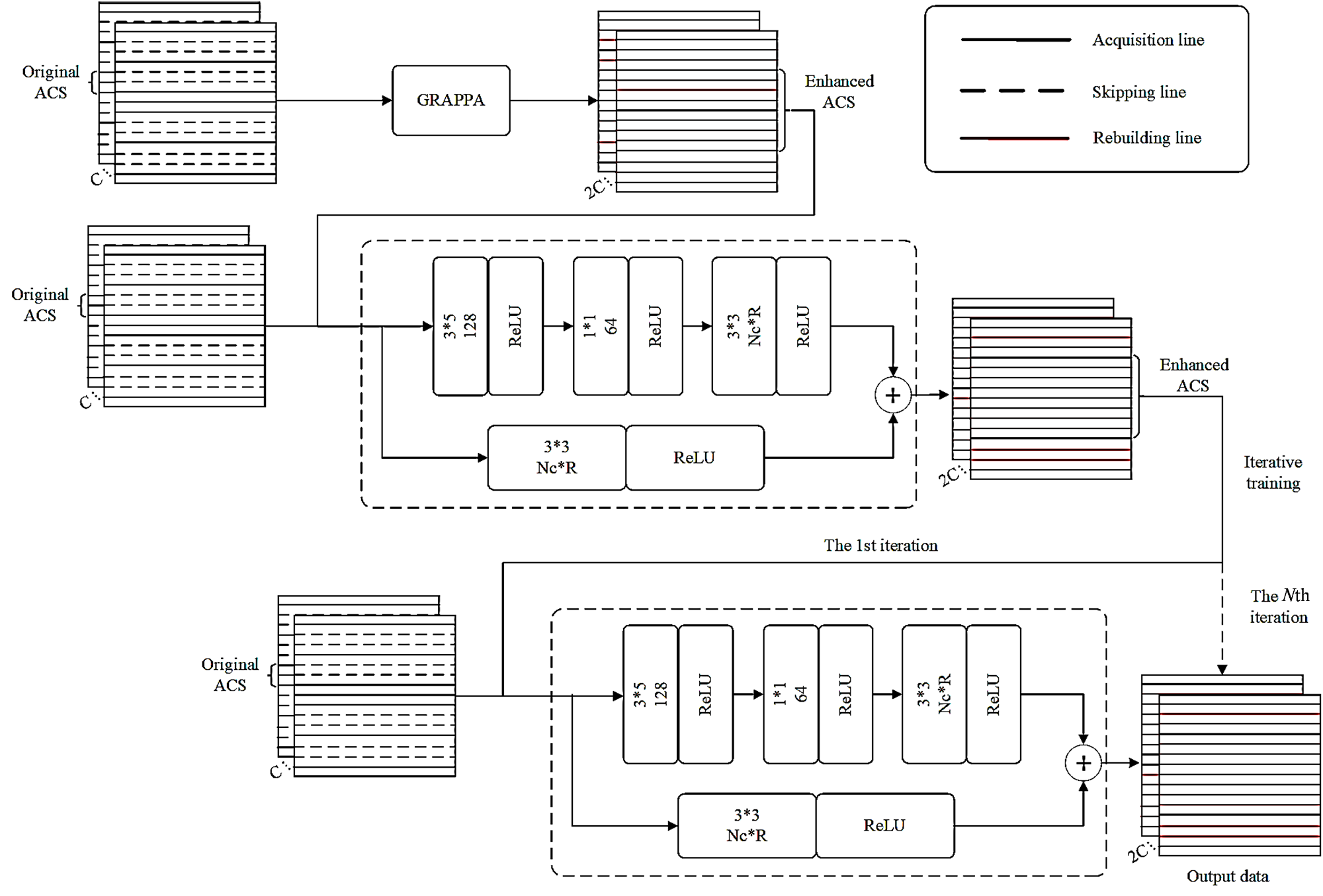
并行磁共振成像(PMRI)是一种通过多个接收线圈进行欠采样的成像技术,它利用空间信息补充梯度相位编码不足,通过特定算法重建无混叠图像,从而加速成像过程. 针对基于特定扫描的PMRI算法在有限数量的自动校准信号(ACS)下使用较高的加速因子会出现过拟合或泛化能力差的问题,提出一种基于虚拟线圈和GRAPPA增强网络的重建方法. 该方法通过使用虚拟共轭线圈扩充样本,并利用GRAPPA算法获得增强的ACS进行非线性的深度学习网络训练. 实验结果表明,提出的PMRI方法在较少ACS数量与较高加速因子的情况下,能够有效减少由于参考数据不足引起的混叠伪影,从而显著提高图像重建质量.
高照耀 , 张展 , 胡亮亮 , 许光宇 , 周胜 , 胡雨欣 , 林子捷 , 周超 . 基于虚拟线圈和GRAPPA增强网络的PMRI方法[J]. 波谱学杂志, 2025 , 42(4) : 390 -401 . DOI: 10.11938/cjmr20253147
Parallel magnetic resonance imaging (PMRI) is an imaging technique that uses multiple receiver coils for undersampling. It utilizes spatial information to supplement the insufficient gradient phase encoding and reconstructs aliasing-free images with specific algorithms to accelerate the imaging process. To address the issue of overfitting or poor generalization when using high acceleration factors with a limited number of auto calibration signals (ACS) in PMRI algorithms based on specific scans, a reconstruction method based on virtual coils and GRAPPA-enhanced networks is proposed. This method expands the sample by using virtual conjugate coils and enhances the ACS using the GRAPPA algorithm for training a nonlinear deep learning network. Experimental results show that the proposed PMRI method can effectively reduce aliasing artifacts caused by insufficient reference data, significantly improving image reconstruction quality with fewer ACS and higher acceleration factors.
| [1] | HUANG M, ZHU J L, KAO Y C, et al. Multi-coil MRI image reconstruction based on ISTAVS-Net of physical model[J]. Chinese J Magn Reson, 2024, 41(4): 418-429. |
| 黄敏, 朱俊琳, 考宇辰, 等. 基于物理模型的ISTAVS-Net多线圈MRI图像重建[J]. 波谱学杂志, 2024, 41(4): 418-429. | |
| [2] | CHEN W F. Parallel magnetic resonance imaging: past, present and future[J]. Chinese Journal of Biomedical Engineering, 2005, (6): 649-654. |
| 陈武凡. 并行磁共振成像的回顾、现状与发展前景[J]. 中国生物医学工程学报, 2005, (6): 649-654. | |
| [3] | LARKMAN D J, NUNES R G. Parallel magnetic resonance imaging[J]. Phys Med Biol, 2007, 52(7): R15. |
| [4] | PRUESSMANN K P, WEIGER M, SCHEIDEGGER M B, et al. SENSE: sensitivity encoding for fast MRI[J]. Magn Reson Med, 1999, 42(5): 952-962. |
| [5] | GRISWOLD M A, JAKOB P M, HEIDEMANN R M, et al. Generalized autocalibrating partially parallel acquisitions (GRAPPA)[J]. Magn Reson Med, 2002, 47(6): 1202-1210. |
| [6] | ZHAO T, HU X. Iterative GRAPPA (iGRAPPA) for improved parallel imaging reconstruction[J]. Magn Reson Med, 2008, 59(4): 903-907. |
| [7] | BLAIMER M, GUTBERLET M, KELLMAN P, et al. Virtual coil concept for improved parallel MRI employing conjugate symmetric signals[J]. Magn Reson Med, 2009, 61(1): 93-102. |
| [8] | WANG W T, SU S, JIA S, et al. Reconstruction of simultaneous multi-slice MRI data by combining virtual conjugate coil technology and convolutional neural network[J]. Chinese J Magn Reson, 2020, 37(4): 407-421. |
| 王婉婷, 苏适, 贾森, 等. 基于虚拟线圈和卷积神经网络的多层同时激发图像重建[J]. 波谱学杂志, 2020, 37(4): 407-421. | |
| [9] | FABIAN Z, TINAZ B, SOLTANOLKOTABI M. Humus-net: Hybrid unrolled multi-scale network architecture for accelerated MRI reconstruction[J]. Adv Neural Inf Process Syst, 2022, 35: 25306-25319. |
| [10] | GE R, YU X, CHEN Y, et al. Tc-kanrecon: High-quality and accelerated mri reconstruction via adaptive kan mechanisms and intelligent feature scaling[J]. arxiv preprint arxiv: 2408.05705, 2024. |
| [11] | AK?AKAYA M, MOELLER S, WEING?RTNER S, et al. Scan-specific robust artificial-neural-networks for k-space interpolation (RAKI) reconstruction: database-free deep learning for fast imaging[J]. Magn Reson Med, 2019, 81(1): 439-453. |
| [12] | ZHANG C, MOELLER S, DEMIREL O B, et al. Residual RAKI: A hybrid linear and non-linear approach for scan-specific k-space deep learning[J]. NeuroImage, 2022, 256: 119248. |
| [13] | ZHENG H R, WU Y, HE Q, et al. Fast and high-resolution magnetic resonance imaging on high field system[J]. Life Science Instruments, 2018, 16(Z1): 29-44+54. |
| 郑海荣, 吴垠, 贺强, 等. 基于高场磁共振的快速高分辨成像[J]. 生命科学仪器, 2018, 16(Z1): 29-44+54. | |
| [14] | KEBAILI A, LAPUYADE-LAHORGUE J, RUAN S. Deep learning approaches for data augmentation in medical imaging: a review[J]. J Imaging, 2023, 9(4): 81. |
| [15] | YU X, WANG J, HONG Q Q, et al. Transfer learning for medical images analyses: A survey[J]. Neurocomputing, 2022, 489: 230-254. |
| [16] | CHEN Y, YANG X H, WEI Z, et al. Generative adversarial networks in medical image augmentation: a review[J]. Comput Biol Med, 2022, 144: 105382. |
| [17] | GOODFELLOW I, POUGET-ABADIE J. Generative adversarial networks (GANs) for low-data MRI reconstruction[J]. Nat Mach Intell, 2019, 1(5): 236-245. |
| [18] | DENCK J, GUEHRING J, MAIER A, et al. Enhanced magnetic resonance image synthesis with contrast-aware generative adversarial networks[J]. J Imaging, 2021, 7(8): 133. |
| [19] | NING X Z, HUANG Z, CHEN X Q, et al. Research on transformer super-resolution reconstruction algorithmfor ultrafast spatiotemporal encoding magnetic resonance imaging[J]. Chinese J Magn Reson, 2024, 41(4): 454-468. |
| 宁欣宙, 黄臻, 陈西曲, 等. 用于超快时空编码MRI的Transformer超分辨率重建算法研究[J]. 波谱学杂志, 2024, 41(4): 454-468. | |
| [20] | ZHANG C, HOSSEINI S A H, WEING?RTNER S, et al. Optimized fast GPU implementation of robust artificial-neural-networks for k-space interpolation (RAKI) reconstruction[J]. PloS one, 2019, 14(10): e0223315. |
| [21] | ROEMER P B, EDELSTEIN W A, HAYES C E, et al. The NMR phased array[J]. Magn Reson Med, 1990, 16(2): 192-225. |
| [22] | WALSH D O, GMITRO A F, MARCELLIN M W. Adaptive reconstruction of phased array MR imagery[J]. Magn Reson Med, 2015, 43(5): 682-690. |
/
| 〈 |
|
〉 |