

基于对抗学习与交叉注意力的多任务阿尔茨海默病分类
收稿日期: 2025-05-31
网络出版日期: 2025-10-14
基金资助
上海市自然科学基金资助项目(18ZR1426900)
Multi-task Alzheimer's Disease Classification Based on Adversarial Learning and Cross-attention
Received date: 2025-05-31
Online published: 2025-10-14
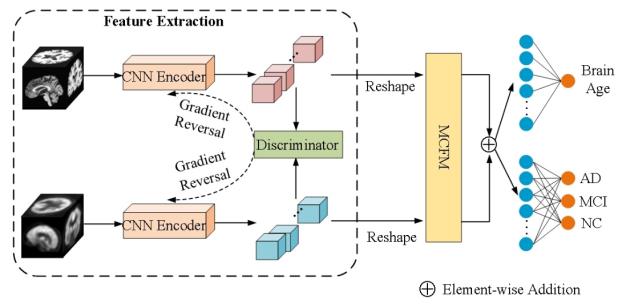
磁共振成像和正电子发射断层扫描是阿尔茨海默病早期诊断常用的成像技术.结合这两种模态可同时利用解剖和代谢信息更全面地评估大脑状态.然而,传统多模态融合主要通过通道拼接,未能充分利用模态间的互补信息,影响了模型的有效性.为此,本文提出了一种基于对抗学习与交叉注意力的多任务阿尔茨海默病分类模型.该模型通过对抗学习减少不同模态间的特征差异,并用交叉注意力进行特征融合,同时将脑龄预测任务作为辅助任务提升分类性能.实验结果表明,该方法在阿尔茨海默病、轻度认知障碍和正常对照分类任务中,准确率和F1分数分别达到91.10%和91.01%,这不仅提高了早期诊断的准确性,还增强了对疾病进展的监测能力,为阿尔茨海默病的临床干预提供重要支持.
顾佳佳 , 王远军 . 基于对抗学习与交叉注意力的多任务阿尔茨海默病分类[J]. 波谱学杂志, 2026 , 43(2) : 186 -199 . DOI: 10.11938/cjmr20253168
Magnetic resonance imaging (MRI) and positron emission tomography (PET) are commonly used imaging techniques for the early diagnosis of Alzheimer's disease (AD). The combination of these two modalities enables a more comprehensive assessment of brain status by utilizing both anatomical and metabolic information. However, traditional multimodal fusion, which relies primarily on simple channel splicing, fails to fully exploit the complementary information across modalities and limits the model's effectiveness. To address this, this paper proposes a multi-task classification model for AD based on adversarial learning and cross-attention. The model reduces inter-modal feature discrepancies through adversarial learning, followed by feature fusion via cross-attention, and introduces a brain age prediction task as an auxiliary task to improve classification performance. Experimental results demonstrate that the proposed method achieves an accuracy of 91.10% and an F1 score of 91.01% in classifying AD, mild cognitive impairment (MCI), and normal controls (NC). This not only enhances the accuracy of early diagnosis but also strengthens the ability to monitor disease progression, thereby providing strong support for clinical interventions in AD.
| [1] | ANDERSON N D. State of the science on mild cognitive impairment (MCI)[J]. CNS Spectrums, 2019, 24(1): 78-87. |
| [2] | CUMMINGS J, ZHOU Y, LEE G, et al. Alzheimer's disease drug development pipeline: 2023[J]. Alzh Dement-TRCI, 2023, 9(2): e12385. |
| [3] | BEACH T G, MONSELL S E, Phillips L E, et al. Accuracy of the clinical diagnosis of Alzheimer disease at National Institute on Aging Alzheimer Disease Centers, 2005-2010[J]. J Neuropathol Exp, 2012, 71(4): 266-273. |
| [4] | LIU H, JIN F, Zeng H, et al. Image enhancement guided object detection in visually degraded scenes[J]. IEEE T Neur Net Lear, 2024, 35(10): 14164-14177. |
| [5] | KONG Z, ZHANG M, ZHU W, et al. Multi-modal data Alzheimer’s disease detection based on 3D convolution[J]. Biomed Signal Proces, 2022, 75: 103565. |
| [6] | ZHANG F, LI Z, ZHANGH B, et al. Multi-modal deep learning model for auxiliary diagnosis of Alzheimer’s disease[J]. Neurocomputing, 2019, 361: 185-195. |
| [7] | MENG X, LIU J, FAN X, et al. Multi-modal neuroimaging neural network-based feature detection for diagnosis of Alzheimer’s disease[J]. Front Aging Neurosci, 2022, 14: 911220. |
| [8] | KUN H A N, HAIWEI P A N, WEI Z, et al. Alzheimer's disease classification method based on multi-modal medical images[J]. J Tsinghua Univ (Sci Technol), 2020, 60(8): 664-671,682. |
| [9] | SONG J, ZHENG J, LI P, et al. An effective multimodal image fusion method using MRI and PET for Alzheimer's disease diagnosis[J]. Front Digit Health, 2021, 3: 637386. |
| [10] | LOGAN R, WILLIAMS B G, FERREIRA DA SILVA M, et al. Deep convolutional neural networks with ensemble learning and generative adversarial networks for Alzheimer’s disease image data classification[J]. Front Aging Neurosci, 2021, 13: 720226. |
| [11] | ZHANG Y X, WU X H, TANG L L, et al. Alzheimer's disease classification method based on multimodal data[J]. J Comput Appl, 2023, 43(S2): 298. |
| 张昀枭, 吴晓红, 唐荔莉, 等. 基于多模态数据的阿尔兹海默病分类方法[J]. 计算机应用, 2023, 43(S2): 298. | |
| [12] | GU J J, WANG Y J. Hybrid attention and multiscale module for Alzheimer's disease classification[J]. Chinese J Magn Reson, 2025, 42(2): 103-116. |
| 顾佳佳, 王远军. 混合注意力和多尺度模块的阿尔茨海默病分类方法[J]. 波谱学杂志, 2025, 42(2): 103-116. | |
| [13] | VASWANI A, SHAZEER N, PARMAR N, et al. Attention is all you need[C]// Proceedings of the 31st International Conference on Neural Information Processing Systems, 2017: 6000-6010. |
| [14] | DOSOVITSKIY A, BEYER L, KOLESNIKOV A, et al. An image is worth 16x16 words: Transformers for image recognition at scale. arXiv (2021-06-03) [2025-05-30]. https://arxiv.org/abs/2010.11929. |
| [15] | ZHU J, TAN Y, LIN R, et al. Efficient self-attention mechanism and structural distilling model for Alzheimer’s disease diagnosis[J]. Comput Biol Med, 2022, 147: 105737. |
| [16] | KUSHOL R, MASOUMZADEH A, HUO D, et al. Addformer: Alzheimer’s disease detection from structural mri using fusion transformer[C]// 2022 IEEE 19th I Symp Biomed Imaging (ISBI). IEEE, 2022: 1-5. |
| [17] | KAUFMANN T, VAN DER MEER D, DOAN N T, et al. Common brain disorders are associated with heritable patterns of apparent aging of the brain[J]. Nat Neurosci, 2019, 22(10): 1617-1623. |
| [18] | SIMONYAN K, ZISSERMAN A. Very deep convolutional networks for large-scale image recognition[C]// International Conference on Learning Representations (ICLR). 2015: 1-14. |
| [19] | GOODFELLOW I, POUGET-ABADIE J, MIRZA M, et al. Generative adversarial nets[C]// Proceedings of the 28th International Conference on Neural Information Processing Systems, 2014, 2: 2672-2680. |
| [20] | CHEN C F R, FAN Q, PANDA R. Crossvit: Cross-attention multi-scale vision transformer for image classification[C]// 2021 IEEE/CVF International Conference on Computer Vision, Montreal, QC, Canada, 2021: 347-356. |
| [21] | JACK JR C R, BERNSTEIN M A, FOX N C, et al. The Alzheimer's disease neuroimaging initiative (ADNI): MRI methods[J]. J Magn Reson Imaging, 2008, 27(4): 685-691. |
| [22] | ESKILDSEN S F, COUPE P, GARCIA-LORENZO D, et al. Prediction of Alzheimer's disease in subjects with mild cognitive impairment from the ADNI cohort using patterns of cortical thinning[J]. NeuroImage, 2013, 65: 511-521. |
| [23] | JENKINSON M, BECKMANe C F, BEHRENS T E J, et al. FSL[J]. NeuroImage, 2012, 62(2): 782-790. |
| [24] | SELVARAJU R R, COGSWELL M, DAS A, et al. Grad-cam: Visual explanations from deep networks via gradient-based localization[C]// 2017 IEEE International Conference on Computer Vision, Venice, Italy, 2017: 618-626. |
| [25] | HUANG Y, XU J, ZHOU Y, et al. Diagnosis of Alzheimer’s disease via multi-modality 3D convolutional neural network[J]. Front Neurosci, 2019, 13: 509. |
| [26] | ZHANG M, SUN L, KONG Z, et al. Pyramid-attentive GAN for multimodal brain image complementation in Alzheimer’s disease classification[J]. Biomed Signal Process Control, 2024, 89: 105652. |
| [27] | ABUHMED T, El-SAPPAGH S, AlONSON J M. Robust hybrid deep learning models for Alzheimer’s progression detection[J]. Knowl-Based Syst, 2021, 213: 106688. |
/
| 〈 |
|
〉 |