

基于深度学习的低场NMR弛豫时间谱反演新方法
收稿日期: 2026-01-26
网络出版日期: 2026-08-11
基金资助
国家自然科学基金资助项目(22404165);国家自然科学基金资助项目(22374158);国家自然科学基金资助项目(22204168);国家自然科学基金资助项目(22574167);中国科学院战略性先导科技专项(XDB0540301);国家重大科研仪器研制项目(22327901)
A Deep Learning-based Method for LF-NMR Relaxation Time Spectrum Inversion
Received date: 2026-01-26
Online published: 2026-08-11
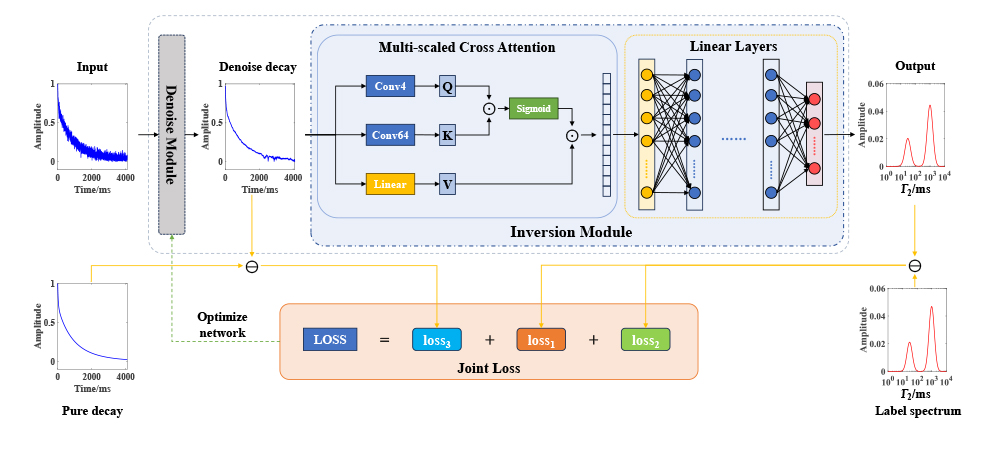
低场核磁共振(LF-NMR)弛豫时间谱检测技术在石油、地质勘探等领域应用广泛.然而,常规的NMR弛豫时间谱反演算法要求采集到的NMR时域信号具有较高的信噪比,这在很多实际应用场景(如现场岩心分析)下难以实现.因此,亟需发展能够对低信噪比信号实现准确稳定反演的新算法.针对这一问题,本文提出了基于深度学习的结合U-Net降噪和多尺度交叉注意力的反演网络(UDMCA),在该网络中创新性地融入了多尺度交叉注意力机制,针对NMR时域信号的衰减特性进行对应尺度的弛豫特征提取并交叉融合全局特征信息,以提升网络对低信噪比多组分信号的反演准确性.同时,在反演模块前引入U-Net去噪模块,进一步提升网络的抗噪鲁棒性.实验结果表明,该算法对信噪比为10~50的低信噪比信号能够实现准确且稳定的反演,并在岩心NMR信号反演中表现出良好的适用性,为低场低信噪比NMR数据的处理与反演提供了一种有效新方案.
刘可文 , 姜予康 , 陈方 , 陈俊飞 , 卢媛 , 陈黎 , 刘朝阳 . 基于深度学习的低场NMR弛豫时间谱反演新方法[J]. 波谱学杂志, 2026 , 43(3) : 307 -320 . DOI: 10.11938/cjmr20263201
Low-field nuclear magnetic resonance (LF-NMR) relaxation time spectrum analysis has been widely applied in petroleum engineering and geological exploration. However, conventional NMR relaxation time spectrum inversion algorithms require time-domain signals with high signal-to-noise ratios (SNRs), which are often difficult to obtain in practical scenarios such as on-site core analysis. To achieve accurate and stable inversion of low-SNR NMR signals, this paper proposes a deep learning-based inversion network named UDMCA (U-Net Denoising and Multi-scale Cross Attention Inversion Network), which incorporates a multi-scale cross-attention mechanism to extract and fuse relaxation features at multiple scales according to the decay characteristics of NMR signals, thereby improving inversion accuracy for low-SNR multi-component signals. In addition, a U-Net denoising module is introduced to further enhance noise robustness. Experimental results show that the proposed method achieves accurate and stable inversion for low-SNR signals and demonstrates good applicability in core NMR signal inversion, providing an effective solution for low-SNR LF-NMR data processing and inversion.
| [1] | GUO J C, ZHOU H Y, ZENG J, et al. Advances in low-field nuclear magnetic resonance (NMR) technologies applied for characterization of pore space inside rocks: a critical review[J]. Pet Sci, 2020, 17(5): 1281-1297. |
| [2] | FAJT M, MAZUR-ROSMUS W, STEFA?SKA A, et al. Chert outcrops differentiation by means of low-field NMR relaxometry[J]. Sci Rep, 2024, 14(1): 25280. |
| [3] | LU Y, LIU K, WANG Y. Applying NMR T2 spectral parameters in pore structure evaluation—an example from an Eocene low-permeability sandstone reservoir[J]. Appl Sci, 2021, 11(17): 8027. |
| [4] | MITCHELL J, HOWE A M, CLARKE A. Real-time oil-saturation monitoring in rock cores with low-field NMR[J]. J Magn Reson, 2015, 256: 34-42. |
| [5] | PRANGE M, SONG Y Q. Understanding NMR spectral uncertainty[J]. J Magn Reson, 2010, 204(1): 118-123. |
| [6] | 高汉宾, 张振芳. 核磁共振原理与实验方法[M]. 武汉: 武汉大学出版社, 2008. |
| [7] | TIKHONOV A N. On the solution of ill-posed problems and the method of regularization[J]. Dokl Akad Nauk SSSR, 1963, 151(3): 501-504. |
| [8] | BUTLER J P, REEDS J A, DAWSON S V. Estimating solutions of first kind integral equations with nonnegative constraints and optimal smoothing[J]. SIAM J Numer Anal, 1981, 18(3): 381-397. |
| [9] | DAY I J. On the inversion of diffusion NMR data: Tikhonov regularization and optimal choice of the regularization parameter[J]. J Magn Reson, 2011, 211(2): 178-185. |
| [10] | BECK A, TEBOULLE M. A fast iterative shrinkage-thresholding algorithm for linear inverse problems[J]. SIAM J Imaging Sci, 2009, 2(1): 183-202. |
| [11] | BERMAN P, LEVI O, PARMET Y, et al. Laplace inversion of low-resolution NMR relaxometry data using sparse representation methods[J]. Concepts Magn Reson Part A, 2013, 42(3): 72-88. |
| [12] | ZOU Y, XIE R, LIU M, et al. Nuclear magnetic resonance spectrum inversion based on the residual hybrid L1/L2 norm[J]. IEEE Geosci Remote Sens Lett, 2018, 15(8): 1194-1198. |
| [13] | LUO S H, XIAO L Z, JIN Y, et al. Low-field NMR inversion based on low-rank and sparsity restraint of relaxation spectra[J]. Pet Sci, 2022, 19(6): 2741-2756. |
| [14] | PARASRAM T, DAOUD R, XIAO D. T2 analysis using artificial neural networks[J]. J Magn Reson, 2021, 325: 106930. |
| [15] | LUO G, XIAO L Z, LUO S H, et al. A study on multi-exponential inversion of nuclear magnetic resonance relaxation data using deep learning[J]. J Magn Reson, 2023, 346: 107358. |
| [16] | CHEN B, WU L, CUI X, et al. High-quality reconstruction for Laplace NMR based on deep learning[J]. Anal Chem, 2023, 95(31): 11596-11602. |
| [17] | DEY K K, ASH J T, TREASE N M, et al. Trading sensitivity for information: Carr-Purcell-Meiboom-Gill acquisition in solid-state NMR[J]. J Chem Phys, 2010, 133(5): 054501. |
| [18] | WHITTALL K P, MACKAY A L. Quantitative interpretation of NMR relaxation data[J]. J Magn Reson, 1989, 84(1): 134-152. |
| [19] | RONNEBERGER O, FISCHER P, BROX T. U-Net: Convolutional networks for biomedical image segmentation[C]// Medical Image Computing and Computer-Assisted Intervention-MICCAI 2015. Cham: Springer, 2015: 234-241. |
| [20] | KOMATSU R, GONSALVES T. Comparing U-Net based models for denoising color images[J]. AI, 2020, 1(4): 465-486. |
/
| 〈 |
|
〉 |