
Chinese Journal of Magnetic Resonance ›› 2025, Vol. 42 ›› Issue (4): 445-456.doi: 10.11938/cjmr20253170cstr: 32225.14.cjmr20253170
• Review Article • Previous Articles
ZHANG Yuanyuan1, WANG Pengcheng1, LI Tao1, HU Rui1,2,*( ), YANG Yunhuang1,2, LIU Maili1,2
Received:2025-06-13
Published:2025-12-05
Online:2025-09-03
Contact:
* Tel: 027-87198318, E-mail: hurui@apm.ac.cn.
CLC Number:
ZHANG Yuanyuan, WANG Pengcheng, LI Tao, HU Rui, YANG Yunhuang, LIU Maili. Development and Applications of HDX-NMR and HDX-MS in Protein Structure and Dynamics Research[J]. Chinese Journal of Magnetic Resonance, 2025, 42(4): 445-456.
Add to citation manager EndNote|Reference Manager|ProCite|BibTeX|RefWorks
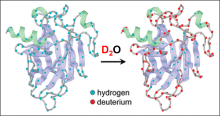
Fig. 1
Schematic illustration of the HDX principle[16]. The chemical exchange behavior between hydrogen (H) and deuterium (D) isotopes is utilized to probe the accessibility and dynamic properties of specific hydrogen atoms in protein molecules
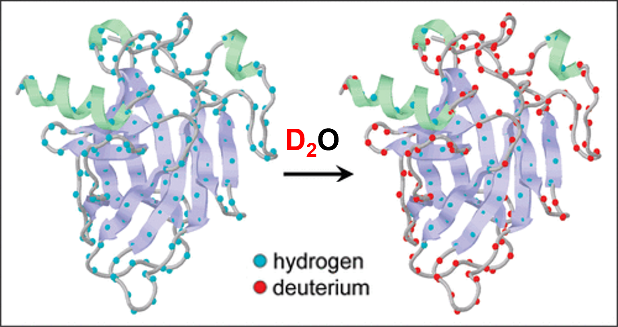
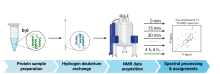
Fig. 2
HDX-NMR workflow, including protein sample preparation, hydrogen-deuterium exchange, NMR data acquisition, spectral processing and assignments


Fig. 3
HDX-MS workflow[21], including sample preparation, HDX labeling, quenching, enzymatic digestion, peptide separation by liquid chromatography (LC), MS analysis, HDX analysis, and data presentation


Table 1
Comparison of HDX-NMR and HDX-MS
| 比较维度 | HDX-NMR | HDX-MS |
|---|---|---|
| 技术原理 | HDX后蛋白质分子酰胺键上的H-N信号强度的衰减 | HDX后,酶解为肽段,通过MS检测质荷比变化 |
| 分辨率 | 单个氨基酸残基分辨率,定位精确 | 肽段级别分辨率,具体位点定位依赖酶解位点 |
| 结构信息 | 可提供构象变化、柔性区、相互作用位点等细节 | 可识别构象变化区域,但精细结构信息有限 |
| 实时动态监测 | 监测某一时间段的蛋白质分子信号的平均变化 | 需快速淬灭和冷冻,实时性相对较弱 |
| 样品处理 | 冻干重溶于重水,无需酶解,避免酶解引入偏差 | 需蛋白酶消化,可能引入序列覆盖度不全或选择性偏差 |
| 适用蛋白大小 | 分子量限制,通常适于 < 30 kDa的中小蛋白 | 可应用于大分子蛋白甚至多蛋白复合物 |
| 样品浓度要求 | 浓度要求高(通常 > 0.1 mmol/L) | 浓度要求低,适合高通量筛选 |
| 检测灵敏度 | 灵敏度相对较低 | MS灵敏度高,适合复杂样品和痕量检测 |
| 数据解析难度 | 谱图复杂,解析过程需要专业知识,周期较长 | 数据分析流程成熟,软件支持广泛,适合标准化处理 |
| 非破坏性 | 样品可重复使用,适合长期跟踪观察 | 酶解和MS过程不可逆,样品不可回收 |
| 典型应用 | 蛋白-配体结合、构象动态研究、弱相互作用分析 | 构象筛选、蛋白质稳定性、复合物交互界面快速分析 |

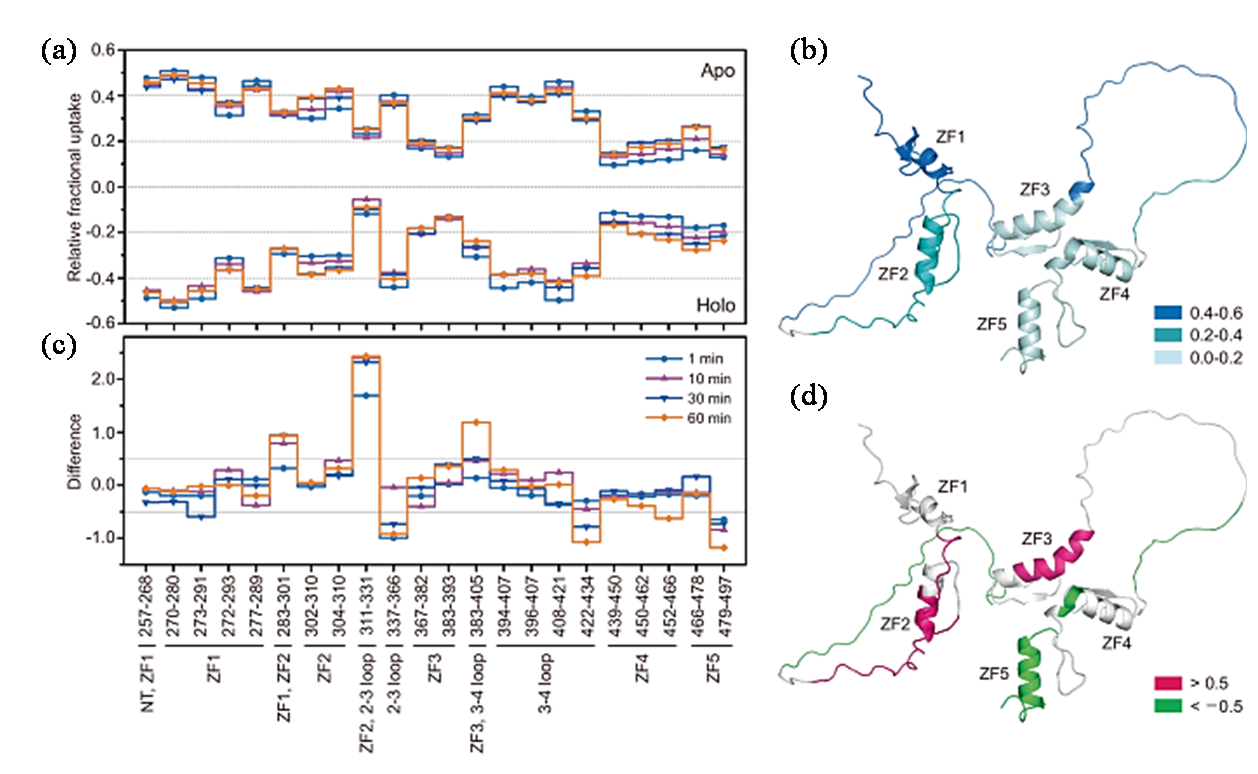
Fig. 4
HDX-MS reveals the highly dynamic conformational characteristics of INSM1 in binding to nucleic acids[43]. (a) A mirror plot of HDX-MS data comparing the relative deuterium uptake for each peptide of free INSM1 ZF1-ZF5 (Apo) and INSM1 ZF1-ZF5 bound by M2 DNA (Holo); (b) The relative deuterium uptake for each peptide of Apo INSM1 ZF1-ZF5 at 1 min was mapped on the structure of INSM1 ZF1-ZF5; (c) A difference plot of HDX-MS data showing the changes in relative deuterium uptake between Apo and Holo INSM1 ZF1-ZF5; (d) The segments of INSM1 ZF1-ZF5 with significant changes between Apo and Holo states at 60 min
| [1] |
CHAYEN N E. Turning protein crystallisation from an art into a science[J]. Curr Opin Struc Biol, 2004, 14(5): 577-583.
pmid: 15465318 |
| [2] |
WÜTHRICH K. NMR studies of structure and function of biological macromolecules (Nobel lecture)[J]. Angew Chem Int Ed, 2003, 42(29): 3340-3363.
doi: 10.1002/anie.v42:29 |
| [3] |
CHENG Y. Single-particle cryo-EM-How did it get here and where will it go[J]. Science, 2018, 361(6405): 876-880.
doi: 10.1126/science.aat4346 pmid: 30166484 |
| [4] |
HENZLER-WILDMAN K, KERN D. Dynamic personalities of proteins[J]. Nature, 2007, 450(7172): 964-972.
doi: 10.1038/nature06522 |
| [5] |
SPRANGERS R, KAY L E. Quantitative dynamics and binding studies of the 20S proteasome by NMR[J]. Nature, 2007, 445(7128): 618-622.
doi: 10.1038/nature05512 |
| [6] |
NOGALES E, SCHERES S H. Cryo-EM: A unique tool for the visualization of macromolecular complexity[J]. Mol Cell, 2015, 58(4): 677-689.
doi: 10.1016/j.molcel.2015.02.019 pmid: 26000851 |
| [7] |
NGUYEN T T, MARZOLF D R, SEFFERNICK J T, et al. Protein structure prediction using residue-resolved protection factors from hydrogen-deuterium exchange NMR[J]. Structure, 2022, 30(2): 313-320.e3.
doi: 10.1016/j.str.2021.10.006 |
| [8] |
PEACOCK R B, KOMIVES E A. Hydrogen/deuterium exchange and nuclear magnetic resonance spectroscopy reveal dynamic allostery on multiple time scales in the serine protease thrombin[J]. Biochemistry, 2021, 60(46): 3441-3448.
doi: 10.1021/acs.biochem.1c00277 pmid: 34159782 |
| [9] |
HEBLING C M, MORGAN C R, STAFFORD D W, et al. Conformational analysis of membrane proteins in phospholipid bilayer nanodiscs by hydrogen exchange mass spectrometry[J]. Anal Chem, 2010, 82(13): 5415-5419.
doi: 10.1021/ac100962c pmid: 20518534 |
| [10] |
ZHANG M M, HUANG R Y, BENO B R, et al. Epitope and paratope mapping of PD-1/nivolumab by mass spectrometry-based hydrogen-deuterium exchange, cross-linking, and molecular docking[J]. Anal Chem, 2020, 92(13): 9086-9094.
doi: 10.1021/acs.analchem.0c01291 pmid: 32441507 |
| [11] | LU H R, HUANG Q S. Hydrogen/deuterium exchange mass spectrometry and its application in the study of protein-protein interaction[J]. Biophys Rep, 2013, 29(11):811-822. |
| 陆海荣, 黄青山. 氢氘交换质谱技术及其在蛋白质相互作用研究中的应用[J]. 生物物理学报, 2013, 29(11): 811-822. | |
| [12] | HUANG J, LI H L. Application progress of hydrogen deuterium exchange mass spectrometry in structural study of proteins and protein complexes[J]. J Instrum Anal, 2020, 39(1): 57-67. |
| 黄静, 李惠琳. 氢氘交换质谱技术在蛋白质和蛋白复合物结构研究中的应用进展[J]. 分析测试学报, 2020, 39(1): 57-67. | |
| [13] | MA L Y, SUN H F, LIU J Y, et al. Application of hydrogen-deuterium exchange mass spectrometry technology in the field of protein drug research[J]. Life Sci Instrum, 2021, 19(3): 20-28. |
| 马凌云, 孙浩峰, 刘健仪, 等. 氢氘交换质谱技术在蛋白质类药物研究领域的应用[J]. 生命科学仪器, 2021, 19(3): 20-28. | |
| [14] |
KONERMANN L, PAN J, LIU Y H. Hydrogen exchange mass spectrometry for studying protein structure and dynamics[J]. Chem Soc Rev, 2011, 40(3): 1224-1234.
doi: 10.1039/c0cs00113a pmid: 21173980 |
| [15] | CHU I T, PIELA G J. Using NMR-detected hydrogen-deuterium exchange to quantify protein stability in cosolutes, under crowded conditions in vitro and in cells[J]. Magn Reson Lett, 2023(3): 319-326. |
| [16] |
ENGEN J R. Analysis of protein conformation and dynamics by hydrogen/deuterium exchange MS[J]. Anal Chem, 2009, 81(19), 7870-7875.
doi: 10.1021/ac901154s pmid: 19788312 |
| [17] |
LIU H, WANG D, ZHANG Q, ZHAO Y, et al. Parallel post-translational modification scanning enhancing hydrogen-deuterium exchange-mass spectrometry coverage of key structural regions[J]. Anal Chem, 2019, 91(11): 6976-6980.
doi: 10.1021/acs.analchem.9b01410 pmid: 31082219 |
| [18] |
SUN H, MA L, WANG L, et al. Research advances in hydrogen-deuterium exchange mass spectrometry for protein epitope mapping[J]. Anal Bioanal Chem, 2021, 413(9): 2345-2359.
doi: 10.1007/s00216-020-03091-9 pmid: 33404742 |
| [19] | WONG Z W, YANG D. Specific protein-urea interactions[J]. Magn Reson Lett, 2022(2): 131-138. |
| [20] |
SCHANDA P, BRUTSCHER B. Very fast two-dimensional NMR spectroscopy for real-time investigation of dynamic events in proteins on the time scale of seconds[J]. J Am Chem Soc, 2005, 127(22): 8014-8015.
pmid: 15926816 |
| [21] |
FENG Y C, AGRAWAL S, YANG C H, et al. The Structural and dynamic insights into the Ala97Ser amyloidogenic mutation in transthyretin[J]. Chem Asian J, 2025, 20(4): e202401438.
doi: 10.1002/asia.v20.4 |
| [22] |
YANAKA S, YAGI-UTSUMI M, KATO K, et al. The B domain of protein A retains residual structures in 6 M guanidinium chloride as revealed by hydrogen/deuterium-exchange NMR spectroscopy[J]. Protein Sci, 2023, 32(3): e4569.
doi: 10.1002/pro.4569 pmid: 36659853 |
| [23] |
BASAK S, NOBREGA R P, TAVELLA D, et al. Networks of electrostatic and hydrophobic interactions modulate the complex folding free energy surface of a designed βα protein[J]. Proc Natl Acad Sci U S A, 2019, 116(14): 6806-6811.
doi: 10.1073/pnas.1818744116 |
| [24] | SO P K. Hydrogen-deuterium exchange mass spectrometry for probing changes in conformation and dynamics of proteins[J]. Methods Mol Biol, 2021, 2199: 159-173. |
| [25] |
MCALLISTER R G, KONERMANN L. Challenges in the interpretation of protein h/d exchange data: a molecular dynamics simulation perspective[J]. Biochemistry, 2015, 54(16): 2683-2692.
doi: 10.1021/acs.biochem.5b00215 pmid: 25860179 |
| [26] |
ZHANG Z, ZHANG A, XIAO G. Improved protein hydrogen/deuterium exchange mass spectrometry platform with fully automated data processing[J]. Anal Chem, 2012, 84(11): 4942-4949.
doi: 10.1021/ac300535r pmid: 22571272 |
| [27] |
YU J, UZUNER U, LONG B, et al. Artificial intelligence-based HDX (AI-HDX) prediction reveals fundamental characteristics to protein dynamics: Mechanisms on SARS-CoV-2 immune escape[J]. iScience, 2023, 26(4): 106282.
doi: 10.1016/j.isci.2023.106282 |
| [28] |
MISTARZ U H, BELLINA B, JENSEN P F, et al. UV photodissociation mass spectrometry accurately localize sites of backbone deuteration in peptides[J]. Anal Chem, 2018, 90(2): 1077-1080.
doi: 10.1021/acs.analchem.7b04683 pmid: 29266933 |
| [29] |
BRODIE N I, HUGUET R, ZHANG T, et al. Top-down hydrogen-deuterium exchange analysis of protein structures using ultraviolet photodissociation[J]. Anal Chem, 2018, 90(5): 3079-3082.
doi: 10.1021/acs.analchem.7b03655 pmid: 29336549 |
| [30] |
HAYNES C A, KEPPEL T R, MEKONNEN B, et al. Inclusion of deuterated glycopeptides provides increased sequence coverage in hydrogen/deuterium exchange mass spectrometry analysis of SARS-CoV-2 spike glycoprotein[J]. Rapid Commun Mass Spectrom, 2024, 38(5): e9690.
doi: 10.1002/rcm.v38.5 |
| [31] |
HANSEN A B, SVEJDAL R R, AERTS J T, et al. Development of a thiol-ene microfluidic chip for hydrogen/deuterium exchange mass spectrometry (HDX-MS)[J]. Anal Chem, 2025, 97(24): 12503-12512.
doi: 10.1021/acs.analchem.4c06230 |
| [32] |
GRIFFITHS D, ANDERSON M, RICHARDSON K, et al. Cyclic ion mobility for hydrogen/deuterium exchange-mass spectrometry applications[J]. Anal Chem, 2024, 96(15): 5869-5877.
doi: 10.1021/acs.analchem.3c05753 pmid: 38561318 |
| [33] |
WOOD V E, KELLERMAN M A, GROVES K, et al. Investigation of the solid-state interactions in lyophilized human G-CSF using hydrogen-deuterium exchange mass spectrometry[J]. Mol Pharm, 2024, 21(4): 1965-1976.
doi: 10.1021/acs.molpharmaceut.3c01211 |
| [34] |
LAU A M, JIA R, BRADSHAW R T, et al. Structural predictions of the functions of membrane proteins from HDX-MS[J]. Biochem Soc Trans, 2020, 48(3): 971-979.
doi: 10.1042/BST20190880 |
| [35] |
STÄNDER S, SCARSELLI M, et al. Epitope mapping of polyclonal antibodies by hydrogen-deuterium exchange mass spectrometry (HDX-MS)[J]. Anal Chem, 2021, 93(34): 11669-11678.
doi: 10.1021/acs.analchem.1c00696 pmid: 34308633 |
| [36] |
CALVARESI V, WROBEL A G, TOPOROWSKA J, et al. Structural dynamics in the evolution of SARS-CoV-2 spike glycoprotein[J]. Nat Commun, 2023, 14(1): 1421.
doi: 10.1038/s41467-023-36745-0 pmid: 36918534 |
| [37] |
LOU S C, WETZEL S, ZHANG H, et al. The knotted protein UCH-L1 exhibits partially unfolded forms under native conditions that share common structural features with its kinetic folding intermediates[J]. J Mol Biol, 2016, 428(11): 2507-2520.
doi: 10.1016/j.jmb.2016.04.002 |
| [38] |
MOULICK R, DAS R, UDGAONKAR J B. Partially unfolded forms of the prion protein populated under misfolding-promoting conditions: characterization by hydrogen exchange mass spectrometry and NMR[J]. J Biol Chem, 2015, 290(42): 25227-25240.
doi: 10.1074/jbc.M115.677575 pmid: 26306043 |
| [39] |
UZAWA T, NISHIMURA C, AKIYAMA S, et al. Hierarchical folding mechanism of apomyoglobin revealed by ultra-fast H/D exchange coupled with 2D NMR[J]. Proc Natl Acad Sci U S A, 2008, 105(37): 13859-13864.
doi: 10.1073/pnas.0804033105 |
| [40] |
GELENTER M D, WANG T, LIAO S Y, et al. (2)H-(13)C correlation solid-state NMR for investigating dynamics and water accessibilities of proteins and carbohydrates[J]. J Biomol NMR, 2017, 68(4): 257-270.
doi: 10.1007/s10858-017-0124-7 |
| [41] |
KUWAJIMA K, YAGI-UTSUMI M, YANAKA S, et al. DMSO-quenched H/D-exchange 2D NMR spectroscopy and its applications in protein science[J]. Molecules, 2022, 27(12): 3748.
doi: 10.3390/molecules27123748 |
| [42] | NASER D, TARASCA M V, SIEBENEICHLER B, et al. High-resolution NMR H/D exchange of human superoxide dismutase inclusion bodies reveals significant native features despite structural heterogeneity[J]. Angew Chem Int Ed, 2022, 61(24): e202112645. |
| [43] |
ZHOU H, HE X, XIONG Y, et al. Structural insights into a highly flexible zinc finger module unravel INSM1 function in transcription regulation[J]. Nat Commun, 2025, 16(1): 2162.
doi: 10.1038/s41467-025-57478-2 |
| [44] |
HUANG R Y, IACOB R E, SANKARANARAYANAN S, et al. Probing conformational dynamics of tau protein by hydrogen/deuterium exchange mass spectrometry[J]. J Am Soc Mass Spectrom, 2018, 29(1): 174-182.
doi: 10.1007/s13361-017-1815-8 |
| [45] |
SEETALOO N, ZACHAROPOULOU M, STEPHENS A D, et al. Millisecond hydrogen/deuterium-exchange mass spectrometry approach to correlate local structure and aggregation in α-synuclein[J]. Anal Chem, 2022, 94(48): 16711-16719.
doi: 10.1021/acs.analchem.2c03183 |
| [46] |
SHAW A L, SURESH S, PARSON M A H, et al. Structure of calcineurin bound to PI4KA reveals dual interface in both PI4KA and FAM126A[J]. Structure, 2024, 32(11): 1973-1983.e6.
doi: 10.1016/j.str.2024.08.007 |
| [47] |
BAGGEN J, JACQUEMYN M, PERSOONS L, et al. TMEM106B is a receptor mediating ACE2-independent SARS-CoV-2 cell entry[J]. Cell, 2023, 186(16): 3427-3442.e22.
doi: 10.1016/j.cell.2023.06.005 pmid: 37421949 |
| [48] |
SHAH M B, JANG H H, et al. Effect of detergent binding on cytochrome P450 2B4 structure as analyzed by X-ray crystallography and deuterium-exchange mass spectrometry[J]. Biophys Chem, 2016, 216: 1-8.
doi: S0301-4622(16)30132-6 pmid: 27280734 |
| [49] |
LÉGER C, PITARD I, SADI M, et al. Dynamics and structural changes of calmodulin upon interaction with the antagonist calmidazolium[J]. BMC Biol, 2022, 20(1): 176.
doi: 10.1186/s12915-022-01381-5 pmid: 35945584 |
| [50] |
GRAUSLUND L R, CALVARESI V, PANSEGRAU W, et al. Epitope and paratope mapping by HDX-MS combined with SPR elucidates the difference in bactericidal activity of two anti-NadA monoclonal antibodies[J]. J Am Soc Mass Spectrom, 2021, 32(7): 1575-1582.
doi: 10.1021/jasms.0c00431 |
| [51] |
HAMACHI T, YANAI N. Recent developments in materials and applications of triplet dynamic nuclear polarization[J]. Prog Nucl Magn Reson Spectrosc, 2024, 142-143: 55-68.
doi: 10.1016/j.pnmrs.2024.05.001 |
| [52] |
HOBO F, TANIMOTO Y, ENDO Y, et al. 400 MHz/263 GHz ultra-low temperature MAS-DNP using a closed-cycle helium gas cooling system and a solid-state microwave source[J]. J Magn Reson, 2025, 373: 107842.
doi: 10.1016/j.jmr.2025.107842 |
| [53] |
BAHTI A, TELFAH A, HERGENRÖDER R, et al. NMR spectral editing, water suppression, and dipolar decoupling in low-field NMR spectroscopy using optimal control pulses and multiple-pulse sequence[J]. Anal Chem, 2025, 97(4): 1983-1991.
doi: 10.1021/acs.analchem.3c05226 |
| [54] |
CRAFT DL, SCHUYLER AD. NUS-tool: A unified program for generating and analyzing sample schedules for nonuniformly sampled NMR experiments[J]. J Magn Reson, 2023, 352: 107458.
doi: 10.1016/j.jmr.2023.107458 |
| [55] |
RAO KAKITA V M, BOPARDIKAR M, KUMAR SHUKLA V, et al. An efficient combination of BEST and NUS methods in multidimensional NMR spectroscopy for high throughput analysis of proteins[J]. RSC Adv, 2018, 8(32): 17616-17621.
doi: 10.1039/C8RA00527C |
| [56] |
BECKER J, KOOS M R M, SCHULZE-SÜNNINGHAUSEN D, et al. ASAP-HSQC-TOCSY for fast spin system identification and extraction of long-range couplings[J]. J Magn Reson, 2019, 300: 76-83.
doi: S1090-7807(18)30351-3 pmid: 30711785 |
| [1] | Yun-shan PEI, Cai ZHANG, Xiao-li LIU, Kai CHENG, Ze-ting ZHANG, Cong-gang LI. Inhibition of α-Synuclein Aggregation by the Interaction Between Protein Disulfide Isomerase and α-Synuclein [J]. Chinese Journal of Magnetic Resonance, 2022, 39(4): 381-392. |
| [2] | Qian XU,Lang CHEN,Xiang-ying HU,Cong-gang LI,Yi-xiang LIU,Ling JIANG. The Effect of T69E-mimicked Phosphorylation on the Interaction Between Bcl-2 and Nur77 [J]. Chinese Journal of Magnetic Resonance, 2022, 39(1): 87-95. |
| [3] | Chao-wei SHI,Pan SHI,Chang-lin TIAN. NMR Studies of Large Protein Dynamics Using Unnatural Amino Acids [J]. Chinese Journal of Magnetic Resonance, 2021, 38(4): 523-532. |
| [4] | XU Xiao-jun, WANG Shen-lin. Probing Membrane Protein Interactions by 19F Solid-State NMR [J]. Chinese Journal of Magnetic Resonance, 2019, 36(2): 238-251. |
| [5] | RAN Meng-lin, QIN Ling-yun, TANG Chun, DONG Xu. Regulation of Inter-Protein Interactions Between Ubiquitin and Ubiquitin-Associated Domains in Rad23A/Ubiquilin-1 by Phosphorylation [J]. Chinese Journal of Magnetic Resonance, 2019, 36(1): 15-22. |
| [6] | WANG Dan, LIU Yi-xiang, KOU Xin-hui, LIU Mai-li, JIANG Ling. NMR Studies on Key Residues That Affect Phosphorylation and Dephosphorylation Processes of Bacterial Response Regulator RR468 [J]. Chinese Journal of Magnetic Resonance, 2017, 34(4): 397-407. |
| [7] | SUN Yi, CHEN Yan-ke, LI Jian-ping, ZHAO Yong-xiang, YANG Jun. Efficiency of Double Cross Polarization in Magic-Angle Spinning Solid-State NMR Studies on Membrane Proteins [J]. Chinese Journal of Magnetic Resonance, 2017, 34(3): 257-265. |
| [8] | CHEN Yan-hua, ZHANG Ze-ting, BAI Jia, LIU Xiao-li, LIU Mai-li, LI Cong-gang. Inhibition Mechanisms of Protein Disulfide Isomerase on α-Synuclein Fibril Aggregation [J]. Chinese Journal of Magnetic Resonance, 2017, 34(2): 131-136. |
| [9] | LI Shuang-li, ZHU Qing-jun, LIU Mai-li, YANG Yun-huang. Characteristics of Protein NMR Resonances and Chemical Shift Assignments [J]. Chinese Journal of Magnetic Resonance, 2017, 34(2): 137-147. |
| [10] | WANG Hua-pu, ZHU Qin-jun, LIU Mai-li, YANG Yun-huang, YUE Xia-li. Expression,Purification and Characterization of the Zinc-Finger (4-5) Domain in Human Protein INSM1 [J]. Chinese Journal of Magnetic Resonance, 2017, 34(1): 1-7. |
| [11] | LI Hua, Yuji O. KAMATARI, Ryo KITAHARA, Kazuyuki AKASAKA. High-Pressure NMR for Studying Protein Structure and Dynamics [J]. Chinese Journal of Magnetic Resonance, 2016, 33(1): 1-26. |
| [12] | DAI Chen-ye, ZHANG Ze-ting, LIU Mai-li, LI Cong-gang. Application of NMR in the Studies of Structure and Interactions of α-Synuclein [J]. Chinese Journal of Magnetic Resonance, 2016, 33(1): 153-167. |
| [13] | HU Yun-fei1,2,HE Peng3,WU Yu-jie1,3,JIN Chang-wen1,2,3,4*. Solution Structure of Bacillus subtilis Twin-Arginine Translocation TatAy Protein [J]. Chinese Journal of Magnetic Resonance, 2015, 32(2): 291-307. |
| [14] | WEI Shu-yi, PAN Yun-ru, TSENG Tien-sheng, CHEN Chin-pan?. The Extended Loop Reduces Ca2+-Binding Affinity on the Tellurite Resistance Protein TerZ from Klebsiella penumoniae [J]. Chinese Journal of Magnetic Resonance, 2015, 32(2): 308-317. |
| [15] | KUMAR Sriramoju M , LYU Ping-chiang, HSU Shang-te Danny, . Structural Perturbation of the Parkinson´s Disease-Associated I93M Mutation in Human UCH-L1 Revealed by Solution State NMR Spectroscopy [J]. Chinese Journal of Magnetic Resonance, 2015, 32(2): 329-341. |
| Viewed | ||||||
|
Full text |
|
|||||
|
Abstract |
|
|||||
