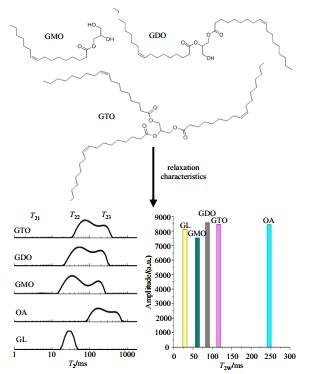
Low field-nuclear magnetic resonance (LF-NMR) relaxation characteristics of glyceride mixture can be used in rapid monitoring and product analysis of lipid remodeling processes. In this study, the LF-NMR relaxation properties of single or mixed glyceryl oleate with different esterification degrees were studied. The results indicated that three peaks appeared in the T2 relaxation map of glyceryl oleate. With increasing esterification degree or temperature, both the single component and multi-component relaxation time increased, and the ratios of peak area changed as well. The higher the esterification degree was, the larger the relaxation time changed. For the binary or ternary mixed glyceryl oleate systems, with the glycerol trioleate (GTO) ratio increased to 40%, the single and multi-component relaxation time, the peak area proportion S22 all increased, while the peak area proportion S23 decreased. Principal components analysis (PCA) showed that the LF-NMR relaxation characteristics of ternary system had regular distribution on the score plot with changing GTO ratio and glycerol dioleate (GDO)/glycerol monooleate(GMO) ratio.
CHENG Shi
,
WANG Xin
,
LIU Bao-lin
. Low Field-NMR Relaxation Characteristics of Glyceryl Oleate System[J]. Chinese Journal of Magnetic Resonance, 2018
, 35(2)
: 243
-254
.
DOI: 10.11938/cjmr20172597
[1] ROXANA R, MAMORU Y, YUGO I, et al. Enzymatic synthesis of symmetrical 1,3-diacylglycerols by direct esterification of glycerol in solvent-free system[J]. J Am Oil Chem Soc, 1999, 76(7):839-843.
[2] FELTES M M C, DE OLIVEIRA D, Block J M, et al. The Production, benefits, and applications of monoacylglycerols and diacylglycerols of nutritional interest[J]. Food Bioprocess Tech, 2013, 6(1):17-35.
[3] GUNSTONE F D. Lipid synthesis and manufacture[M]. Boca Raton:CRC Press. 1999.
[4] HAMMOND E W. Chromatography for the analysis of lipids. Chapter3. Thin layer chromatography[M]. Boca Raton:CRC Press. 1993.
[5] BLUMICH B, PERLO J, Casanova F. Mobile single-sided NMR[J]. Prog Nucl Mag Res Sp, 2008, 52(4):197-269.
[6] WANG Z Z, QIN L M, GAI S S, et a1. The effects of oil-mixed drilling fluid on oil layer identification studied by NMR spectroseopy[J]. Chinese J Magn Reson, 2014, 31(4):579-586. 王志战, 秦黎明, 盖姗姗, 等. 利用NMR技术判识混油钻井液条件下钻遇的油层[J]. 波谱学杂志, 2014, 31(4):579-586.
[7] DENG F, XIAO L Z, TAO Y, et a1. Low-field and on-line NMR detection for fluid molecular structure[J]. Chinese J Magn Reson, 2017, 34(2):214-222. 邓峰, 肖立志, 陶冶, 等. 低场核磁共振流体分子结构在线探测技术[J]. 波谱学杂志, 2017, 34(2):214-222.
[8] LU R S, ZHOU X L, WU W P, et al. Development of the miniature NMR apparatus for edible oil quality control[J]. Appl Magn Reson, 2014, 45(5):461-469.
[9] BERTRAM H C, WIKING L, NIELSEN J H, et al. Direct measurement of phase transitions in milk fat during cooling of cream-a low-field NMR approach[J]. Int Dairy J, 2005, 15(10):1056-1063.
[10] BERMAN P, MEIRI N, LUIZ A C, et al. Study of liquid-phase molecular packing interactions and morphology of fatty acid methyl esters (biodiesel)[J]. Biotechnol Biofuels, 2015, 8(1):12.
[11] CHALAND B, MARIETTE F, MARCHAL P, et al. H-1 nuclear magnetic resonance relaxometric characterization of fat and water states in soft and hard cheese[J]. J Dairy Res, 2000, 67(4):609-618.
[12] DI NICOLA G, PACETTI M, POLONARA F, et al. Development and optimization of a method for analyzing biodiesel mixtures with non-aqueous reversed phase liquid chromatography[J]. J Chromatogr A, 2008, 1190(1, 2):120-126.
[13] HARTEL R W. Crystallization in Foods[M]. The United States:Aspen Publishers, 1988.
[14] LARSSON K, FRIBERG SE, LARSSO K, et al. Molecular organization in lipids and emulsions[M]. UK:CABI press, 2004.
[15] NICOLAAS B, PURCELL E M, POUND R V. Relaxation effects in nuclear magnetic resonance absorption[J]. Phys Rev, 1948, 73(7):679-712.

