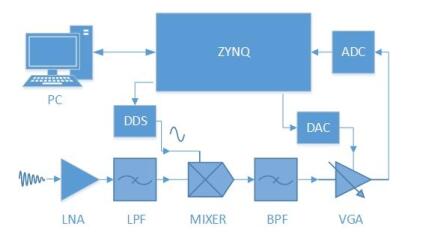
This paper presents the design of a magnetic resonance signal receiving system based on all programmable SoC (System-on-a-Chip) and LabVIEW (Laboratory Virtual Instrument Engineering Workbench). Using the all programmable SoC that integrates ARM (Advanced RISC Machines) and FPGA (Field Programmable Gate Array) as the main chips of the receiver, the DDC (Digital Down Converter) algorithm was designed using System Generator, a DSP (Digital Signal Processing) development tool provided by Xilinx, and the receiver hardware circuit designed by the authors. The visual programming platform LabVIEW was used to design the magnetic resonance upper computer software. Display, storage and communication of the magnetic resonance signals were done with the receiver. Experimental results showed that the receiver designed could receive magnetic resonance echo signals correctly and provided a high signal-to-noise ratio. Using LabVIEW to design magnetic resonance software on personal computers significantly improved software development efficiency.
LIU Ying
,
SONG Ming-hui
,
WANG Kun
,
ZHANG Hao-wei
. A Magnetic Resonance Receiver System Design Based on All Programmable System-on-a-Chip and LabVIEW[J]. Chinese Journal of Magnetic Resonance, 2018
, 35(4)
: 475
-485
.
DOI: 10.11938/cjmr20182647
[1] REN J J, XU Q, LI G Y. A digital receiver for nuclear magnetic resonance spectrometer[J]. Chinese J Magn Reson, 2007, 24(1):27-33. 任洁静, 徐勤, 李鲠颖. 一体化核磁共振数字接收机设计[J]. 波谱学杂志, 2007, 24(1):27-33.
[2] 周鹏, 许钢. 精通LabVIEW信号处理[M]. 北京:清华大学出版社, 2013.
[3] 高瑜翔主编. 高频电子线路[M]. 北京:科学出版社, 2008.
[4] AD8099 datasheet[EB]. Analog Devices, 2016.
[5] AD831 datasheet[EB]. Analog Devices, 2003.
[6] HU Z Q, JIN T, ZHANG X M. Receiving MRI echo with software-defined radio approach[J]. Chinese J Magn Reson, 2013, 30(1):29-39. 胡曾千, 金涛, 章新明. 用软件无线电方法实现MRI回波信号接收[J]. 波谱学杂志, 2013, 30(1):29-39.
[7] LIU Y, ZHANG Y W, LIANG Z, et al. A heterogeneous dual-core receiver system for magnetic resonance applications[J]. Chinese J Magn Reson, 2017, 34(1):100-107. 刘颖, 张育文, 梁浈, 等. 基于异构双核的磁共振接收机设计[J]. 波谱学杂志, 2017, 34(1):100-107.
[8] AD8331 datasheet[EB]. Analog Devices, 2010.
[9] DAC101C08XX datasheet[EB]. TEXAS INSTRUMENTS, 2016.
[10] LM4121 datasheet[EB]. TEXAS INSTRUMENTS, 2013.
[11] ADS805 datasheet[EB]. TEXAS INSTRUMENTS, 2002.
[12] TPS7A4901 datasheet[EB]. TEXAS INSTRUMENTS, 2015.
[13] TPS7A3001 datasheet[EB]. TEXAS INSTRUMENTS, 2015.
[14] 纪志成, 高春能. FPGA数字信号处理设计教程-System Generator入门与提高[M]. 西安:西安电子科技大学出版社, 2008.
[15] HU J J,YAO J J, XU J C, et al. A magnetic resonance imaging receiver design based on NI PXIe-7966R[J]. Chinese J Magn Reson, 2017, 34(4):489-497. 胡晋杰, 姚俊江, 徐俊成, 等. 基于NI PXIe-7966R的磁共振成像接收机设计[J]. 波谱学杂志, 2017, 34(4):489-497.
[16] WANG H, SUN H Y, TANG W N, et al. An FPGA-based multi-chanel receiver module for magnetic resonance imaging[J]. Chinese J Magn Reson, 2012, 29(2):239-247. 王洪, 孙宏宇, 汤伟男, 等. 基于单片FPGA的多通道磁共振成像接收模块[J]. 波谱学杂志, 2012, 29(2):239-247.
[17] FT245R datasheet[EB]. Future Technology Devices International Limited, 2010.

