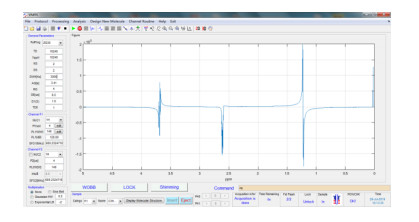
Nuclear magnetic resonance (NMR) spectroscopy is an important tool for studying the structures of molecules and materials. Mainly due to their high costs, the NMR spectrometers are often not available for teaching experiments. Teaching NMR experiments cannot be performed routinely and effectively also because that the students are not able to understand the principles underlying the operational steps without proper and adequate training. In this work, a virtual NMR spectrometer (VMRS1.0) for teaching experiments, which is based on numerical computational simulation technology and can be operated like a real spectrometer, is presented. With the VMRS1.0, the students can perform basic NMR experiments, including tuning, shimming, field lock, power adjustment for radio frequency, selecting samples, acquiring data, fast Fourier transform and spectrum processing (i.e., phase correction, integration, chemical shift correction, auto peak finding and J-coupling constant measurement). In addition to the routine one-dimensional NMR experiments, more complicated experiments such as decoupling, DEPT and HMQC can also be performed on the VMRS1.0. With the virtual NMR spectrometer developed, the students can practice their experimental skills and gain deeper understandings of the underlying principles in a more easy and cost-efficient way.
WANG Hong-zhi
,
WANG Shen-lin
,
HU Bin-wen
,
YU Yi-hua
,
SONG Yi-qiao
,
YAO Ye-feng
. A Virtual NMR Spectrometer Based on Numerical Computational Simulations[J]. Chinese Journal of Magnetic Resonance, 2019
, 36(3)
: 288
-297
.
DOI: 10.11938/cjmr20182684
[1] GUNTER P, SCHAEFER N, OTTING G, et al. POMA:a complete mathematica implementation of the NMR product operator formalism[J]. J Magn Reson A, 1993, 101(4):103-105.
[2] SMITH S A, LEVANTE T O, MEIER B H, et al. Computer simulations in magnetic resonance:an object-oriented programming approach[J]. J Magn Reson A, 1994, 106(1):75-105.
[3] ALLMAN T, BAIN A D, GARBOW J R. SIMPLTN:a program for the simulation of pulse NMR spectra[J]. J Magn Reson A, 1996, 123(1):26-31.
[4] JERSCHOW A, MULLER N. Efficient simulation of coherence transfer pathway selection by phase cycling and pulsed field gradients in NMR[J]. J Magn Reson, 1998,134(1):17-29.
[5] MERSI G H, CUPERLOVIC M, PALKE W E, et al. Pulsed field gradients in simulations of one-and two-dimensional NMR spectra[J]. J Magn Reson, 1999, 137(1):186-195.
[6] JIN F Z, CHEN H W, ZHOU R X, et al. Experimental simulation of the Unruh effect on an nuclear magnetic resonance (NMR) quantum simulator[J]. Science China:Physics, Mechanics and Astronomy, 2016, 59(3):1-8.
[7] TOSNER Z, ANDERSON R, STEVENSON B. SIMPSON:A general program for solid-state NMR spectroscopy[J]. J Magn Reson, 2000, 147(2):296-330.
[8] SCHATS P. NMR Simulator[J]. J Chem Edu, 1988, 65(4):296-297.
[9] NICOLAS P, FUSHMAN D, RUCHINSKY V, et al. The virtual NMR spectrometer:a computer program for efficient simulation of NMR experiments involving pulsed field gradients[J]. J Magn Reson. 2000, 145(2):262-275.
[10] KEELER J. Understanding NMR spectroscopy[M]. London:Wiley, 2002:80-118.

