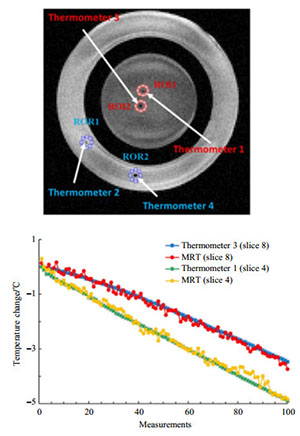
High-intensity focused ultrasound (HIFU) is a noninvasive thermal ablation therapy. Thermometry techniques with high precision and temporal resolution are needed to ensure the safety and effectiveness of HIFU. The magnetic resonance thermometry (MRT) technique based on proton resonance frequency shift (PRFS) shows good linearity with and high sensitivity to temperature change, and is frequently used in HIFU therapy. In practice, HIFU may have a potential danger of causing unwanted skin burns far away from the focus of ultrasound irradiation. It is therefore desirable to increase the spatial coverage of MRT measurements to include the skins. In this work, a fast three-dimensional (3D) MRT technique was developed based on an echo-shifted gradient-recalled sequence with controlled aliasing in volumetric parallel imaging. Phantom experiments were first used to calibrate the accuracy and precision of temperature measurements made by the proposed technique to those obtained by an optical fiber thermometer. Pork tissues were then scanned at room temperature to determine the precision of temperature measurements before and after imaging acceleration. The pork tissues were also scanned under the condition of HIFU heating to compare the accuracy of temperature measurements with or without imaging acceleration.
JIANG Rui
,
ZOU Chao
,
QIAO Yang-zi
,
XU Zong-wei
,
QIU Zhi-lang
,
LIU Xin
,
ZHENG Hai-rong
. Fast Three-Dimensional Magnetic Resonance Thermometry Using an Echo-Shifted Gradient-Recalled Sequence[J]. Chinese Journal of Magnetic Resonance, 2019
, 36(3)
: 253
-260
.
DOI: 10.11938/cjmr20182699
[1] WU Z Q, KUMON R E, LAUGHNER J I, et al. Electrophysiological changes correlated with temperature increases induced by high-intensity focused ultrasound ablation[J]. Ultrasound Med Biol, 2015, 41(2):432-448.
[2] NING R P, ZHU Y, LI G Y. A simple MR-compatible thermometer:design and applications[J]. Chinese J Magn Reson, 2010, 27(2):157-162. 宁瑞鹏, 朱岩, 李鲠颖. 一种简单的MR兼容测温装置[J]. 波谱学杂志, 2010, 27(2):157-162.
[3] PALOMBO C, MALSHI E, MORIZZO C, et al. Arterial wave reflection during antihypertensive therapy with barnidipine:a 6-month, open-label study using an integrated cardiovascular ultrasound approach in patients with newly diagnosed hypertension[J]. Clin Ther, 2009, 31(12):2873-2885.
[4] MOONEN C T, LIU G, VAN G P, et al. A fast gradient-recalled MRI technique with increased sensitivity to dynamic susceptibility effects[J]. Magn Reson Med, 1992, 26(1):184-189.
[5] CURTIS S L, ZAMBANINI A, MAYET J, et al. Reduced systolic wave generation and increased peripheral wave reflection in chronic heart failure[J]. Am J Physiol Heart Circ Physiol, 2007, 293(1):H557-H562.
[6] CHUNG Y C, DUERK J L. Signal formation in echo-shifted sequences[J]. Magn Reson Med, 1999, 42(5):864-875.
[7] BANKSON J A, STAFFORD R J, HAZLE J D. Partially parallel imaging with phase-sensitive data:Increased temporal resolution for magnetic resonance temperature imaging[J]. Magn Reson Med, 2005, 53(3):658-665.
[8] BREUER F A, BLAIMER M, MUELLER M F, et al.Controlled aliasing in volumetric parallel imaging (2D CAIPIRINHA)[J]. Magn Reson Med, 2006, 55(3):549-556.
[9] DE P J, DE W C, DE D Y, et al. Noninvasive MRI thermometry with the proton resonance frequency (PRF) method:in vivo results in human muscle[J]. Magn Reson Med, 1995, 33(1):74-81.
[10] CHUNG Y C, DUERK J L, SHANKARANARAYANAN A, et al. Temperature measurement using echo-shifted FLASH at low field for interventional MRI[J]. J Magn Reson Imaging, 1999, 9(1):138-145.
[11] DENOLIN V, AZIZIEH C, METENS T. New insights into the mechanisms of signal formation in RF-spoiled gradient echo sequences[J]. Magn Reson Med, 2005, 54(4):937-954.
[12] BORMAN P T, BOS C, DE B T, et al. Towards real-time thermometry using simultaneous multislice MRI[J]. Phys Med Biol, 2016, 61(17):N461-N477.
[13] PENG Y H, ZOU C, QIAO Y Z. Fast MR thermometry using an echo-shifted sequence with simultaneous multi-slice imaging[J]. Magn Reson Mater Phy, 2018, 31(6):771-779.

