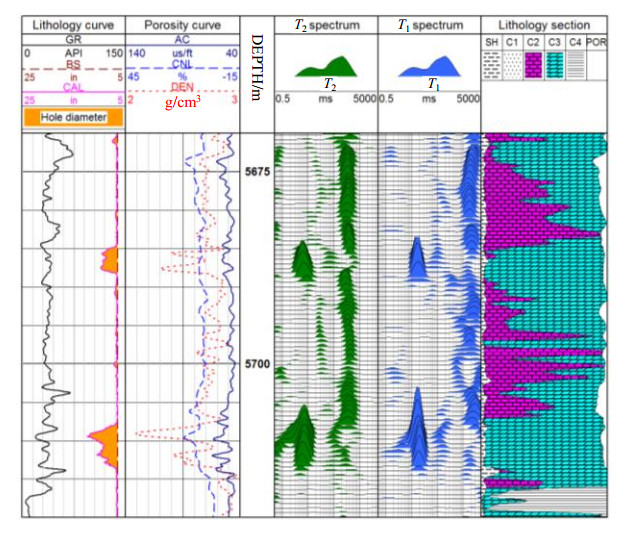
Formation porosity can be calculated from one-dimensional nuclear magnetic resonance (NMR) logging data with a fixed cutoff value and the volume model of conventional logging data. However, the porosity calculated with this method often appears to be overestimated in the enlarged hole section. In this work, the calculation methods for T2 and T1 nuclear magnetic porosity from NMR results of core samples and two-dimensional NMR logging data were investigated. Firstly, the characteristics of NMR relaxation spectra of fluids at different pore sizes were obtained and used to analyze the distribution range of pore diameter and affecting factors of the cutoff value of the drilling fluid peak. A model for estimating the cutoff value of the drilling fluid relaxation time was then established. A method for calculating the effective porosity was then proposed with variable cutoff value of clay bond water relaxation time, according to the deterministic principle about cutoff value of clay bond water relaxation time in un-enlarged and enlarged hole section. The method proposed was applied to the data from many wells, and demonstrated better accuracy than the traditional method using T1 distribution spectra. The method can effectively solve the problem of overestimated porosity in the enlarged hole section and meet the requirement for reservoir evaluation.
HOU Ke-jun
,
WU Jian-meng
,
GE Xiang
,
ZHANG Shi-mao
. Calculating Porosity From Two-Dimensional NMR Relaxation Spectra of the Leikoupo Group's 4th Section[J]. Chinese Journal of Magnetic Resonance, 2020
, 37(2)
: 162
-171
.
DOI: 10.11938/cjmr20192708
[1] HAMAD S, MESHAL A, M.NASER, et al. Uncertainty of porosity measurement correlations using NMR and conventional logging in carbonate reservoirs[C]//International Petroleum Technology Conference, Doha Qatar, 2014:19-22.
[2] HASSALL J K, ZAKARIA A S, SHTEPANI E. Evaluation of porosity and permeability in lower cretaceous carbonates in UAE using NMR measurements at laboratory and reservoir conditions[C]//International Petroleum Exhibition & Conference. Society of Petroleum Engineers, 2016, Abu Dhabi, 2016:7-10.
[3] CHEN J H, ZHANG J L, ARVE K, et al. Method for correcting NMR porosity in formate brine-invaded formations[C]//SPWLA 52nd Annual Logging Symposium. Society of Petrophysicists and Well-Log Analysts, 2011:14-18.
[4] 中国石油大学(北京). 核磁共振测井孔隙度校正方法及装置:中国, 201510614235.4[P], 2015.09.23.
[5] WANG Z D. Correction of mud signal influence about enlarged borehole in NMR logging hole[J]. Well Logging & Perforation, 2005, 2:9-11. 王忠东. 核磁测井井眼扩径泥浆信号影响的校正[J]. 测井与射孔, 2005, 2:9-11.
[6] 孟铎. 二维磁共振测井原理及其系统设计[D]. 武汉:华中科技大学, 2014.
[7] 谢然红. 陆相油气藏核磁共振测井应用基础与二维方法研究[D]. 北京:中国石油大学, 2008.
[8] ZHANG S M, ZHANG S N, GE X, et al. Optimal design and application of two-dimensional NMR logging in Chuanxi tight gas reservoir[J]. Chinese J Magn Reson, 2018, 35(2):234-242. 张世懋, 张哨楠, 葛祥, 等. 川西致密气藏二维核磁共振测井优化设计与应用[J]. 波谱学杂志, 2018, 35(2):234-242.
[9] GU Z B, LIU W, SUN D Q, et al. Application of 2D NMR techniques in petroleum logging[J]. Chinese J Magn Reson, 2009, 26(4):560-568. 顾兆斌, 刘卫, 孙佃庆, 等. 2D NMR技术在石油测井中的应用[J]. 波谱学杂志, 2009, 26(4):560-568.
[10] HU H T, XIAO L Z. Investigation characteristics of NMR wireline logging tools[J]. Chinese J Magn Reson, 2010, 27(4):572-583. 胡海涛, 肖立志. 电缆核磁共振测井仪探测特性研究[J]. 波谱学杂志, 2010, 27(4):572-583.
[11] 肖立志, 谢然红, 廖广志. 中国复杂油气藏核磁共振测井理论与方法[M]. 北京:科学出版社, 2012.
[12] ANAND V, HIRASAKI G J. Paramagnetic relaxation in sandstones:Distinguishing T1 and T2 dependence on surface relaxation, internal gradients and dependence on echo spacing[J]. Journal of Magnetic Resonance, 2008, 190(1):68-85.
[13] HU H T, XIAO L Z, WU X L. A method for evaluation the performance of NMR logging device[J]. Chinese J Magn Reson, 2011, 28(1):78-83. 胡海涛, 肖立志, 吴锡令. 一种评价核磁共振测井仪探测特性的方法[J]. 波谱学杂志, 2011, 28(1):78-83.
[14] ZHOU Y, WEI G Q, GUO H K. Impact factors analysis and decision tree correction of NMR porosity measurements[J]. Well Logging Technology, 2011, 35(3):210-214. 周宇, 魏国齐, 郭和坤. 核磁共振孔隙度影响因素分析与校准[J], 测井技术, 2011, 35(3):210-214.
[15] WANG W M, GUO H K, YE C H. The laboratory studies of NMR properties of natural gas in low magnetic field[J]. Chinese J Magn Reson, 2001, 18(3):223-227. 王为民, 郭和坤, 叶朝辉. 低磁场条件下天然气核磁共振特性的实验研究[J]. 波谱学杂志, 2001, 18(3):223-227.
[16] ZHAO H, SIMA L Q, YAN Q B, et al. NMR experiments and analysis of carbonate rock samples[J]. Well Logging Technology, 2011, 35(2):117-121. 赵辉, 司马立强, 颜其彬, 等. 碳酸盐岩岩样核磁共振实验特征分析[J]. 测井技术, 2011, 35(2):117-121.
[17] WANG Y J, CUI G, TANG H M, et al. Research status of nuclear magnetic resonance experiment in carbonate rock[J]. Fault-Block Oil & Gas Field, 2016, 23(6):818-824. 王翼君, 崔刚, 唐洪明, 等. 碳酸盐岩核磁共振实验研究现状[J]. 断块油气田, 2016, 23(6):818-824.
[18] WU F, DAI S H, ZHAO H. Application of NMR data to carbonate reservoir effectiveness evaluation in Moxi gas field[J]. Well Logging Technology, 2009, 33(3):249-252. 吴丰, 戴诗华, 赵辉. 核磁共振测井资料在磨溪气田碳酸盐岩储层有效性评价中的应用[J]. 测井技术, 2009, 33(3):249-252.
[19] TAN M J, ZHAO W J. Description of carbonate reservoirs with NMR log analysis method[J]. Progress in Geophysics, 2006, 21(2):489-493. 谭茂金, 赵文杰. 用核磁共振测井资料评价碳酸盐岩等复杂岩性储集层[J]. 地球物理学进展, 2006, 21(2):489-493.

