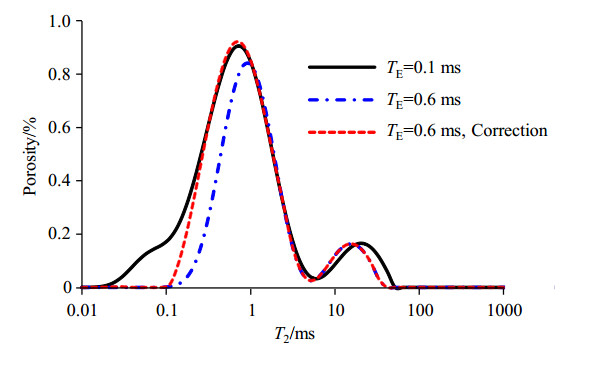
In order to study the effect of echo time (TE) on nuclear magnetic resonance (NMR) porosity in tight oil (gas) and shale reservoir, multi-TE NMR experiments and NMR numerical simulations were performed on CuSO4 solutions with specific transversal relaxation time (T2). The results showed that the normalization NMR porosity of different T2 relaxation components remained 100% in the low TE region, and rapidly decreased with increasing TE. When TE was greater than certain value, the normalization NMR porosity dropped to zero. However, the TE value at which the normalization NMR porosity began to decrease and the TE value at which the normalization NMR porosity dropped to zero were different for different NMR relaxation component. Moreover, the whole NMR measurement was divided into lossless zone, fast decay zone, invalid parameter zone and instrument blind zone, based on the relationships between the normalization NMR porosity of different relaxation component and TE. For each specific relaxation component, a logarithmic relationship was demonstrated between the loss of relaxation component and TE in the fast decay zone. A method for NMR porosity correction was given.
ZHANG Gong
,
HE Zong-bin
,
CAO Wen-qian
,
CHEN Yao
. Effects of Echo Time on NMR Apparent Porosity and Correction Methods[J]. Chinese Journal of Magnetic Resonance, 2020
, 37(2)
: 172
-181
.
DOI: 10.11938/cjmr20192771
[1] PRAMMER M G, DRACK E D, BOUTON J C, et al. Measurements of clay-bound water and total porosity by magnetic resonance logging[C]. Colorado:SPE Annual Technical Conference and Exhibition, Formation Evaluation and Reservoir Geology, 1996:311-320.
[2] WANG W M, YE C H, GUO H K. Experimental studies of NMR properties of continental sedimentary rocks[J]. Chinese J Magn Reson, 2001, 18(2):113-121.王为民, 叶朝辉, 郭和坤. 陆相储层岩石核磁共振物理特征的实验研究[J]. 波谱学杂志, 2001, 18(2):113-121.
[3] WANG Z D, WANG H, LI N G, et al. Analysis of core NMR data from laboratory measurements[J]. Well Logging Technology, 2001, 25(3):170-174.王忠东, 汪浩, 李能根, 等. 核磁共振岩心基础实验分析[J]. 测井技术, 2001, 25(3):170-174.
[4] FAN Y R, NI Z G, DENG S G, et al. Experimental study on NMR measurement parameters and reservoir properties[J]. Petroleum Geology & Experiment, 2005, 27(6):624-626.范宜仁, 倪自高, 邓少贵, 等. 储层性质与核磁共振测量参数的实验研究[J]. 石油实验地质, 2005, 27(6):624-626.
[5] YAN W C, SUN J M, SUN Y, et al. A robust NMR method to measure porosity of low porosity rocks[J]. Microporous and Mesoporous Materials, 2018, 269:113-117
[6] GAO M Z, ZOU C C, PENG C, et al. Study on selection method of core nuclear magnetic experiment parameters for shale reservoir[J]. Chinese Journal of Engineering Geophysics, 2016, 13(3):263-270.高明哲, 邹长春, 彭诚, 等. 页岩储层岩心核磁共振实验参数选取方法研究[J]. 工程地球物理学报, 2016, 13(3):263-270.
[7] SUN J M, ZONG C L, DONG X, et al. Porosity measurement of crushed shales using NMR[J]. Well Logging Technology, 2017, 41(5):512-516.孙建孟, 宗成林, 董旭, 等. 基于核磁共振的页岩粉碎样品孔隙度研究[J]. 测井技术, 2017, 41(5):512-516.
[8] ZHANG T, ZHANG X W. Comparative study on qualitative and quantitative methods for shale pore characterization[J]. Natural Gas Exploration and Development, 2017, 40(4):34-43.张涛, 张希巍. 页岩孔隙定性与定量方法的对比研究[J]. 天然气勘探与开发, 2017, 40(4):34-43.
[9] SONDERGELD C, TINNI A, RAI C, et al. NMR considerations in shale evaluation[C]//Spwla-2016-rrr,[S.l.]:Society of Petrophysicists and Well-log Analysts, 2016:9.
[10] CHAKRAVARTY A, TINNI A, RAIC C S, et al. NMR considerations in shales at elevated temperature[C]. Texas:SPE/AAPG/SEG Unconventional Resources Technology Conference. Houston, 2018.
[11] WANG Z Z, LI X, WEI Y X, et al. NMR technologies for evaluating oil & gas shale:a review[J]. Chinese J Magn Reson, 2015, 32(4):688-698.王志战, 李新, 魏杨旭, 等. 页岩油气层核磁共振评价技术综述[J]. 波谱学杂志, 2015, 32(4):688-698.
[12] XIE R H, XIAO L Z, LIU J J, et al. A method for multiple echo trains jointing inversion of NMR relaxing measurements[J]. Chinese Journal of Geophysics, 2009, 52(11):2913-2919.谢然红, 肖立志, 刘家军, 等. 核磁共振多回波串联合反演方法[J]. 地球物理学报, 2009, 52(11):2913-2919.
[13] JIANG R Z, YAO Y P, MIAO S, et al. Improved algorithm for singular value decomposition inversion of T2 spectrum in nuclear magnetic resonance[J]. Acta Petrolei Sinica, 2005, 26(6):57-59.姜瑞忠, 姚彦平, 苗盛, 等. 核磁共振T2谱奇异值分解反演改进算法[J]. 石油学报, 2005, 26(6):57-59.
[14] ZHANG S M, ZHANG S N, GE X, et al. Optimal design and application of two-dimensional NMR logging in Chuanxi tight gas reservoir[J]. Chinese J Magn Reson, 2018, 35(2):234-242.张世懋, 张哨楠, 葛祥, 等. 川西致密气藏二维核磁共振测井优化设计与应用[J]. 波谱学杂志, 2018, 35(2):234-242.

