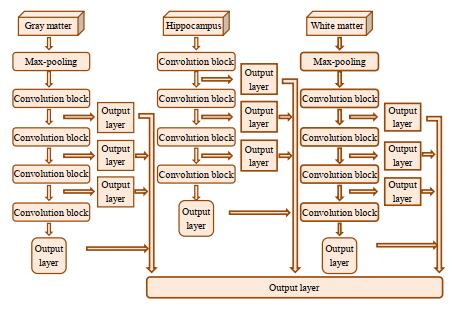
Alzheimer's disease has become more prevalent in our lives as the population ages. Accurate diagnosis and positive intervention can effectively delay the progress of early-stage Alzheimer’s disease. Accurate diagnosis of Alzheimer’s disease requires the combination of information from multiple regions of interest (ROIs), because the use of one single ROI may lose the connection and impact among multiple brain regions. In this paper, we firstly proposed a three-input convolutional neural network (CNN) to comprehensively utilize the information from three ROIs, hippocampus, other gray matter (without hippocampus) and white matter. In addition, as the neural network deepens, important feature information of original image will be partially lost. Therefore, we proposed a multi-output 3D CNN, which increases the connection and output of middle layers, shortens the distance between input and output, enhances feature propagation and reduces the loss of feature information. The results showed that the accuracy rate, precision rate, sensitivity, specificity and F1-score of the test set diagnosis obtained by multi-output 3D CNN model were 90.5%, 91.0%, 90.4%, 95.2% and 90.5%, respectively. The diagnostic performance was better than that of the single-output 3D CNN model.
WEI Zhi-hong
,
YAN Shi-ju
,
HAN Bao-san
,
SONG Cheng-li
. Diagnosis of Alzheimer's Disease Based on Multi-Output Three-Dimensional Convolutional Neural Network[J]. Chinese Journal of Magnetic Resonance, 2021
, 38(1)
: 92
-100
.
DOI: 10.11938/cjmr20202808
[1] LUO T, DUAN C. The status and research significance of Alzheimer's disease at home and abroad[J]. Clinical Medical Practice, 2013, 22(11):839-840.罗涛,段晨.阿尔茨海默病的国内外现状及研究意义[J].临床医药实践, 2013, 22(11):839-840.
[2] MCKHANN G, DRACHMAN D, FOLSTEIN M, et al. Clinical diagnosis of Alzheimer's disease:Report of the NINCDS-ADRDA Work Group*under the auspices of department of health and human services task force on Alzheimer's disease[J]. Neurology, 1984, 34(7):939-939.
[3] CUI R X, LIU M H. Hippocampus analysis by combination of 3D DenseNet and shapes for Alzheimer's disease diagnosis[J]. IEEE J Biomed Health Inform, 2018, 23(5):2099-2107.
[4] JAIN R, JAIN N, AGGARWAL A, et al. Convolutional neural network based Alzheimer's disease classification from magnetic resonance brain images[J]. Cogn Syst Res, 2019, 57:147-159.
[5] ALZHEIMER'S ASSOCIATION. 2018 Alzheimer's disease facts and figures[J]. Alzheimers Dement, 2018, 14(3):367-429.
[6] BRON E E, SMITS M, VAN DER FLIER W M, et al. Standardized evaluation of algorithms for computer-aided diagnosis of dementia based on structural MRI:the CADDementia challenge[J]. Neuroimage, 2015, 111:562-579.
[7] SORENSEN L, SHAKER S B, DE BRUIJNE M. Quantitative analysis of pulmonary emphysema using local binary patterns[J]. IEEE Trans Med Imaging, 2010, 29(2):559-569.
[8] UCHIYAMA Y, KATSURAGAWA S, ABE H, et al. Quantitative computerized analysis of diffuse lung disease in high-resolution computed tomography[J]. Med Phys, 2003, 30(9):2440-2454.
[9] PLIS S M, HJELM D R, SALAKHUTDINOV R, et al. Deep learning for neuroimaging:a validation study[J]. Front Neurosci-Switz, 2014, 8:229.
[10] KOROLEV S, SAFIULLIN A, BELYAEV M, et al. Residual and plain convolutional neural networks for 3d brain mri classification[C]//2017 IEEE 14 th International Symposium on Biomedical Imaging (ISBI 2017). IEEE, 2017:835-838.
[11] KHVOSTIKOV A, ADERGHAL K, BENOS-PINEAU J, et al. 3D CNN-based classification using sMRI and MD-DTI images for Alzheimer disease studies[J]. 2018. arXiv:1801.05968.
[12] SUN J W, YAN S J, HAN Y S, et al. Classifying the course of Alzheimer's disease with brain MR images and a method based on three-dimensional local pattern transformation[J]. Chinese J Magn Reson, 2019, 36(3):268-277.孙京文,闫士举,韩勇森,等.基于脑部磁共振图像三维局部模式变换特征提取进行阿尔茨海默病病程预测分类[J].波谱学杂志, 2019, 36(3):268-277.
[13] PLANCHE V, RUET A, COUPÉ P, et al. Hippocampal microstructural damage correlates with memory impairment in clinically isolated syndrome suggestive of multiple sclerosis[J]. Mult Scler J, 2017, 23(9):1214-1224.
[14] ZHAO J, DING X, DU Y, et al. Functional connectivity between white matter and gray matter based on fMRI for Alzheimer's disease classification[J]. Brain Behav, 2019, 9(10):e01407.
[15] FEIS R A, BOUTS M J R J, DOPPER E G P, et al. Multimodal MRI of grey matter, white matter, and functional connectivity in cognitively healthy mutation carriers at risk for frontotemporal dementia and Alzheimer's disease[J]. BMC Neurol, 2019, 19(1):1-11.
[16] BÄCKSTRÖM K, NAZARI M, GU I Y H, et al. An efficient 3D deep convolutional network for Alzheimer's disease diagnosis using MR images[C]//2018 IEEE 15th International Symposium on Biomedical Imaging (ISBI 2018). IEEE, 2018:149-153.
[17] ZHANG H M, CHEN S Z. A new brain function imaging analysis method-statistical parameter graph (SPM)[J]. Chinese Medical Imaging Technology, 2002, 18(7):711-713.张海敏,陈盛祖.一种新的脑功能显像分析法-统计参数图(SPM)[J].中国医学影像技术, 2002, 18(7):711-713.
[18] ZHAO S Y, WANG Y J. Classification of Alzheimer's disease patient and healthy group based on magnetic resonance images and improved UNet++model[J]. Chinese J Magn Reson, 2020, 37(3):321-331.赵尚义,王远军.基于磁共振图像和改进的UNet++模型区分阿尔茨海默症患者和健康人群[J].波谱学杂志, 2020, 37(3):321-331.
[19] ORTIZ-SUÁREZ J M, RAMOS-POLLÁN R, ROMERO E. Exploring Alzheimer's anatomical patterns through convolutional networks[C]//12th International Symposium on Medical Information Processing and Analysis. International Society for Optics and Photonics, 2017, 10160:101600Z.
[20] TRAN D, BOURDEV L, FERGUS R, et al. Learning spatiotemporal features with 3d convolutional networks[C]//Proceedings of the IEEE international conference on computer vision. 2015:4489-4497.
[21] NORMALIZATION B. Accelerating deep network training by reducing internal covariate shift[J]. 2015. Arxiv:1502.03167.
[22] RIEKE J, EITEL F, WEYGANDT M, et al. Visualizing convolutional networks for MRI-based diagnosis of Alzheimer's disease[M]//Understanding and Interpreting Machine Learning in Medical Image Computing Applications. Springer, Cham, 2018:24-31.

