

Chinese Journal of Magnetic Resonance >
Magnetic Resonance Images Segmentation of Synovium Based on Dense-UNet++
Received date: 2021-04-06
Online published: 2021-07-01
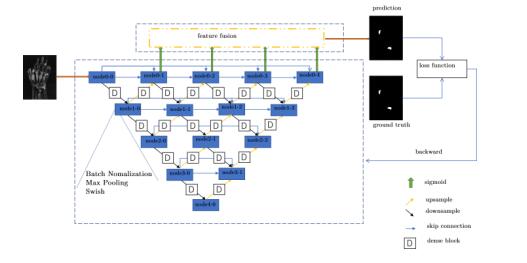
To further improve the segmentation accuracy, robustness, and training efficiency of existing articular synovium segmentation algorithms, a new deep learning network based on Dense-UNet++ was proposed. First, we inserted the DenseNet module into the UNet++ network, then applied the Swish activation function to train the model. The network was trained through 14 512 synovial images augmented from 1 036 synovial images, and tested through 68 images. The average accuracy of the model reached 0.819 9 for dice similarity coefficient (DSC), and 0.927 9 for intersection over union (IOU) index. Compared with UNet, ResUNet and VGG-UNet++, DSC coefficient and IOU index were improved, and DSC oscillation coefficient reduced. In addition, when applied in the same synovial image set and using the same network structure, the Swish function can help improve the accuracy of segmentation compared with the ReLu function. The experimental results show that the proposed algorithm performs better in segmenting articular synovium and may assist doctors in disease diagnosis.
Zhen-yu WANG , Ying-shan WANG , Jin-ling MAO , Wei-wei MA , Qing LU , Jie SHI , Hong-zhi WANG . Magnetic Resonance Images Segmentation of Synovium Based on Dense-UNet++[J]. Chinese Journal of Magnetic Resonance, 2022 , 39(2) : 208 -219 . DOI: 10.11938/cjmr20212905
| 1 | KONG X Y , WANG R Z . Artificial intelligence and its application in medical field[J]. Journal of Medical Intelligence, 2016, 37 (11): 2- 5. |
| 1 | 孔祥溢, 王任直. 人工智能及在医疗领域的应用[J]. 医学信息学杂志, 2016, 37 (11): 2- 5. |
| 2 | 张明月. 基于深度学习的图像分割研究[D]. 长春: 吉林大学, 2017. |
| 3 | ZHOU H Y , LIU P C . Clinical value and research progress of MR in wrist facet joint lesions[J]. China Medical Engineering, 2010, 18 (3): 172- 175. |
| 3 | 周海燕, 刘鹏程. MR在手腕部小关节病变的临床价值及研究进展[J]. 中国医学工程, 2010, 18 (03): 172- 175. |
| 4 | MA J , CHEN M , LI H , et al. Clinical observation of traditional Chinese medicine combined with antirheumatic drug treatment of rheumatoid arthritis in active stage[J]. Chinese Journal of Experimental Traditional Medical Formulae, 2014, 20 (5): 192- 196. |
| 4 | 马进, 陈岷, 李获, 等. 中药联合抗风湿药治疗类风湿性关节炎活动期的临床观察[J]. 中国实验方剂学杂志, 2014, 20 (05): 192- 196. |
| 5 | 马强. 类风湿关节炎的腕关节MRI及临床应用研究[D]. 太原: 山西医科大学, 2003. |
| 6 | WEI X N , XING J Q , WANG Z Y , et al. Magnetic resonance image segmentation of articular synovium based on improved U-Net[J]. Journal of Computer Applications, 2020, 40 (11): 3340- 3345. |
| 6 | 魏小娜, 邢嘉祺, 王振宇, 等. 基于改进U-Net的关节滑膜磁共振图像的分割[J]. 计算机应用, 2020, 40 (11): 3340- 3345. |
| 7 | LONG Z , ZHANG X , LI C , et al. Segmentation and classification of knee joint ultrasonic image via deep learning[J]. Applied Soft Computing, 2020, 97 (9): 106765. |
| 8 | LING Z, SONKA M, LE L, et al. Combining fully convolutional networks and graph-based approach for automated segmentation of cervical cell nuclei[C]. IEEE ISBI (Oral). IEEE, 2017. |
| 9 | PHAM D L , XU C Y , PRINCE J L . Current methods in medical image segmentation[J]. Annu Rev Biomed Eng, 2000, 2, 315- 337. |
| 10 | XIAO L , LOU Y K , ZHOU H Y . A U-net network-based rapid construction of knee models for specific absorption rate estimation[J]. Chinese J Magn Reson, 2020, 37 (2): 144- 151. |
| 10 | 肖亮, 娄煜堃, 周航宇. 用于SAR估计的基于U-Net网络的快速膝关节模型重建[J]. 波谱学杂志, 2020, 37 (2): 144- 151. |
| 11 | FARAHANI A, MOHSENI H. Medical image segmentation using customized U-Net with adaptive activation functions[J]. Neural Computing & Applications, doi: 10.1007/s00521-020-05396-317. |
| 12 | ZHOU Z, SIDDIQUEE M M R, TAJBAKHSH N, et al. UNet++: A nested U-Net architecture for medical image segmentation[C]. Deep Learning in Medical Image Analysis and Multimodal Learning for Clinical Decision Support: MICCAI 2018, Granada, Spain, 2018, 110453-11. |
| 13 | ZHAO S Y , WANG Y J . Classification of Alzheimer's disease patients based on magnetic resonance images and an improved UNet++ model[J]. Chinese J Magn Reson, 2020, 37 (3): 321- 331. |
| 13 | 赵尚义, 王远军. 基于磁共振图像和改进的UNet++模型区分阿尔茨海默症患者和健康人群[J]. 波谱学杂志, 2020, 37 (3): 321- 331. |
| 14 | ZHANG K , GUO Y R , WANG X S , et al. Multiple feature reweight densenet for image classification[J]. IEEE Access, 2019, 7, 9872- 9880. |
| 15 | ZENG M J , XIAO N F . Effective combination of densenet and bilSTM for keyword spotting[J]. IEEE Access, 2019, 7, 10767- 10775. |
| 16 | TAO Y , XU M , LU Z , et al. DenseNet-based depth-width double reinforced deep learning neural network for high-resolution remote sensing image per-pixel classification[J]. Remote Sensing, 2018, 10 (5) |
| 17 | CHU X X, ZHANG B, XU R J. Searching beyond mobileNetV3[C]. ICASSP, 2020. https://arxiv.org/pdf/1908.01314.pdf. |
| 18 | SOOMRO T A, AFIFI A J, JUNBIN G, et al. Strided U-net model: retinal vessels segmentation using dice loss[C]//2018 Digital Image Computing: Techniques and Applications (DICTA), 2018. |
| 19 | LEVINE R A . The art of data augmentation - Discussion[J]. Journal of Computational and Graphical Statistics, 2001, 10 (1): 51- 58. |
/
| 〈 |
|
〉 |