

Chinese Journal of Magnetic Resonance >
Design and Application of Micellar Magnetic Resonance Imaging Molecular Probe
Received date: 2021-07-06
Online published: 2021-11-29
Molecular imaging plays an increasingly important role in the early diagnosis and detection of tumors. As a significant branch of molecular imaging, magnetic resonance imaging (MRI) shows incomparable advantages and broad development prospects than other imaging technologies. It requires no radioactive tracer, no ionizing radiation, but presents high spatial and temporal resolution and tissue contrast. In recent years, a series of progress has been made in the research and development of new magnetic resonance molecular probes and imaging sequences, including responsive molecular probes, 19F MRI, hyperpolarized 129Xe MRI, and chemical exchange saturation transfer (CEST) imaging, which have expanded the application range of MRI. One crucial research in MRI development is to further improve sensitivity. Therefore, the research of new multimodal MRI contrast agents with good targeting capacity, high relaxation efficiency and high safety is an important topic in the current biomedical engineering field. For example, the sensitivity of MRI molecular probes could be improved by combining the characteristics of micelles with some new magnetic resonance methods. Some deficiencies of MRI could be overcome by introducing multimodal molecular probes. This article reviews the research progress and application analysis of the core technology of micellar MRI molecular probes, and elucidates the importance of molecular imaging technology in biomedical engineering research and clinical diagnosis.
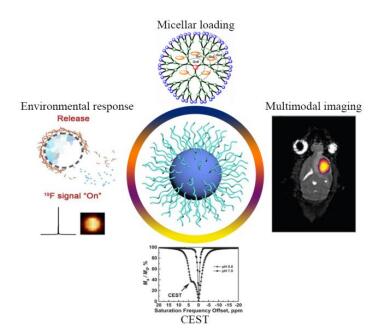
Long XIAO , Xiao-lei ZHU , Ye-qing HAN , Shi-zhen CHEN , Xin ZHOU . Design and Application of Micellar Magnetic Resonance Imaging Molecular Probe[J]. Chinese Journal of Magnetic Resonance, 2021 , 38(4) : 474 -490 . DOI: 10.11938/cjmr20212933
| 1 | WEISSLEDER R , MAHMOOD U . Molecular imaging[J]. Radiol, 2001, 219 (2): 316- 333. |
| 2 | BADER H , RINGSDORF H , SCHMIDT B . Watersoluble polymers in medicine[J]. Macromol Mater Eng, 1984, 123 (1): 457- 485. |
| 3 | YANG L J , ZHANG C R , LIU J J , et al. ICG-conjugated and 125I-labeled polymeric micelles with high biosafety for multimodality imaging-guided photothermal therapy of tumors[J]. Adv Healthcare Mater, 2020, 9 (5): 1901616. |
| 4 | CAO Y , LIU M , ZHANG K C , et al. Poly(glycerol) used for constructing mixed polymeric micelles as T1 MRI contrast agent for tumor-targeted imaging[J]. Biomacromolecules, 2017, 18 (1): 150- 158. |
| 5 | LU L J , WANG Y , CAO M H , et al. A novel polymeric micelle used for in vivo MR imaging tracking of neural stem cells in acute ischemic stroke[J]. RSC Advances, 2017, 7 (25): 15041- 15052. |
| 6 | SU P F , WU H X , WANG Z , et al. Biodegradable catalase-modified micelles as ultrasound contrast agents for inflammation detection[J]. Part Part Syst Charact, 2020, 37 (10): 2000193. |
| 7 | ELSAID Z , TAYLOR K M G , PURI S , et al. Mixed micelles of lipoic acid-chitosan-poly (ethylene glycol) and distearoylphosphatidylethanolamine-poly (ethylene glycol) for tumor delivery[J]. Eur J Pharm Sci, 2017, 101, 228- 242. |
| 8 | WAN Z A , ZHENG R H , MOHARIL P , et al. Polymeric micelles in cancer immunotherapy[J]. Molecules, 2021, 26 (5): 1220. |
| 9 | SHEN D , SHEN Y , CHEN Q , et al. Macrophage escape by cholesterol-polyoxyethylene sorbitol oleate micelles for pulmonary delivery[J]. Nanomedicine, 2020, 15 (5): 489- 509. |
| 10 | WANG Z , DENG X P , DING J S , et al. Mechanisms of drug release in pH-sensitive micelles for tumour targeted drug delivery system: A review[J]. Int J Pharm, 2018, 535 (1, 2): 253- 260. |
| 11 | HONG G B , ZHOU J X , YUAN R X . Folate-targeted polymeric micelles loaded with ultrasmall superparamagnetic iron oxide: combined small size and high MRI sensitivity[J]. Int J Nanomed, 2012, 7, 2863- 2872. |
| 12 | GONG F M , ZHANG Z Q , CHEN X D , et al. A dual ligand targeted nanoprobe with high MRI sensitivity for diagnosis of breast cancer[J]. Chinese J Polym Sci, 2014, 32 (3): 321- 332. |
| 13 | CUI M Y , DONG Z , CAI H , et al. Folate?targeted polymeric micelles loaded with superparamagnetic iron oxide as a contrast agent for magnetic resonance imaging of a human tongue cancer cell line[J]. Mol Med Rep, 2017, 16 (5): 7597- 7602. |
| 14 | XIE X X , CHEN Y , CHEN Z Y , et al. Polymeric hybrid nanomicelles for cancer theranostics: an efficient and precise anticancer strategy for the codelivery of doxorubicin/miR-34a and magnetic resonance imaging[J]. ACS Appl Mater Interfaces, 2019, 11 (47): 43865- 43878. |
| 15 | YAN L , AMIRSHAGHAGHI A , HUANG D , et al. Protoporphyrin IX (PpIX)-coated superparamagnetic iron oxide nanoparticle (SPION) nanoclusters for magnetic resonance imaging and photodynamic therapy[J]. Adv Funct Mater, 2018, 28 (16): 1707030. |
| 16 | DENG L H , JIANG H , LU F L , et al. Size and PEG length-controlled PEGylated monocrystalline superparamagnetic iron oxide nanocomposite for MRI contrast agent[J]. Int J Nanomed, 2021, 16, 201- 211. |
| 17 | HEMMATI , K , ALIZADEH R , GHAEMY M . Synthesis and characterization of controlled drug release carriers based on functionalized amphiphilic block copolymers and super-paramagnetic iron oxide nanoparticles[J]. Polym Adv Technol, 2016, 27 (4): 504- 514. |
| 18 | ZHANG X M , GUO K , LI L H , et al. Multi-stimuli-responsive magnetic assemblies as tunable releasing carriers[J]. J Mater Chem B, 2015, 3 (29): 6026- 6031. |
| 19 | DALMINA M , PITTELLA F , SIERRA J A , et al. Magnetically responsive hybrid nanoparticles for in vitro siRNA delivery to breast cancer cells[J]. Mater Sci Eng: C, 2019, 99, 1182- 1190. |
| 20 | LIN M H , DAI Y , XIA F , et al. Advances in non-covalent crosslinked polymer micelles for biomedical applications[J]. Mater Sci Eng: C, 2020, 119, 111626. |
| 21 | QI C , MUSETTI S , FU L H , et al. Biomolecule-assisted green synthesis of nanostructured calcium phosphates and their biomedical applications[J]. Chem Soc Rev, 2019, 48 (10): 2698- 2737. |
| 22 | LIU Y J , LI J S , LIU F X , et al. Theranostic polymeric micelles for the diagnosis and treatment of hepatocellular carcinoma[J]. J Biomed Nanotechnol, 2015, 11 (4): 613- 622. |
| 23 | ZHANG Y H , ZHANG H Y , ZHANG H L , et al. A new Gd-based T2-weighted magnetic resonance imaging contrast agent: Preparation and application in stem cell imaging[J]. Chinese J Magn Reson, 2017, 34 (3): 302- 310. |
| 23 | 张艳辉, 张宏岩, 张海禄, 等. 新型Gd基T2造影剂的制备和应用[J]. 波谱学杂志, 2017, 34 (3): 302- 310. |
| 24 | MA J P , DONG H Q , ZHU H Y , et al. Deposition of gadolinium onto the shell structure of micelles for integrated magnetic resonance imaging and robust drug delivery systems[J]. J Mater Chem B, 2016, 4 (36): 6094- 6102. |
| 25 | JIANG D D , ZHANG X P , YU D X , et al. Tumor-microenvironment relaxivity-changeable Gd-loaded poly (L-lysine)/carboxymethyl chitosan nanoparticles as cancer-recognizable magnetic resonance imaging contrast agents[J]. J Biomed Nanotechnol, 2017, 13 (3): 243- 254. |
| 26 | LIU Y J , FENG L X , LIU T X , et al. Multifunctional pH-sensitive polymeric nanoparticles for theranostics evaluated experimentally in cancer[J]. Nanoscale, 2014, 6 (6): 3231- 3242. |
| 27 | ZHU D R , LIU F Y , MA L N , et al. Nanoparticle-based systems for T1-weighted magnetic resonance imaging contrast agents[J]. Int J Mol Sci, 2013, 14 (5): 10591- 10607. |
| 28 | ZHAN Y Y , XUE R , ZHU Y L , et al. A biocompatible gadolinium-based amino acid copolymer contrast agent for magnetic resonance imaging[J]. Chinese J Magn Reson, 2016, 33 (4): 635- 645. |
| 28 | 湛游洋, 薛蓉, 祝云龙, 等. 氨基酸共聚物修饰的生物相容性MRI造影剂[J]. 波谱学杂志, 2016, 33 (4): 635- 645. |
| 29 | KUMAGAI M , IMAI Y , NAKAMURA T , et al. Iron hydroxide nanoparticles coated with poly (ethylene glycol)-poly (aspartic acid) block copolymer as novel magnetic resonance contrast agents for in vivo cancer imaging[J]. Colloids Surf., B, 2007, 56 (1-2): 174- 181. |
| 30 | ZHANG Z Q , SUN Q Q , ZHONG J L , et al. Magnetic resonance imaging-visible and pH-sensitive polymeric micelles for tumor targeted drug delivery[J]. J Biomed Nanotechnol., 2014, 10 (2): 216- 226. |
| 31 | JIANG B , LIU M , ZHNG K C , et al. Oligoethylenimine grafted PEGylated poly (aspartic acid) as a macromolecular contrast agent: properties and in vivo studies[J]. J Mater Chem B, 2016, 4 (19): 3324- 3330. |
| 32 | WILSON M P , PATEL D , MURAD M H , et al. Diagnostic performance of MRI in the detection of renal lipid-poor angiomyolipomas: a systematic review and meta-analysis[J]. Radiol, 2020, 296 (3): 511- 520. |
| 33 | SUN J , ZHAO X Q , BALU N , et al. Carotid plaque lipid content and fibrous cap status predict systemic CV outcomes: the MRI substudy in AIM-HIGH[J]. JACC Cardiovasc Imaging, 2017, 10 (3): 241- 249. |
| 34 | ALKHALIL M , BIASIOLLI L , AKBAR N , et al. T2 mapping MRI technique quantifies carotid plaque lipid, and its depletion after statin initiation, following acute myocardial infarction[J]. Atherosclerosis, 2018, 279, 100- 106. |
| 35 | BASTIAANSEN J A M , STUBER M . Flexible water excitation for fat-free MRI at 3T using lipid insensitive binomial off-resonant RF excitation (LIBRE) pulses[J]. Magn Reson Med, 2018, 79 (6): 3007- 3017. |
| 36 | ROMEO V , MAUREA S , GUARINO S , et al. The role of dynamic post-contrast T1-w MRI sequence to characterize lipid-rich and lipid-poor adrenal adenomas in comparison to non-adenoma lesions: preliminary results[J]. Abdom Radiol, 2018, 43 (8): 2119- 2129. |
| 37 | XIA J , YIN A Y , LI Z Z , et al. Quantitative analysis of lipid-rich necrotic core in carotid atherosclerotic plaques by in vivo magnetic resonance imaging and clinical outcomes[J]. Med Sci Monit, 2017, 23, 2745- 2750. |
| 38 | LU C Y , JI J S , ZHU X L , et al. T2-weighted magnetic resonance imaging of hepatic tumor guided by SPIO-loaded nanostructured lipid carriers and ferritin reporter genes[J]. ACS Appl Mater Interfaces, 2017, 9 (41): 35548- 35561. |
| 39 | ZHANG Y , UDAYAKUMAR D , CAI L , et al. Addressing metabolic heterogeneity in clear cell renal cell carcinoma with quantitative Dixon MRI[J]. JCI insight, 2017, 2 (15): e94278. |
| 40 | WEINMANN H J , BRASCH R C , PRESS W R , et al. Characteristics of gadolinium-DTPA complex: a potential NMR contrast agent[J]. AJR Am J Roentgenol, 1984, 142 (3): 619- 624. |
| 41 | AKAI H , SHIRAISHI K , YOKOYAMA M , et al. PEG-poly (L-lysine)-based polymeric micelle MRI contrast agent: Feasibility study of a Gd-micelle contrast agent for MR lymphography[J]. J Magn Reson Imaging, 2018, 47 (1): 238- 245. |
| 42 | ZHANG N N , YU S S , MIN X , et al. Visual targeted therapy of hepatic cancer using homing peptide modified calcium phosphate nanoparticles loading doxorubicin guided by T1 weighted MRI[J]. Nanomed-Nanotechnol, 2018, 14 (7): 2167- 2178. |
| 43 | YAN Q D , DONG X , XIE R Z , et al. Preparation of Mn2+@PolyDOPA-b-polysarcosine micelle as MRI contrast agent with high longitudinal relaxivity[J]. J Macromol Sci A, 2021, 58 (3): 175- 181. |
| 44 | JOHNSON N J J , HE S , NGUYEN HUU V A , et al. Compact micellization: a strategy for ultrahigh T1 magnetic resonance contrast with gadolinium-based nanocrystals[J]. ACS Nano, 2016, 10 (9): 8299- 8307. |
| 45 | ARESTEANU R N S , BORODETSKY A , AZHARI H , et al. Ultrasound-induced and MRI-monitored CuO nanoparticles release from micelle encapsulation[J]. Nanotechnology, 2020, 32 (5): 055705. |
| 46 | SUN C J , LIN H Y , GONG X Q , et al. DOTA-branched organic frameworks as giant and potent metal chelators[J]. J Am Chem Soc, 2020, 142 (1): 198- 206. |
| 47 | WANG Y X J . Superparamagnetic iron oxide based MRI contrast agents: Current status of clinical application[J]. Quant Imag Med Surg, 2011, 1 (1): 35- 40. |
| 48 | RAY S , LI Z , HSU C H , et al. Dendrimer-and copolymer-based nanoparticles for magnetic resonance cancer theranostics[J]. Theranostics, 2018, 8 (22): 6322- 6349. |
| 49 | YE S , LIU Y , LU Y , et al. Cyclic RGD functionalized liposomes targeted to activated platelets for thrombosis dual-mode magnetic resonance imaging[J]. J Mater Chem B, 2020, 8 (3): 447- 453. |
| 50 | YAN L , LUO L J , AMIRSHAGHAGHI A , et al. Dextran-benzoporphyrin derivative (BPD) coated superparamagnetic iron oxide nanoparticle (SPION) micelles for T2-weighted magnetic resonance imaging and photodynamic therapy[J]. Bioconjugate Chem, 2019, 30 (11): 2974- 2981. |
| 51 | WARD K M , ALETRAS A H , BALABAN R S . A new class of contrast agents for MRI based on proton chemical exchange dependent saturation transfer (CEST)[J]. J Magn Reson, 2000, 143 (1): 79- 87. |
| 52 | SUN P Z , VAN ZIJL P C M , ZHOU J Y . Optimization of the irradiation power in chemical exchange dependent saturation transfer experiments[J]. J Magn Reson, 2005, 175 (2): 193- 200. |
| 53 | WOESSNER D E , ZHANG S R , MERRITT M E , et al. Numerical solution of the Bloch equations provides insights into the optimum design of PARACEST agents for MRI[J]. Magn Reson Med, 2010, 53 (4): 790- 799. |
| 54 | FERRAUTO G , BEAUPREZ F , DI GREGORIO E , et al. Development and characterization of lanthanide-HPDO3A-C16-based micelles as CEST-MRI contrast agents[J]. Dalton Trans, 2019, 48 (16): 5343- 5351. |
| 55 | GONAWALA S , ALI M M . Application of dendrimer-based nanoparticles in glioma imaging[J]. J Nanomed Nanotechnol, 2017, 8 (3): 444. |
| 56 | ZHANG S R , ZHOU K J , HUANG G , et al. A novel class of polymeric pH-responsive MRI CEST agents[J]. Chem Commun, 2013, 49 (57): 6418- 6420. |
| 57 | HAN Z , LIU G S . CEST MRI trackable nanoparticle drug delivery systems[J]. Biomed Mater, 2021, 16 (2): 024103. |
| 58 | HILL L K , FREZZO J A , KATYAL P , et al. Protein-engineered nanoscale micelles for dynamic 19F magnetic resonance and therapeutic drug delivery[J]. ACS Nano, 2019, 13 (3): 2969- 2985. |
| 59 | FU C K , DEMIR B , ALCANTARA S , et al. Low-fouling fluoropolymers for bioconjugation and in vivo tracking[J]. Angew Chem Int Ed, 2020, 59 (12): 4729- 4735. |
| 60 | LI B , CAI M Y , LIN L , et al. MRI-visible and pH-sensitive micelles loaded with doxorubicin for hepatoma treatment[J]. Biomater Sci, 2019, 7 (4): 1529- 1542. |
| 61 | CAI M Y , LV G , YANG Q , et al. MRI-visible and pH-sensitive nanomicelles for targeting delivery of sorafenib to hepatocellular carcinoma[J]. Chinese Journal of Radiology, 2019, 11, 1005- 1011. |
| 61 | 蔡明岳, 吕格, 杨琴, 等. MRI可视化pH敏感纳米胶束用于肝癌靶向输送索拉非尼的可行性[J]. 中华放射学杂志, 2019, 11, 1005- 1011. |
| 62 | ZHOU G Y , XIAO H , LI X X , et al. Gold nanocage decorated pH-sensitive micelle for highly effective photothermo-chemotherapy and photoacoustic imaging[J]. Acta Biomater, 2017, 64, 223- 236. |
| 63 | ZHU X L , TANG X X , LIN H Y , et al. A fluorinated ionic liquid-based activatable 19F MRI platform detects biological targets[J]. Chem, 2020, 6 (5): 1134- 1148. |
| 64 | YANG H K , MIAO Y L , CHEN Y P , et al. Redox-responsive nanoparticles from disulfide bond-linked poly-(N-ε-carbobenzyloxy-L-lysine)- grafted hyaluronan copolymers as theranostic nanoparticles for tumor-targeted MRI and chemotherapy[J]. Int J Biol Macromol, 2020, 148, 483- 492. |
| 65 | ZHAI S D , HU X L , HU Y J , et al. Visible light-induced crosslinking and physiological stabilization of diselenide-rich nanoparticles for redox-responsive drug release and combination chemotherapy[J]. Biomater, 2017, 121, 41- 54. |
| 66 | HSU J C , NAHA P C , LAU K C , et al. An all-in-one nanoparticle (AION) contrast agent for breast cancer screening with DEM-CT-MRI-NIRF imaging[J]. Nanoscale, 2018, 10 (36): 17236- 17248. |
| 67 | MIURA Y , TSUJI A B , SUGYO A , et al. Polymeric micelle platform for multimodal tomographic imaging to detect scirrhous gastric cancer[J]. ACS Biomater Sci Eng, 2015, 1 (11): 1067- 1076. |
| 68 | MOUKHEIBER D , CHITGUPI U , CARTER K A , et al. Surfactant-stripped pheophytin micelles for multimodal tumor imaging and photodynamic therapy[J]. ACS Appl Bio Mater, 2018, 2 (1): 544- 554. |
| 69 | CARAVAN P . Strategies for increasing the sensitivity of gadolinium-based MRI contrast agents[J]. Chem Soc Rev, 2006, 35 (6): 512- 523. |
/
| 〈 |
|
〉 |