

Chinese Journal of Magnetic Resonance >
NMR Study on the Mechanism of Cytochrome c Methionine Oxidation
Received date: 2022-04-10
Online published: 2022-05-12
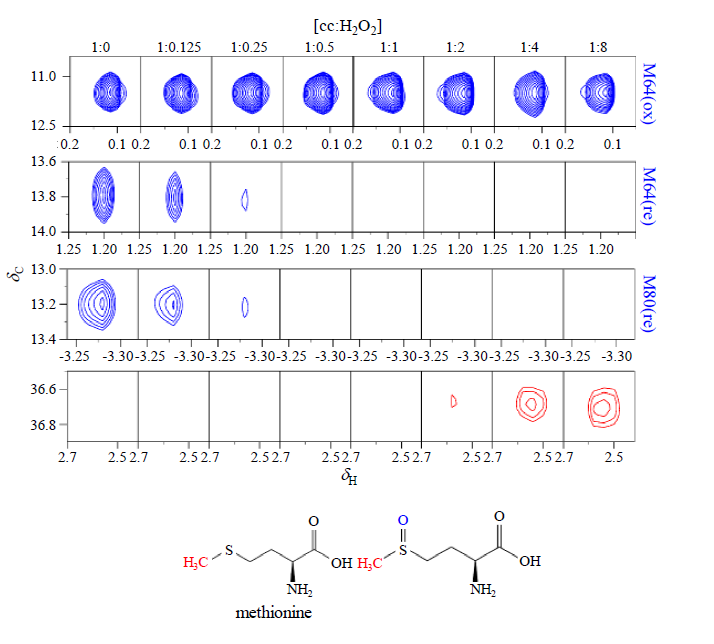
Mitochondria generate reactive oxygen species (ROS) during respiration. Low levels of ROS are conducive to signal transduction, whereas excessive accumulation of ROS can lead to protein oxidative modification. Cytochrome c (cyt c) is a multifunctional metalloprotein located in mitochondria. The oxidative modification of cyt c, especially the Met80 has been found to result in conformational change, but the mechanism is still unclear. In this study, the terminal methyl group of methionine on cytochrome c was selectively labeled with 13C, and the modification of the methionine in cytochrome c under oxidative environments was tracked by NMR. It was observed that under oxidative environments, the protein was first converted from reduced state to oxidized state, then oxidatively modified. The oxidative modification of Met80 occurred under relatively high content of ROS, but did not result in distinctive conformation transition. The result suggests that the protein has high activity to resist ROS damage, therefore, plays a regulatory role in inhibiting apoptosis.
Key words: oxidative modification; cytochrome c; liquid-state NMR; selective labeling
Beibei ZHAO , Jianhua ZHAN , Qin HU , Qinjun ZHU , Maili LIU , Xu ZHANG . NMR Study on the Mechanism of Cytochrome c Methionine Oxidation[J]. Chinese Journal of Magnetic Resonance, 2023 , 40(3) : 246 -257 . DOI: 10.11938/cjmr20222996
| [1] | SIES H. Role of metabolic H2O2 generation: redox signaling and oxidative stress[J]. J Biol Chem, 2014, 289(13): 8735-8741. |
| [2] | KATHIRESAN M, ENGLISH A M. LC-MS/MS suggests that hole hopping in cytochrome c peroxidase protects its heme from oxidative modification by excess H2O2[J]. Chem Sci, 2017, 8(2): 1152-1162. |
| [3] | ZHONG F, PLETNEVA E V. Ligation and reactivity of methionine-oxidized cytochrome c[J]. Inorg Chem, 2018, 57(10): 5754-5766. |
| [4] | MCCALDON P, ARGOS P. Oligopeptide biases in protein sequences and their use in predicting protein coding regions in nucleotide-sequences[J]. Proteins, 1988, 4(2): 99-122. |
| [5] | LUO S, LEVINE R L. Methionine in proteins defends against oxidative stress[J]. Faseb Journal, 2009, 23(2): 464-472. |
| [6] | CHAO C C, MA Y S, STADTMAN E R. Modification of protein surface hydrophobicity and methionine oxidation by oxidative systems[J]. Proc Natl Acad Sci USA, 1997, 94(7): 2969-2974. |
| [7] | HERSHKO A, CIECHANOVER A. The ubiquitin pathway for the degradation of intracellular proteins[J]. Prog Nucleic Acid Res Mol Biol, 1986, 33: 19-56. |
| [8] | KEHM R, BALDENSPERGER T, RAUPBACH J, et al. Protein oxidation-formation mechanisms, detection and relevance as biomarkers in human diseases[J]. Redox Biol, 2021, 42: 101901. |
| [9] | LIU X S, KIM C N, YANG J, et al. Induction of apoptotic program in cell-free extracts: Requirement for dATP and cytochrome c[J]. Cell, 1996, 86(1): 147-157. |
| [10] | ALVAREZ-PAGGI D, HANNIBAL L, CASTRO M A, et al. Multifunctional cytochrome c: learning new tricks from an old dog[J]. Chem Rev, 2017, 117(21): 13382-13460. |
| [11] | GUERRA-CASTELLANO A, MARQUEZ I, PEREZ-MEJIAS G, et al. Post-translational modifications of cytochrome c in cell life and Disease[J]. Int J Mol Sci, 2020, 21(22): 8483 |
| [12] | SANTUCCI R, SINIBALDI F, COZZA P, et al. Cytochrome c: An extreme multifunctional protein with a key role in cell fate[J]. Int J Biol Macromol, 2019, (136): 1237-1246. |
| [13] | KIM J, RODRIGUEZ M E, GUO M, et al. Oxidative modification of cytochrome c by singlet oxygen[J]. Free Radical Biology & Medicine, 2008, 44(9): 1700-1711. |
| [14] | WANG Z, ANDO Y, NUGRAHENI A D, et al. Self-oxidation of cytochrome c at methionine80 with molecular oxygen induced by cleavage of the Met-heme iron bond[J]. Mol Biosyst, 2014, 10(12): 3130-3137. |
| [15] | IVANETICH K M, BRADSHAW J J, KAMINSKY L S. Methionine sulfoxide cytochrome-c[J]. Biochemistry, 1976, 15(5): 1144-1153. |
| [16] | BREN K L, RAVEN E L. Locked and loaded for apoptosis[J]. Science, 2017, 356(6344): 1236. |
| [17] | MUENZNER J, PLETNEVA E V. Structural transformations of cytochrome c upon interaction with cardiolipin[J]. Chem Phys Lipids, 2014, (179): 57-63. |
| [18] | TOMá?KOVá N, NOVáK P, KO?áR T, et al. Early modification of cytochrome c by hydrogen peroxide triggers its fast degradation[J]. Int J Biol Macromol, 2021, (174): 413-423. |
| [19] | YIN V, MIAN S H, KONERMANN L. Lysine carbonylation is a previously unrecognized contributor to peroxidase activation of cytochrome c by chloramine-T[J]. Chem Sci, 2019, 10(8): 2349-2359. |
| [20] | SHI C W, SHI P, TIAN C L. NMR studies of large protein dynamics using unnatural amino acids[J]. Chinese J Magn Reson, 2021, 38(4): 523-532. |
| [20] | 史朝为, 石攀, 田长麟. 非天然氨基酸在蛋白质动态特性核磁共振研究中的应用[J]. 波谱学杂志, 2021, 38(4): 523-532. |
| [21] | SCHüTZ S, SPRANGERS R. Methyl TROSY spectroscopy: a versatile NMR approach to study challenging biological systems[J]. Prog Nucl Mag Res Sp, 2020, (116): 56-84. |
| [22] | YU F, QIAO J, ROBBLEE J, et al. An integrated approach to unique NMR assignment of methionine methyl resonances in proteins[J]. Anal Chem, 2017, 89(3): 1610-1616. |
| [23] | BROOKS D J, FRESCO J R, LESK A M, et al. Evolution of amino acid frequencies in proteins over deep time: Inferred order of introduction of amino acids into the genetic code[J]. Mol Biol Evol, 2002, 19(10): 1645-1655. |
| [24] | LIU M, FARRANT R D, SWEATMAN B C, et al. Observation of separate J-resolved 1H NMR spectra from CH, CH2, and CH3 groups using a maximum-quantum filter[J]. J Magn Reson Ser A, 1995, (1064-1858): 251-256. |
| [25] | FANG Z P, SUN P, WANG Q W, et al. Conformational change of wild type cytochrome c characterized by NMR spectroscopy at natural isotropic abundance[J]. Chinese J Magn Reson, 2019, 36(4): 481-489. |
| [25] | 方仲佩, 孙鹏, 王倩文, 等. 天然同位素丰度野生型酵母细胞色素c构象变化的核磁共振检测[J]. 2019, 36(4): 481-489. |
| [26] | TURNER H S A D L. 13C and proton NMR studies of horse cytochrome c assignment and temperature dependence of methyl resonances[J]. Federation of European Biochemical Societies, 1986, 194(3116): 73-77. |
| [27] | HIREL PH, SCHMITTER J-M, DESSEN P, et al. Extent of N-terminal methionine excision from Escherichia coli proteins is governed by the side-chain length of the penultimate amino acid[J]. Proc Natl Acad Sci USA, 1989, 86(21): 8247-8251. |
| [28] | SUN P, WANG Q, YUAN B, et al. Monitoring alkaline transitions of yeast iso-1 cytochrome c at natural isotopic abundance using trimethyllysine as a native NMR probe[J]. Chem Commun (Camb), 2018, 54(89): 12630-12633. |
| [29] | VOLKOV A, WORRALL J, HOLTZMANN E, et al. Solution structure and dynamics of the complex between cytochrome c and cytochrome c peroxidase determined by paramagnetic NMR[J]. Proc Natl Acad Sci USA, 2006, 103(50): 18945-18950. |
| [30] | PARAKRA R D, KLEFFMANN T, JAMESON G N L, et al. The proportion of Met80-sulfoxide dictates peroxidase activity of human cytochrome c[J]. Dalton Trans, 2018, 47(27): 9128-9135. |
| [31] | BERGHUIS A M B, G. D. Oxidation state-dependent conformational changes in cytochrome c[J]. J Mol Biol, 1992, (223): 959-976. |
| [32] | BUSHNELL G W, LOUIE G V, BRAYER G D. High-resolution 3-dimensional structure of horse heart cytochrome c[J]. J Mol Biol, 1990, (214): 585-595. |
/
| 〈 |
|
〉 |