

Chinese Journal of Magnetic Resonance >
The Aggregation of ATAD2 Bromodomain in Solution
Received date: 2022-04-06
Online published: 2022-06-01
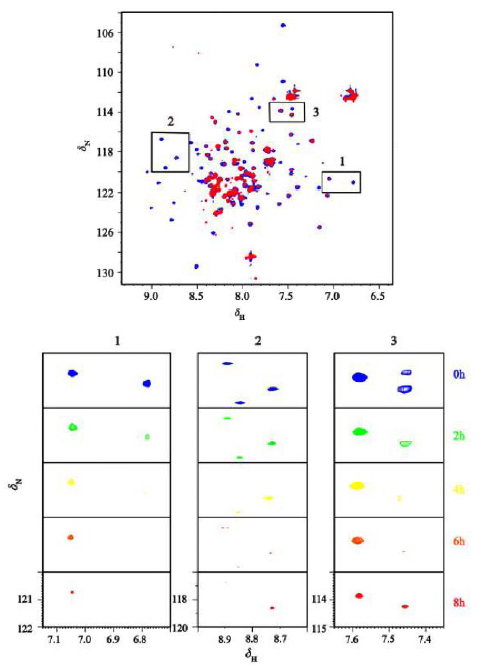
ATPase family AAA domain-containing protein 2 (ATAD2) is a chromatin regulator, also known as an oncogenic transcription cofactor. Its abnormal expression is closely related to the occurrence and development of various malignant tumors. ATAD2 consists of two domains: the ATPase domain and the bromodomain. The bromodomain can specifically recognize and interact with the acetylated lysines in proteins, which regulates the refactoring and transcription of chromosomes. In this work, we found that ATAD2 bromodomains are aggregated under normal solution conditions. Considering the possible impact of aggregation on the interaction between ATAD2 bromodomain and acetylated histone tail, we preliminarily investigated the aggregation of ATAD2 bromodomains mainly by nuclear magnetic resonance (NMR) and circular dichroism (CD) spectra. The results suggested that the aggregation is accompanied with structure alteration and possibly related to the physiological functions of cells. This study may provide new clues for the development of ATAD2 bromodomain inhibitors.
Key words: nuclear magnetic resonance (NMR); ATAD2; bromodomain; aggregation
Yuanfang WANG , Xiaohua WANG , Chang SHU , Xu ZHANG , Maili LIU , Danyun ZENG . The Aggregation of ATAD2 Bromodomain in Solution[J]. Chinese Journal of Magnetic Resonance, 2023 , 40(2) : 169 -178 . DOI: 10.11938/cjmr20222993
| [1] | EVANS C M, PHILLIPS M, MALONE K L, et al. Coordination of di-acetylated histone ligands by the ATAD2 bromodomain[J]. Int J Mol Sci, 2021, 22(17): 9128. |
| [2] | BOUSSOUAR F, JAMSHIDIKIA M, MOROZUMI Y, et al. Malignant genome reprogramming by ATAD2[J]. Biochim Biophys Acta-Gene Regul Mech, 2013, 1829(10): 1010-1014. |
| [3] | ZOU J X, REVENKO A S, LI L B, et al. ANCCA, an estrogen-regulated AAA+ ATPase coactivator for ER alpha, is required for coregulator occupancy and chromatin modification[J]. P Natl Acad Sci USA, 2007, 104(46): 18067-18072. |
| [4] | CIRO M, PROSPERINI E, QUARTO M, et al. ATAD2 is a novel cofactor for MYC, overexpressed and amplified in aggressive tumors[J]. Cancer Res, 2009, 69(21): 8491-8498. |
| [5] | KRAKSTAD C, TANGEN I L, HOIVIK E A, et al. ATAD2 overexpression links to enrichment of B-MYB-translational signatures and development of aggressive endometrial carcinoma[J]. Oncotarget, 2015, 6(29): 28440-28452. |
| [6] | ZOU J X, GUO L L, REVENKO A S, et al. Androgen-induced coactivator ANCCA mediates specific androgen receptor signaling in prostate cancer[J]. Cancer Res, 2009, 69(8): 3339-3346. |
| [7] | FOURET R, LAFFAIRE J, HOFMAN P, et al. A comparative and integrative approach identifies ATPase family, AAA domain containing 2 as a likely driver of cell proliferation in lung adenocarcinoma[J]. Clinical Cancer Research, 2012, 18(20): 5606-5616. |
| [8] | MURAKAMI H, ITO S, TANAKA H, et al. Establishment of new intraperitoneal paclitaxel-resistant gastric cancer cell lines and comprehensive gene expression analysis[J]. Anticancer Res, 2013, 33(10): 4299-4307. |
| [9] | CARON C, LESTRAT C, MARSAL S, et al. Functional characterization of ATAD2 as a new cancer/testis factor and a predictor of poor prognosis in breast and lung cancers[J]. Oncogene, 2010, 29(37): 5171-5181. |
| [10] | SHANG P, MENG F L, LIU Y D, et al. Overexpression of ANCCA/ATAD2 in endometrial carcinoma and its correlation with tumor progression and poor prognosis[J]. Tumor Biology, 2015, 36(6): 4479-4485. |
| [11] | HONG S, BI M, YAN Z, et al. Silencing of ATPase family AAA domain-containing protein 2 inhibits migration and invasion of colorectal cancer cells[J]. Neoplasma, 2016, 63(6): 846-855. |
| [12] | CHEN D, MARUSCHKE M, HAKENBERG O, et al. TOP2A, HELLS, ATAD2, and TET3 are novel prognostic markers in renal cell carcinoma[J]. Urology, 2017, 102: 265. e1-265.e7. |
| [13] | SNIDER J, THIBAULT G, HOURY W A. The AAA plus superfamily of functionally diverse proteins[J]. Genome Biol, 2008, 9(4): 216. |
| [14] | HANSON P I, WHITEHEART S W. AAA+ proteins: Have engine, will work[J]. Nat Rev Mol Cell Biol, 2005, 6(7): 519-529. |
| [15] | ZENG L, ZHOU M M. Bromodomain: an acetyl-lysine binding domain[J]. FEBS Lett, 2002, 513(1): 124-128. |
| [16] | FILIPPAKOPOULOS P, PICAUD S, MANGOS M, et al. Histone recognition and large-scale structural analysis of the human bromodomain family[J]. Cell, 2012, 149(1): 214-231. |
| [17] | PONCET-MONTANGE G, ZHAN Y A, BARDENHAGEN J P, et al. Observed bromodomain flexibility reveals histone peptide- and small molecule ligand-compatible forms of ATAD2[J]. Biochem J, 2015, 466(3): 37-46. |
| [18] | MOROZUMI Y, BOUSSOUAR F, TAN M J, et al. Atad2 is a generalist facilitator of chromatin dynamics in embryonic stem cells[J]. J Mol Cell Biol, 2016, 8(4): 349-362. |
| [19] | FILIPPAKOPOULOS P, PICAUD S, MANGOS M, et al. Histone Recognition and large-scale structural analysis of the human bromodomain family[J]. Cell, 2012, 149(1): 214-231. |
| [20] | OLZSCHA H, FEDOROV O, KESSLER B M, et al. CBP/p300 bromodomains regulate amyloid-like protein aggregation upon aberrant lysine acetylation[J]. Cell Chem Biol, 2017, 24(1): 9-23. |
| [21] | HARNER M J, CHAUDER B A, PHAN J, et al. Fragment-based screening of the bromodomain of ATAD2[J]. J Med Chem, 2014, 57(22): 9687-9692. |
| [22] | GAY J C, ECKENROTH B E, EVANS C M, et al. Disulfide bridge formation influences ligand recognition by the ATAD2 bromodomain[J]. Proteins, 2019, 87(2): 157-167. |
/
| 〈 |
|
〉 |