

Chinese Journal of Magnetic Resonance >
Fast Multi-channel Magnetic Resonance Imaging Based on PCAU-Net
Received date: 2022-03-29
Online published: 2022-08-26
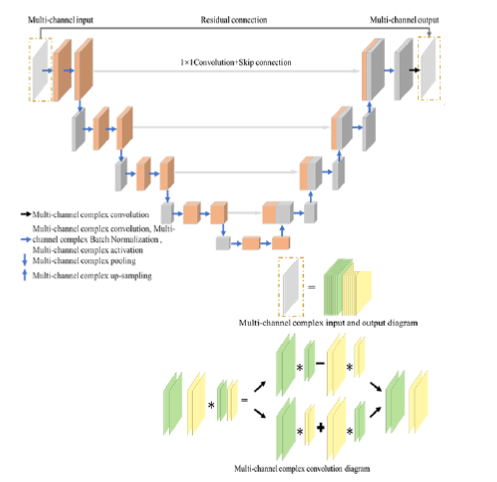
Multi-channel magnetic resonance imaging methods utilize multiple receiving coils to simultaneously under-sample k-space for fast magnetic resonance imaging. Post-processing algorithms were often used to restore the missing information for under-sampled images. However, the quality of reconstructed images is far from satisfying, especially at higher acceleration factor. In this backdrop, a fast multi-channel magnetic resonance imaging method based on parallel complex asymmetric U-Net (PCAU-Net) was proposed, which extends single-channel real-valued U-shaped convolutional neural network to multi-channel complex convolutional neural network. A U-shaped network with an asymmetric structure was designed to reduce the model complexity by reducing the network size in decoding. A 1×1 convolution block was added before skip-connection for PCAU-Net to share cross-channel information. The residual connection between the input and output of the network facilitates loss backpropagation. The experimental results show that by using regular and random sampling templates, the proposed PCAU-Net method can reconstruct the complex magnetic resonance images with high quality compared with the conventional generalized auto-calibrating partially parallel acquisitions (GRAPPA) reconstruction algorithm and iterative self-consistent parallel imaging reconstruction (SPIRiT) algorithm at different acceleration factors. Moreover, compared with the parallel complex U-Net (PCU-Net) method, PCAU-Net reduces model parameters and shortens the training time.
Weicheng SHI , Zhaoyang JIN , Zheng YE . Fast Multi-channel Magnetic Resonance Imaging Based on PCAU-Net[J]. Chinese Journal of Magnetic Resonance, 2023 , 40(1) : 39 -51 . DOI: 10.11938/cjmr20222992
| [1] | EDELMAN R R, WARACH S. Medical progress: Magnetic resonance imaging[J]. New Engl J Med, 1993, 328(11): 785-791. |
| [2] | BUXTON R B. Introduction to functional magnetic resonance imaging: principles and techniques[M]. Cambridge university press, 2009. |
| [3] | MORRIS S A, SLESNICK T C. Magnetic resonance imaging[J]. Visual Guide to Neonatal Cardiology, 2018: 104-108. |
| [4] | LARKMAN D J, NUNES R G. Parallel magnetic resonance imaging[J]. Phys Med Biol, 2007, 52(7): R15-55. |
| [5] | CARLSON J W. An algorithm for NMR imaging reconstruction based on multiple RF receiver coils[J]. J Magn Reson (1969), 1987, 74(2): 376-380. |
| [6] | HUTCHINSON M, RAFF U. Fast MRI data acquisition using multiple detectors[J]. Magn Reson Med, 1988, 6(1): 87-91. |
| [7] | GRISWOLD M A, JAKOB P M, HEIDEMANN R M, et al. Generalized autocalibrating partially parallel acquisitions (GRAPPA)[J]. Magn Reson Med, 2002, 47(6): 1202-1210. |
| [8] | PRUESSMANN K P, WEIGER M, SCHEIDEGGER M B, et al. SENSE: sensitivity encoding for fast MRI[J]. Magn Reson Med, 1999, 42(5): 952-962. |
| [9] | LUSTIG M, PAULY J M. SPIRiT: Iterative self-consistent parallel imaging reconstruction from arbitrary k-space[J]. Magn Reson Med, 2010, 64(2): 457-471. |
| [10] | DENG L, YU D. Deep learning: Methods and applications[J]. Found Trends Signal, 2014, 7(3,4): 197-387. |
| [11] | LECUN Y, BENGIO Y, HINTON G. Deep learning[J]. Nature, 2015, 521(7553): 436-444. |
| [12] | RONNEBERGER O, FISCHER P, BROX T. U-net: Convolutional networks for biomedical image segmentation[C]// International Conference on Medical image computing and computer-assisted intervention. Springer, Cham, 2015: 234-241. |
| [13] | WANG S S, SU Z H, YING L, et al. Accelerating magnetic resonance imaging via deep learning[C]// 2016 IEEE 13th international symposium on biomedical imaging (ISBI). IEEE, 2016: 514-517. |
| [14] | SCHLEMPER J, DUAN J, OUYANG C, et al. Data consistency networks for (calibration-less) accelerated parallel MR image reconstruction[EB/OL]. arXiv preprint, arXiv:19-09.11795, 2019. |
| [15] | SCHLEMPER J, QIN C, DUAN J M, et al. Σ-net: Ensembled iterative deep neural networks for accelerated parallel MR image reconstruction[EB/OL]. arXiv preprint, arXiv:1912.05480, 2019. |
| [16] | SRIRAM A, ZBONTAR J, MURRELL T, et al. GrappaNet: Combining parallel imaging with deep learning for multi-coil MRI reconstruction[C]// Proceedings of the IEEE/CVF Conference on Computer Vision and Pattern Recognition. 2020: 14315-14322. |
| [17] | LEE D, YOO J, TAK S, et al. Deep residual learning for accelerated MRI using magnitude and phase networks[J]. IEEE Trans Biomed Eng, 2018, 65(9): 1985-1995. |
| [18] | CHENG H T, WANG S S, KE Z W, et al. A Deep recursive cascaded convolutional network for parallel MRI[J]. Chinese J Magn Reson, 2019, 36(4): 437-445. |
| [18] | 程慧涛, 王珊珊, 柯子文, 等. 基于深度递归级联卷积神经网络的并行磁共振成像方法[J]. 波谱学杂志, 2019, 36(4): 437-445. |
| [19] | TRABELSI C, BILANIUK O, ZHANG Y, et al. Deep complex networks[EB/OL]. arXiv preprint, arXiv:1705.09792, 2017. |
| [20] | DEDMARI M A, CONJETI S, ESTRADA S, et al. Complex fully convolutional neural networks for MR image reconstruction[C]// International Workshop on Machine Learning for Medical Image Reconstruction. Springer, Cham, 2018: 30-38. |
| [21] | LIANG H Y, GONG Y, KERVADEC H, et al. Laplacian pyramid-based complex neural network learning for fast MR imaging[C]// Medical Imaging with Deep Learning. PMLR, New York, 2020: 454-464. |
| [22] | WANG S S, CHENG H T, YING L, et al. DeepcomplexMRI: Exploiting deep residual network for fast parallel MR imaging with complex convolution[J]. Magn Reson Imaging, 2020, 68: 136-147. |
| [23] | 施伟成, 王春林, 金朝阳. 基于PCU-Net网络的快速多通道磁共振成像方法[P]. 中国: CN112946545A, 2021-06-11. |
| [24] | MYRONENKO A. 3D MRI brain tumor segmentation using autoencoder regulari-zation[C]// International MICCAI Brainlesion Workshop. Springer, Cham, 2018: 311-320. |
| [25] | LIN M, CHEN Q, YAN S Q. Network in network[EB/OL]. arXiv preprint arXiv:1312.4400, 2013. |
| [26] | SZEGEDY C, LIU W, JIA Y, et al. Going deeper with convolutions[C]// Proceedings of the IEEE conference on computer vision and pattern recognition. IEEE, Boston, 2015: 1-9. |
| [27] | HE K M, ZHANG X Y, REN S Q, et al. Deep residual learning for image recognition[C]// Proceedings of the IEEE conference on computer vision and pattern recognition. IEEE, Las Vegas, 2016: 770-778. |
| [28] | WANG Z, BOVIK A C, SHEIKH H R, et al. Image quality assessment: from error visibility to structural similarity[J]. IEEE T Image Process, 2004, 13(4): 600-612. |
| [29] | ZHANG T, PAULY J M, VASANAWALA S S, et al. Coil compression for accelerated imaging with Cartesian sampling[J]. Magn Reson Med, 2013, 69(2): 571-582. |
/
| 〈 |
|
〉 |