

Chinese Journal of Magnetic Resonance >
Research Progress on Imaging Classification of Alzheimer’s Disease Based on Deep Learning
Received date: 2022-08-12
Online published: 2022-11-08
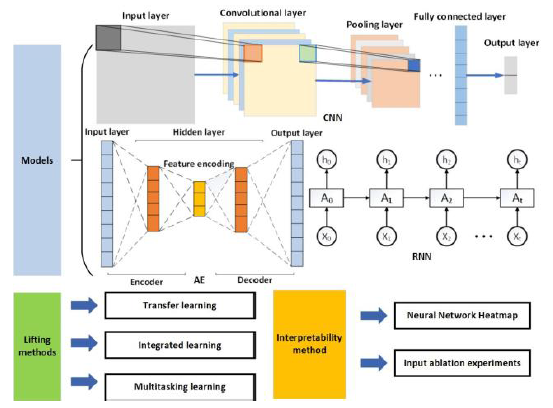
As global aging worsens and deep learning advances, the imaging classification of Alzheimer’s disease (AD) based on deep learning has become a hot topic of research. This paper reviewed the common deep learning models, evaluation criteria and public datasets in AD imaging classification tasks, discussed the application of different image modalities in AD imaging classification. The content was focused on the improvement of deep learning models applied to AD imaging classification. The studies of model interpretability were also introduced. Finally, the paper summarized and compared the classification models mentioned, identified the brain regions related to AD image classification, and outlined the future research directions in this field.
Chengyi QIAN , Yuanjun WANG . Research Progress on Imaging Classification of Alzheimer’s Disease Based on Deep Learning[J]. Chinese Journal of Magnetic Resonance, 2023 , 40(2) : 220 -238 . DOI: 10.11938/cjmr20223013
| [1] | JACK Jr C R, BENNETT D A, BLENNOW K, et al. NIA-AA research framework: Toward a biological definition of Alzheimer’s disease[J]. Alzheimers Dement, 2018, 14(4): 535-562. |
| [2] | SCHELTENS P, DE STROOPER B, KIVIPELTO M, et al. Alzheimer’s disease[J]. The Lancet, 2021, 397(10284): 1577-1590. |
| [3] | ANDERSON N D. State of the science on mild cognitive impairment[J]. J Gerontol B Psycholo Sci Soc Sci, 2020, 75(7): 1359-1360. |
| [4] | MAGGIPINTO T, BELLOTTI R, AMOROSO N, et al. DTI measurements for Alzheimer’s classification[J]. Phys Med Biol, 2017, 62(6): 2361-2375. |
| [5] | LAHMIRI S, SHMUEL A. Performance of machine learning methods applied to structural MRI and ADAS cognitive scores in diagnosing Alzheimer’s disease[J]. Biomed Signal Proces, 2019, 52: 414-419. |
| [6] | ELSHATOURY H, AVOTS E, ANBARJAFARI G, et al. Volumetric histogram-based Alzheimer’s disease detection using support vector machine[J]. J Alzheimers Dis, 2019, 72(2): 515-524. |
| [7] | UYSAL G, OZTURK M. Hippocampal atrophy based Alzheimer’s disease diagnosis via machine learning methods[J]. J Neurosci Meth, 2020, 337: 108669. |
| [8] | CHU Y, XU W L. Review of early classification of Alzheimer’s disease based on computer-aided diagnosistechnology[J]. Computer Engineering & Science, 2022, 44(5): 879-893. |
| [8] | 楚阳, 徐文龙. 基于计算机辅助诊断技术的阿尔兹海默症早期分类研究综述[J]. 计算机工程与科学, 2022, 44(5): 879-893. |
| [9] | YAO X F, YUAN Z B, BU X X. The early predication of Alzheimer's disease based on intelligent radiomics technology[J]. Sci Technol Rev, 2021, 39(20): 101-109. |
| [9] | 姚旭峰, 袁增贝, 卜溪溪. 基于智能影像基因组学技术的阿尔茨海默病预测进展[J]. 科技导报, 2021, 39(20): 101-109. |
| [10] | ZHU Y X, FENG W, GUO X H. Application of deep learning method in brain image of Alzheimer’s disease[J]. Med Recapitulate, 2019, 25(18): 3562-3566. |
| [10] | 朱映璇, 冯巍, 郭秀花. 深度学习方法在阿尔茨海默病脑图像方面的应用进展[J]. 医学综述, 2019, 25(18): 3562-3566. |
| [11] | TANVEER M, RICHHARIYA B, KHAN R U, et al. Machine learning techniques for the diagnosis of Alzheimer’s disease: a review[J]. ACM T Multim Comput, 2020, 16(1s): 30. |
| [12] | FAN Z, XU F, QI X, et al. Classification of Alzheimer’s disease based on brain MRI and machine learning[J]. Neural Comput Appl, 2020, 32(7): 1927-1936. |
| [13] | KARAMI V, NITTARI G, TRAINI E, et al. An optimized decision tree with genetic algorithm rule-based approach to reveal the brain’s changes during Alzheimer’s disease dementia[J]. J Alzheimers Dis, 2021, 84(4): 1577-1584. |
| [14] | ALICKOVIC E, SUBASI A, ALZHEIMERS DIS N. Automatic detection of Alzheimer disease based on histogram and random forest[C]// Banja Luka, BOSNIA & HERCEG: International Conference on Medical and Biological Engineering in Bosnia and Herzegovina (CMBEBIH), 2019, 73: 91-96. |
| [15] | ABUHMED T, EI-SAPPAGH S, ALONSO J M. Robust hybrid deep learning models for Alzheimer’s progression detection[J]. Knowl-Based Syst, 2021, 213: 106688. |
| [16] | JU R H, HU C H, ZHOU P, et al. Early diagnosis of Alzheimer’s disease based on resting-state brain networks and deep learning[J]. IEEE ACM T Comput Bi, 2019, 16(1): 244-257. |
| [17] | BAYDARGIL H B, PARK J S, KANG D Y, et al. Classification of Alzheimer’s disease using stacked sparse convolutional autoencoder[C]// Jeju, SOUTH KOREA:19th International Conference on Control, Automation and Systems (ICCAS), 2019, 891-895. |
| [18] | OH K, CHUNG Y C, KIM K W, et al. Classification and visualization of Alzheimer’s disease using volumetric convolutional neural network and transfer learning[J]. Sci Rep, 2019, 9(1): 18150. |
| [19] | BI X, ZHAO X G, HUANG H, et al. Functional brain network classification for Alzheimer’s disease detection with deep features and extreme learning machine[J]. Cogn Comput, 2020, 12(3): 513-527. |
| [20] | YI?IT A, ISIK Z. Applying deep learning models to structural MRI for stage prediction of Alzheimer’s disease[J]. Turk J Elec Eng & Comp Sci, 2020, 28(1): 196-210. |
| [21] | YU S, LIAO W H. An alzheimer’s disease classificationalgorithm based on 3D-ResNet[J]. Computer Engineering & Science, 2020, 42(6): 1068-1075. |
| [21] | 郁松, 廖文浩. 基于3D-ResNet的阿尔兹海默症分类算法研究[J]. 计算机工程与科学, 2020, 42(6): 1068-1075. |
| [22] | BI X L, LI S T, XIAO B, et al. Computer aided Alzheimer's disease diagnosis by an unsupervised deep learning technology[J]. Neurocomputing, 2020, 392: 296-304. |
| [23] | GUO H B, ZHANG Y J. Resting state fMRI and improved deep learning algorithm for earlier detection of Alzheimer’s disease[J]. IEEE Access, 2020, 8: 115383-115392. |
| [24] | PARMAR H S, NUTTER B, LONG R, et al. Deep learning of volumetric 3D CNN for fMRI in Alzheimer’s disease classification[C]// Houston, TX: SPIE Medical Imaging Conference - Biomedical Applications in Molecular, Structural, and Functional Imaging, 2020, 11317. |
| [25] | REGINOLD W, LUEDKE A C, ITORRALBA J, et al. Altered superficial white matter on tractography MRI in Alzheimer’s disease[J]. Dementia and Geriatric Cognitive Disorders Extra, 2016, 6(2): 233-241. |
| [26] | BIGHAM B, ZAMANPOUR S A, ZEMORSHIDI F, et al. Identification of superficial white matter abnormalities in Alzheimer’s disease and mild cognitive impairment using diffusion tensor imaging[J]. J Alzheimers Dis Rep, 2020, 4(1): 49-59. |
| [27] | MASSALIMOVA A, VAROL H A, IEEE. Input agnostic deep learning for Alzheimer’s disease classification using multimodal MRI images[C]// Electr Network:43rd Annual International Conference of the IEEE-Engineering-in-Medicine-and-Biology-Society (IEEE EMBC), 2021, 10.1109/embc46164.2021.96298072875-2878. |
| [28] | DENG L, WANG Y J. Hybrid diffusion tensor imaging feature-based AD classification[J]. J X-Ray Sci Technol, 2021, 29(1): 151-169. |
| [29] | MARZBAN E N, ELDEIB A M, YASSINE I A, et al. Alzheimer's disease diagnosis from diffusion tensor images using convolutional neural networks[J]. PLoS ONE, 2020, 15(3): e0230409. |
| [30] | KANG L, JIANG J W, HUANG J J, et al. Identifying early mild cognitive impairment by multi-modality MRI-based deep learning[J]. Front Aging Neurosci, 2020, 12: 206. |
| [31] | GAO F. Integrated positron emission tomography/magnetic resonance imaging in clinical diagnosis of Alzheimer’s disease[J]. Eur J Radiol, 2021, 145: 1100170. |
| [32] | RABINOVICI G D, GATSONIS C, APGAR C, et al. Association of amyloid positron emission tomography with subsequent change in clinical management among medicare beneficiaries with mild cognitive impairment or dementia[J]. JAMA-J Am Med Assoc, 2019, 321(13): 1286-1294. |
| [33] | PUNJABI A, MARTERSTECK A, WANG Y R, et al. Neuroimaging modality fusion in Alzheimer’s classification using convolutional neural networks[J]. PLoS ONE, 2019, 14(12): e0225759. |
| [34] | LI Y, DING W, WANG X, et al. Alzheimer’s disease classification model based on MED-3D transfer learning[C]// Proceedings of the 2nd International Symposium on Artificial Intelligence for Medicine Sciences, 2021, 394-398. |
| [35] | CHEN S, MA K, ZHENG Y. Med3d: Transfer learning for 3d medical image analysis[J]. arXiv preprint, arXiv:.00625, 2019. |
| [36] | KONG L X, WU H F, ZENG Y, et al. Transfer-learning feature extraction from rs-fMRI for classification of early mild cognitive impairment[J]. CAAI Transactions on Intelligent Systems, 2021, 16(4): 662-672. |
| [36] | 孔伶旭, 吴海锋, 曾玉, 等. 迁移学习特征提取的rs-fMRI早期轻度认知障碍分类[J]. 智能系统学报, 2021, 16(4): 662-672. |
| [37] | BIN TUFAIL A, MA Y K, ZHANG Q N. Binary classification of Alzheimer’s disease using sMRI imaging modality and deep learning[J]. J Digit Imaging, 2020, 33(5): 1073-1090. |
| [38] | MEHMOOD A, YANG S Y, FENG Z X, et al. A transfer learning approach for early diagnosis of Alzheimer’s disease on MRI images[J]. Neuroscience, 2021, 460: 43-52. |
| [39] | LIAN C F, LIU M X, ZHANG J, et al. Hierarchical fully convolutional network for joint atrophy localization and Alzheimer’s disease diagnosis using structural MRI[J]. IEEE Trans Pattern Anal Mach Intell, 2020, 42(4): 880-893. |
| [40] | BASAIA S, AGOSTA F, WAGNER L, et al. Automated classification of Alzheimer's disease and mild cognitive impairment using a single MRI and deep neural networks[J]. Neuroimage-Clin, 2019, 21: 101645. |
| [41] | CHOI J Y, LEE B H. Combining of multiple deep networks via ensemble generalization loss, based on mri images, for Alzheimer’s disease classification[J]. IEEE Signal Process Lett, 2020, 27: 206-210. |
| [42] | ZENG A, JIA L F, PAN D, et al. Early prognosis of Alzheimer’s disease based on convolutional neural networks and ensemble learning[J]. J Biomed Eng, 2019, 36(5): 711-719. |
| [42] | 曾安, 贾龙飞, 潘丹, 等. 基于卷积神经网络和集成学习的阿尔茨海默症早期诊断[J]. 生物医学工程学杂志, 2019, 36(5): 711-719. |
| [43] | SPASOV S, PASSAMONTI L, DUGGENTO A, et al. A parameter-efficient deep learning approach to predict conversion from mild cognitive impairment to Alzheimer’s disease[J]. Neuroimage, 2019, 189: 276-287. |
| [44] | AMIEVA H, OUVRARD C, GIULIOLI C, et al. Self-reported hearing loss, hearing aids, and cognitive decline in elderly adults: A 25-year study[J]. J Am Geriatr Soc, 2015, 63(10): 2099-2104. |
| [45] | SARATXAGA C L, MOYA I, PICON A, et al. MRI deep learning-based solution for Alzheimer’s disease prediction[J]. J Pers Med, 2021, 11(9): 902. |
| [46] | ZENG N Y, LI H, PENG Y H. A new deep belief network-based multi-task learning for diagnosis of Alzheimer’s disease[J]. Neural Comput Appl, 2021, 10.1007/s00521-021-06149-6. |
| [47] | KATABATHULA S, WANG Q Y, XU R. Predict Alzheimer’s disease using hippocampus MRI data: a lightweight 3D deep convolutional network model with visual and global shape representations[J]. Alzheimers Res Ther, 2021, 13: 104. |
| [48] | LIU M H, LI F, YAN H, et al. A multi-model deep convolutional neural network for automatic hippocampus segmentation and classification in Alzheimer's disease[J]. Neuroimage, 2020, 208: 116459. |
| [49] | ZHANG X, HAN L, ZHU W, et al. An explainable 3D residual self-attention deep neural network for joint atrophy localization and Alzheimer’s disease diagnosis using structural MRI[J]. IEEE J Biomed Health Inform, 2022, 26(11): 5289-5297. |
| [50] | RAJU M, THIRUPALANI M, VIDHYABHARATHI S, et al. Deep learning based multilevel classification of Alzheimer’s disease using MRI scans[J]. IOP Conf Ser: Mater Sci Eng, 2021, 1084: 012017. |
| [51] | GUAN H, WANG C Y, CHENG J, et al. A parallel attention-augmented bilinear network for early magnetic resonance imaging-based diagnosis of Alzheimer’s disease[J]. Hum Brain Mapp, 2022, 43(2): 760-772. |
| [52] | QIU S R, JOSHI P S, MILLER M I, et al. Development and validation of an interpretable deep learning framework for Alzheimer’s disease classification[J]. Brain, 2020, 143(6): 1920-1933. |
| [53] | 金祝新. 迁移学习与可视化辅助的阿尔茨海默症早期诊断[D]. 杭州: 杭州电子科技大学, 2019. |
| [54] | KWAK K, STANFORD W, DAYAN E, et al. Identifying the regional substrates predictive of Alzheimer’s disease progression through a convolutional neural network model and occlusion[J]. Hum Brain Mapp, 2022, 43(18): 5509-5519. |
| [55] | VENUGOPALAN J, TONG L, HASSANZADEH H R, et al. Multimodal deep learning models for early detection of Alzheimer’s disease stage[J]. Sci Rep, 2021, 11(1): 3254. |
| [56] | SHAHAMAT H, ABADEH M S. Brain MRI analysis using a deep learning based evolutionary approach[J]. Neural Netw, 2020, 126: 218-234. |
| [57] | BEHESHTI I, GANAIE M A, PALIWAL V, et al. Predicting brain age using machine learning algorithms: A comprehensive evaluation[J]. IEEE J Biomed Health Inform, 2022, 26(4): 1432-1440. |
| [58] | BASHYAM V M, ERUS G, DOSHI J, et al. MRI signatures of brain age and disease over the lifespan based on a deep brain network and 14 468 individuals worldwide[J]. Brain, 2020, 143(7): 2312-2324. |
/
| 〈 |
|
〉 |