

Chinese Journal of Magnetic Resonance >
Optimizing Sensitivity-enhanced Quantitative 13C NMR Experiment by Genetic Algorithm
Received date: 2023-03-03
Online published: 2023-04-21
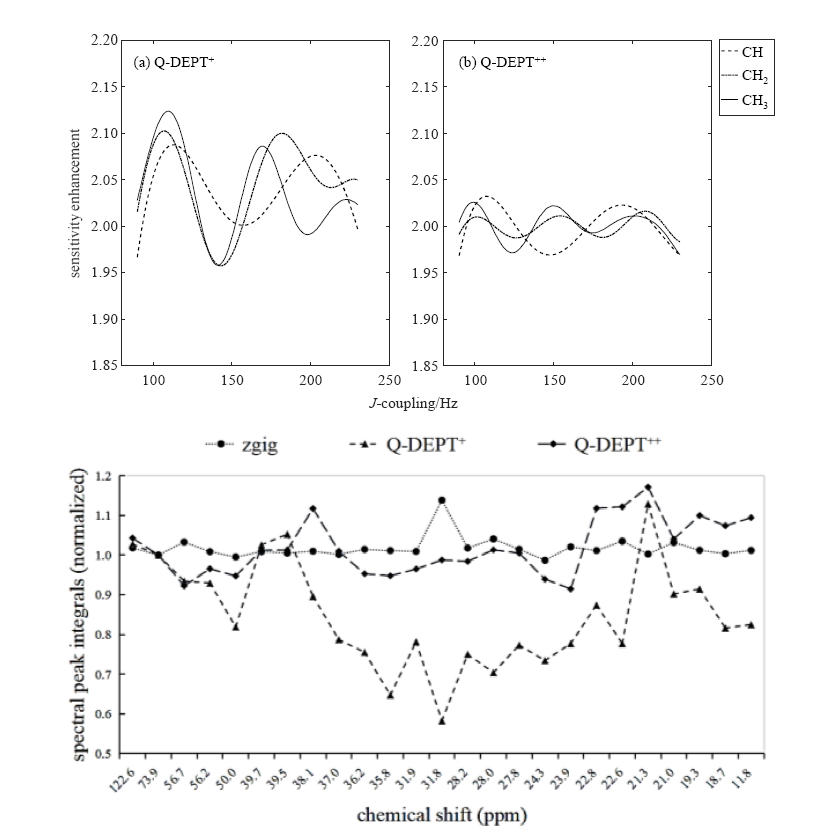
Quantitative NMR experiments are an essential part of NMR analysis, which play a critical role in component analysis and compound structure identification. Carbon atoms form the framework of organic compounds, and 13C NMR has unique advantages in organic analysis due to its wide chemical shift range, narrow spectral peaks, and broadband decoupling capability. However, the low natural abundance, low gyromagnetic ratio, and long longitudinal relaxation time of 13C nuclei hinder its wider application in quantitative experiments. In our previous work, we proposed the Q-DEPT+ pulse sequence and designed a double loop of pulse flip angle and polarization transfer time, which allows for uniform sensitivity enhancement for the three types of carbon nuclei, CH, CH2, and CH3, within a wide 1JCH range, making it suitable for quantitative 13C NMR. In this study, we further optimized the polarization transfer time and read pulse width of the Q-DEPT+ experiment by using a genetic algorithm, and replaced the 180° hard pulse in the 13C channel with a G5 composite pulse that compensates for the frequency offset effect. The optimized pulse sequence was named Q-DEPT ++. Quantitative experiments were performed on cholesterol acetate in CDCl3 by using the reverse-gated decoupling pulse sequence (zgig), Q-DEPT+, and Q-DEPT++ respectively, and the quantification accuracy and sensitivity of the three pulse sequences were compared. The results showed that Q-DEPT++ has obvious improvement in both quantification accuracy and sensitivity.
Key words: liquid-state NMR; quantitative NMR; 13C NMR; DEPT; genetic algorithm; sensitivity enhancement
Linhong SONG , Xin CHAI , Xu ZHANG , Bin JIANG , Maili LIU . Optimizing Sensitivity-enhanced Quantitative 13C NMR Experiment by Genetic Algorithm[J]. Chinese Journal of Magnetic Resonance, 2023 , 40(4) : 365 -375 . DOI: 10.11938/cjmr20233057
| [1] | KIM H C, YIM D-G, KIM J W, et al. Nuclear magnetic resonance (NMR)-based quantification on flavor-active and bioactive compounds and application for distinguishment of chicken breeds[J]. Food Sci Anim Resour, 2021, 41(2): 312-323. |
| [2] | XIAO K, GONG C, GUO Q S, et al. Simultaneous determination of fatty acids at sn-1,3 and sn-2 of triglyceride in edible oils by quantitative C-13-nuclear magnetic resonance[J]. Chinese Journal of Analytical Chemistry, 2020, 48(6): 802-810. |
| [2] | 肖坤, 龚灿, 郭强胜, 等. 定量核磁共振碳谱同时测定食用油中甘油三酯的sn-1,3和sn-2脂肪酸含量[J]. 分析化学, 2020, 48(6): 802-810. |
| [3] | LI Y, MAO W, LIU C, et al. Quantitative determination of fatty acid compositions in edible oils using J-selective 13C QDEPT[J]. Food Anal Method, 2019, 12(4): 991-997. |
| [4] | COLOMBO C, AUPIC C, LEWIS A R, et al. In situ determination of fructose isomer concentrations in wine using 13C quantitative nuclear magnetic resonance spectroscopy[J]. J Agr Food Chem, 2015, 63(38): 8551-8559. |
| [5] | WANG X H, SUN P, ZHANG X, et al. Application of magnetic resonance technique to quality and safety evaluation of food[J]. Chinese J Magn Reson, 2017, 34(2): 245-256. |
| [5] | 王小花, 孙鹏, 张许, 等. 磁共振技术在食品质量与安全研究中的应用[J]. 波谱学杂志, 2017, 34(2): 245-256. |
| [6] | GRADL K, TAIBON J, SINGH N, et al. An isotope dilution LC-MS/MS-based candidate reference method for the quantification of androstenedione in human serum and plasma[J]. Clin Mass Spectrom, 2020, 16: 1-10. |
| [7] | SERRANO J N P, BENEDITO L E C, DE SOUZA M P, et al. Quantitative NMR as a tool for analysis of new psychoactive substances[J]. Forensic Chem, 2020, 218. |
| [8] | CHOULES M P, KLEIN L L, LANKIN D C, et al. Residual complexity does impact organic chemistry and drug discovery: The case of rufomyazine and rufomycin[J]. J Org Chem, 2018, 83(12): 6664-6672. |
| [9] | KAUFMANN M, MUGGE C, KROH L W. Theory of the milieu dependent isomerisation dynamics of reducing sugars applied to D-erythrose[J]. Carbohyd Res, 2015, 418: 89-97. |
| [10] | WANG X, YANG Y, ZHONG H, et al. Molecular H2O promoted catalytic bicarbonate reduction with methanol into formate over Pd0.5Cu0.5/C under mild hydrothermal conditions[J]. Green Chem, 2021, 23(1): 430-439. |
| [11] | SOLOVYOV A, YABUSHITA M, KATZ A. Mechanical control of rate processes: Effect of ligand steric bulk on CO exchange in trisubstituted tetrairidium cluster catalysts[J]. J Phys Chem C, 2020, 124(48): 26279-26286. |
| [12] | CERCEAU C I, BARBOSA L C A, ALVARENGA E S, et al. A validated 1H NMR method for quantitative analysis of α-bisabolol in essential oils of Eremanthus erythropappus[J]. Talanta, 2016, 161: 71-79. |
| [13] | VIOLANTE F G M, WOLLINGER W, GUIMAR?ES E F, et al. Use of quantitative 1H and 13C NMR to determine the purity of organic compound reference materials: a case study of standards for nitrofuran metabolites[J]. Anal Bioanal Chem, 2021, 413(6): 1701-1714. |
| [14] | KEMPRAI P, MAHANTA B P, BORA P K, et al. A 1H NMR spectroscopic method for the quantification of propenylbenzenes in the essential oils: Evaluation of key odorants, antioxidants and post-harvest drying techniques for Piper betle L[J]. Food Chem, 2020, 331: 127278. |
| [15] | MARCHETTI L, BRIGHENTI V, ROSSI M, et al. Use of 13C-qNMR spectroscopy for the analysis of non-psychoactive cannabinoids in fibre-type Cannabis sativa L. (Hemp)[J]. Molecules, 2019, 24(6): 1138. |
| [16] | LANKHORST P, VAN RIJN J, DUCHATEAU A. One-dimensional 13C NMR is a simple and highly quantitative method for enantiodiscrimination[J]. Molecules, 2018, 23(7): 1785. |
| [17] | LIU L H, JIANG B, CHEN D X, et al. The status and challenge of the domestic manufacturing of superconduct magnetic resonance instruments in China[J]. Chinese J Magn Reson, 2022, 39(03): 345-355. |
| [17] | 刘莲花, 蒋滨, 陈代谢, 等. 超导磁共振仪器设备国产化现状及挑战[J]. 波谱学杂志, 2022, 39(03): 345-355. |
| [18] | HUANG X, ZHANG Z L, HU X N, et al. Research progresses concerning the superconducting joints used in nuclear magnetic resonance magnets[J]. Chinese J Magn Reson, 2021, 38(03): 424-432. |
| [18] | 黄兴, 张子立, 胡新宁, 等. 核磁共振磁体超导接头工艺研究进展[J]. 波谱学杂志, 2021, 38(03): 424-432. |
| [19] | OVERHAUSER A W. Polarization of nuclei in metals[J]. Phys Rev, 1953, 92(2): 411-415. |
| [20] | MORRIS G A, FREEMAN R. Enhancement of nuclear magnetic-resonance signals by polarization transfer[J]. J Am Chem Soc, 1979, 101(3): 760-762. |
| [21] | DODDRELL D, PEGG D, BENDALL M R. Distortionless enhancement of NMR signals by polarization transfer[J]. J Magn Reson (1969), 1982, 48(2): 323-327. |
| [22] | BODENHAUSEN G, RUBEN D J. Natural abundance nitrogen-15 NMR by enhanced heteronuclear spectroscopy[J]. Chem Phys Lett, 1980, 69(1): 185-189. |
| [23] | HEIKKINEN S, TOIKKA M M, KARHUNEN P T, et al. Quantitative 2D HSQC (Q-HSQC) via suppression of J-dependence of polarization transfer in NMR spectroscopy: Application to wood lignin[J]. J Am Chem Soc, 2003, 125(14): 4362-4367. |
| [24] | HENDERSON T J. Sensitivity-enhanced quantitative 13C NMR spectroscopy via cancellation of 1JCH dependence in DEPT polarization transfers[J]. J Am Chem Soc, 2004, 126(12): 3682-3683. |
| [25] | FRIEBOLIN H, BECCONSALL J K. Basic one-and two-dimensional NMR spectroscopy[M]. Wiley-vch Weinheim, 2005. |
| [26] | JIANG B, XIAO M, LIU H L, et al. Optimized quantitative DEPT and quantitative POMMIE experiments for 13C NMR[J]. Anal Chem, 2008, 80(21): 8293-8298. |
| [27] | MLAB[EB/OL]. https://www.civilized.com. |
| [28] | M?KEL? A V, KILPEL?INEN I, HEIKKINEN S. Quantitative 13C NMR spectroscopy using refocused constant-time INEPT, Q-INEPT-CT[J]. J Magn Reson, 2010, 204(1): 124-130. |
| [29] | SHAKA A J. Composite pulses for ultra-broadband spin inversion[J]. Chem Phys Lett, 1985, 120(2): 201-205. |
| [30] | MANU V S, KUMAR A. Fast and accurate quantification using Genetic Algorithm optimized 1H-13C refocused constant-time INEPT[J]. J Magn Reson, 2013, 234: 106-111. |
| [31] | HOLLAND J H. Outline for a logical theory of adaptive systems[J]. J ACM, 1962, 9(3): 297-314. |
| [32] | HOLLAND J H. Adaptation in natural and artificial systems: an introductory analysis with applications to biology, control, and artificial intelligence[M]. MIT press, 1992. |
| [33] | BECHMANN M, CLARK J, SEBALD A. Genetic algorithms and solid state NMR pulse sequences[J]. J Magn Reson, 2013, 228: 66-75. |
| [34] | PANG Y, SHEN G X. Improving excitation and inversion accuracy by optimized RF pulse using genetic algorithm[J]. J Magn Reson, 2007, 186(1): 86-93. |
| [35] | RAY FREEMAN W X. Design of magnetic resonance experiments by genetic[J]. J Magn Reson, 1987, 75(1): 184-189. |
| [36] | MANU V S, VEGLIA G. Genetic algorithm optimized triply compensated pulses in NMR spectroscopy[J]. J Magn Reson, 2015, 260: 136-143. |
| [37] | XIA Y, ROSSI P, SUBRAHMANIAN M V, et al. Enhancing the sensitivity of multidimensional NMR experiments by using triply-compensated π pulses[J]. J Biomol NMR, 2017, 69(4): 237-243. |
| [38] | KEELER J. Understanding NMR spectroscopy[M]. 2rd Edition ed.ed. the United States: Wiley, 2010. |
| [39] | LEVITT M H. Spin dynamics basics of nuclear magnetic resonance[M]. 2nd edition ed. the United States: Wiley, 2007. |
| [40] | FREEMAN R, HILL H, KAPTEIN R. Proton-decoupled NMR. Spectra of carbon-13 with the nuclear overhauser effect suppressed[J]. J Magn Reson (1969), 1972, 7(3): 327-329. |
| [41] | Spectral Database for Organic Compounds (SDBS)[EB/OL]. https://sdbs.db.aist.go.jp/sdbs/cgi-bin/direct_frame_top.cgi. |
/
| 〈 |
|
〉 |