

Chinese Journal of Magnetic Resonance >
Development and Validation of Zero-field NMR Spectrometer Based on Compact Atomic Magnetometer
Received date: 2023-03-26
Online published: 2023-06-05
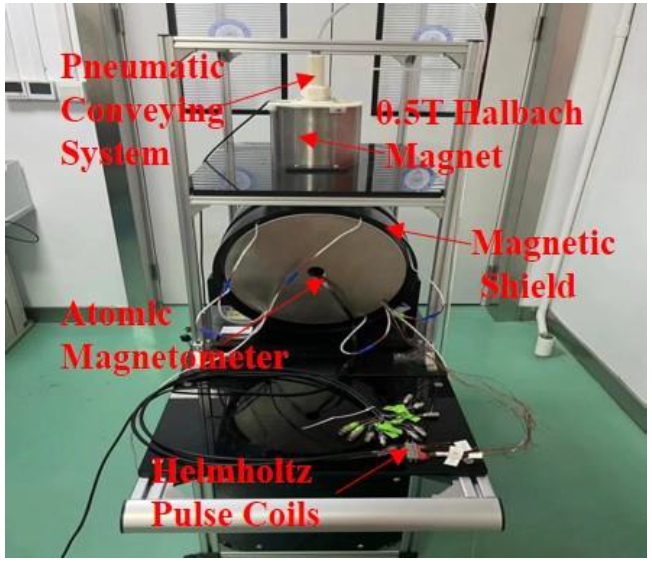
Conventional high-field nuclear magnetic resonance (NMR) spectrometer necessitates advanced superconducting technology, which usually involves a magnet of large volume and high maintenance cost. Moreover, strong magnet often has severe magnetic field inhomogeneity, leading to NMR line broadening. Zero- to ultralow-field (ZULF) NMR emerged as a complementary approach to traditional high-field NMR techniques. In this paper, a portable zero-field NMR spectrometer based on a compact atomic magnetometer was developed, which adopted an integrated control system based on a multi-function data acquisition card (National Instruments PCIe-6353). The spectrometer is of a main magnetic field strength less than 1 nT and enables achieving high-resolution J-spectrum under zero-field environment. Specifically, a series of single pulse excitation experiments for the initial adiabatic state was carried out to calibrate the triaxial magnetic field coils. Then a modified composite pulse sequence was developed to further validate the performance of zero-field NMR spectrometer by single-spin control experiments for the 13C-1H spin system.
Key words: zero-field NMR; J-spectroscopy; atomic magnetometer; single-spin control
Fangyue FU , Qingqian GUO , Xiaoyu FENG , Jiayu XU , Zekun YAO , Tao HU , Xiaodong YANG , Yan CHANG . Development and Validation of Zero-field NMR Spectrometer Based on Compact Atomic Magnetometer[J]. Chinese Journal of Magnetic Resonance, 2024 , 41(1) : 87 -98 . DOI: 10.11938/cjmr20233060
| [1] | BAHTI A, TELFAH A, LAMBERT J, et al. Optimal control pulses for subspectral editing in low field NMR[J]. J Magn Reson, 2021, 328: 106993. |
| [2] | JOHN W B, TENG WU, JAMES E, et al. Zero- to ultralow-field nuclear magnetic resonance J-spectroscopy with commercial atomic magnetometers[J]. J Magn Reson, 2020, 314: 106723. |
| [3] | TAYLER MICHALE C D, THOMAS T, SJOLANDER TOBIAS F, et al. Invited review article: instrumentation for nuclear magnetic resonance in zero and ultralow magnetic field[J]. Rev Sci Instrum, 2017, 88(9): 091101. |
| [4] | TOBIAS F S, JOHN W B, DMITRY B, et al. Two-dimensional single- and multiple-quantum correlation spectroscopy in zero-field nuclear magnetic resonance[J]. J Magn Reson, 2020, 318: 106781. |
| [5] | ALLRED J C, LYMAN R N, KORNACK T W, et al. High-sensitivity atomic magnetometer unaffected by spin-exchange relaxation[J]. Phys Rev Lett, 2002, 89(13): 130801. |
| [6] | LEDBETTER M P, THEIS T, BLANCHARD J W, et al. Near-zero-field nuclear magnetic resonance[J]. Phys Rev B: Condens, 2011, 107(10): 107601. |
| [7] | JOHN W B, MICAH P L, THOMAS T, et al. High-resolution zero-field NMR J-spectroscopy of aromatic compounds[J]. J Am Chem Soc, 2013, 135(9): 3607-3612. |
| [8] | LIU G B, LI X F, SUN X P, et al. Ultralow field NMR spectrometer with an atomic magnetometer near room temperature[J]. J Magn Reson, 2013, 237: 158-163. |
| [9] | JIANG M, ROMAN P F, WU T, et al. Magnetic gradiometer for the detection of zero- to ultralow-field nuclear magnetic resonance[J]. Phys Rev Appl, 2019, 11(2): 024005. |
| [10] | JIANG M, WU T, JOHN W B, et al. Experimental benchmarking of quantum control in zero-field nuclear magnetic resonance[J]. Sci Adv, 2018, 4(6): 6327. |
| [11] | BIAN J, JIANG M, CUI J Y, et al. Universal quantum control in zero-field nuclear magnetic resonance[J]. Phys Rev A, 2017, 95(5): 052342. |
| [12] | JIANG M, BIAN J, LIU X M, et al. Numerical optimal control of spin systems at zero magnetic field[J]. Phys Rev A, 2018, 97(6): 062118. |
| [13] | JI Y L, BIAN J, JIANG M, et al. Time-optimal control of independent spin-1/2 systems under simultaneous control[J]. Phys Rev A, 2018, 98(6): 062108. |
| [14] | JIANG M, JI Y L, LI Q, et al. Multiparameter quantum metrology using strongly interacting spin systems[J]. arXiv.org, 2021, DOI: https://doi.org/10.48550/arXiv.2104.00211 |
| [15] | DANILA A B, MICHAEL C D, IRENE M R, et al. Zero-field nuclear magnetic resonance of chemically exchanging systems[J]. Nat Commun, 2019, 10: 3002. |
| [16] | PIOTR P, SZYMON P, DMITRY B, et al. Zero- to ultralow-field NMR spectroscopy of small biomolecules[J]. Anal Chem, 2021, 93(6): 3226-3232. |
| [17] | SAVUKOV I M, ZOTEV V S, VOLEGOV P L, et al. MRI with an atomic magnetometer suitable for practical imaging applications[J]. J Magn Reson, 2009, 199(2): 188-191. |
| [18] | SHENG D, PERRY A R, KRZYZEWSKI S P, et al. A microfabricated optically-pumped magnetic gradiometer[J]. Appl Phys Lett, 2017, 110(3): 031106. |
| [19] | SHENG J W, WAN S G, SUN Y F, et al. Magnetoencephalography with a Cs-based high-sensitivity compact atomic magnetometer[J]. Rev Sci Instrum, 2017, 88(9): 094304. |
| [20] | THEIS T, LEDBETTER M P, KERVERN G, et al. Zero-field NMR enhanced by parahydrogen in reversible exchange[J]. J Am Chem Soc, 2012, 134(9): 3987-3990. |
| [21] | CI J, YANG X, XIN J X, et al. Preparation and lifetime studies of the singlet state of five spins in hexene molecules used to guide the preservation of the parahydrogen-induced nuclear polarization state[J]. Chinese J Magn Reson, 2023, 40(1):30-38. |
| [21] | 慈杰, 杨雪, 辛家祥, 等. 用于指导仲氢诱导核极化状态保存的己烯分子中五自旋的单重态制备和寿命研究[J]. 波谱学杂志, 2023, 40(1): 30-38. |
| [22] | BODENSTEDT S, MITCHELL M W, TAYLER M C D. Fast-field-cycling ultralow-field nuclear magnetic relaxation dispersion[J]. Nat Commun, 2021, 12: 4041. |
| [23] | DUDARI B B, JAMES E, JOHN W B, et al. Chemical reaction monitoring using zero-field nuclear magnetic resonance enables study of heterogeneous samples in metal containers[J]. Angew Chem Int Ed, 2020, 59(39): 17026-17032. |
| [24] | ZHOU Q J, XIANG J F, TANG Y L, et al. Pure shift proton NMR spectroscopy and its applications[J]. Chinese J Magn Reson, 2016, 33(3): 502-513. |
| [24] | 周秋菊, 向俊锋, 唐亚林, 等. 纯位移核磁共振氢谱及其应用[J]. 波谱学杂志, 2016, 33(3): 502-513. |
| [25] | CHEN C Q, ZHANG X, GUO Q Q, et al. Moving wearable magnetoencephalography measurement study based on optically-pumped magnetometer[J]. Chinese J Magn Reson, 2022, 39(3): 337-344. |
| [25] | 陈春巧, 张欣, 郭清乾, 等. 基于原子磁力计的穿戴式脑磁图动态测量研究[J]. 波谱学杂志, 2022, 39(3): 337-344. |
| [26] | WANG X F, ZHU M H, XIAO K D et al. Static weak magnetic field measurements based on low-field nuclear magnetic resonance[J]. J Magn Reson, 2019, 307: 106580. |
| [27] | BUSSANDRI S, ACOSTA R H, BULJUBASICH L. Radiofrequency encoded only parahydrogen spectroscopy[J]. J Magn Reson, 2020, 323: 106894. |
| [28] | ZHANG S L, CHANG Y, YANG X D. Optimization of limited amplitude radiofrequency pulse with variance evaluation[J]. Chinese J Magn Reson, 2015, 32(3):462-469. |
| [28] | 张树林, 常严, 杨晓冬. 方差评估在幅值限制脉冲优化中的应用[J]. 波谱学杂志, 2015, 32(3): 462-469. |
| [29] | 江敏. 基于高灵敏度原子磁力计的超低场核磁共振研究[D]. 安徽: 中国科学技术大学, 2019. |
| [30] | BODENSTEDT S, MOLL D, GLOGGLER S, et al. Decoupling of spin decoherence paths near zero magnetic field[J]. J Phys Chem Lett, 2022, 13(1): 98-104. |
| [31] | TIMOTHY D W C. High-resolution NMR techniques in organic chemistry[M]. Elsevier, 2009. |
/
| 〈 |
|
〉 |