

Chinese Journal of Magnetic Resonance >
High-precision Frequency Drift Compensation Study of High-performance Rubidium Atomic Clock
Received date: 2023-09-07
Online published: 2023-09-28
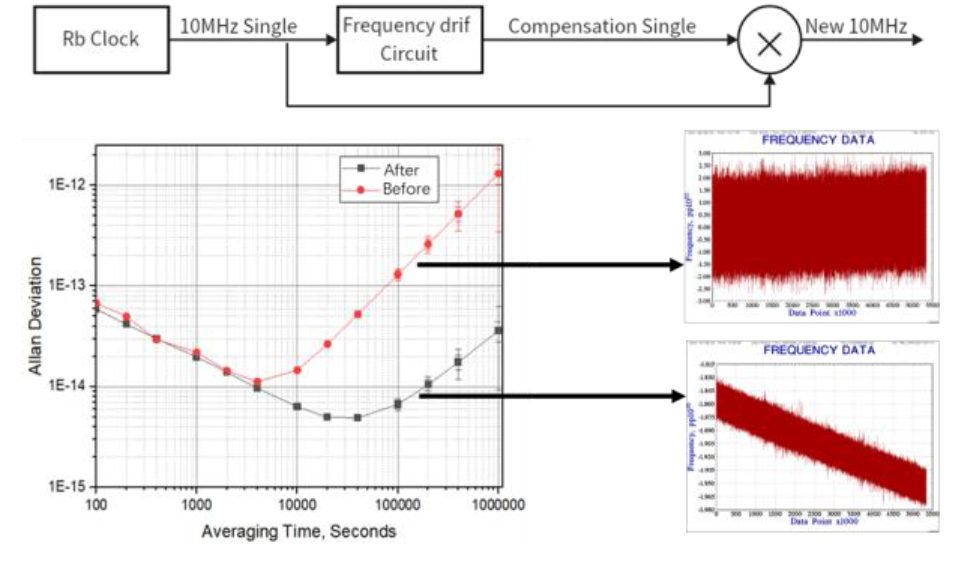
With their high reliability, small size and low power consumption, rubidium atomic clocks are widely used in the fields of navigation, communication, etc. In particular, rubidium atomic clocks for navigation satellites have developed excellent stability. However, their inherent frequency drift characteristics (about E-12 to E-13/day) will deteriorate their long-term performance and affect the autonomous punctual timing of satellites. In this paper, we fully analyzed the frequency data of high-performance rubidium atomic clocks, aiming to figure out the physical mechanism behind the frequency drift. A high-precision frequency drift compensation scheme is proposed and experimentally verified. The results show that the drift rate of high-performance rubidium clock can be maintained in the order of E-15/day within 60 days without external taming, and the day stability can reach the order of E-15 (Allan variance), which greatly improves the autonomous punctual timing ability of rubidium atomic clock.
XU Junqiu , LI Junyao , ZHAO Feng , KANG Songbai , Wang Pengfei , Ming Gang . High-precision Frequency Drift Compensation Study of High-performance Rubidium Atomic Clock[J]. Chinese Journal of Magnetic Resonance, 2024 , 41(2) : 184 -190 . DOI: 10.11938/cjmr20233080
| [1] | MEI G H, ZHAO F, QI F, et al. Characteristics of the space-borne rubidium atomic clocks for the BeiDou III navigation satellite system[J]. Science China Physics, Mechanics & Astronomy, 2021, 51(1): 118-124. (in Chinese) |
| 梅刚华, 赵峰, 祁峰, 等. 用于北斗三号卫星导航系统的星载铷原子钟特性[J]. 中国科学: 物理学力学天文学, 2021, 51(1): 118-124. | |
| [2] | JADUSZLIWER B, CAMPARO J. Past, present and future of atomic clocks for GNSS[J]. GPS Solut 2021, 25 (27): 1-13. |
| [3] | CUI J, MING G, WANG F, et al. Design and studies of an ultra high-performance physics package for vapor-cell rubidium atomic clock[C]// China Satellite Navigation Conference, Beijing, China: Springer, 2022, 910: 403-414. |
| [4] | LI J, MING G, ZHAO F, et al. A rubidium atomic frequency standard with stability at 10-15 level operated under atmospheric condition[C]// China Satellite Navigation Conference, Springer, 2021, 774:62-73. |
| [5] | HAO Q, LI W B, HE S G, et al. A physics package for rubidium atomic frequency standard with a short-term stability of 2.4×10⁻¹³ τ-1/2[J]. Rev Sci Instrum, 2016, 87(12): 123111. |
| [6] | 郭海荣. 导航卫星原子钟时频特性分析理论与方法研究[D]. 解放军信息工程大学, 2006. |
| [7] | LIU C, XU F, QU Y, et al. Analysis on Factors Influencing Frequency Drift of Rubidium Clocks for Satellite Navigation[C]// China Satellite Navigation Conference, Changsha, China: Springer, 2016, 390: 645-652. |
| [8] | 何冬, 赵明, 谢军, 等. 基于DDS的导航卫星钟频率漂移率的补偿方法[C]// 第六届中国卫星导航学术年会论文集—S04原子钟技术与时频系统. 中国, 西安, 2015: 68-72. |
| [9] | CAMPARO J. Does the light shift drive frequency aging in the rubidium atomic clock[J]. IEEE T Ultrason Ferr, 2005, 52(7): 1075-1078. |
| [10] | COFFER J, SICKMILLER B, CAMPARO J. Cavity Q aging observed via an atomic-candle signal[J]. IEEE T Ultrason Ferr, 2004, 51(2): 139-145. |
| [11] | CAMPARO J, KLIMCAK C. Influence of the atmosphere on a rubidium clock’s frequency aging[C]// Conference:39th Annual Precise Time and Time Interval (PTTI) Meeting, Long Beach, CA: IEEE Xplore, 2007: 317-322. |
| [12] | CAMPARO J. Frequency equilibration and the light shift effect for block IIR GPS rubidium clocks[C]// Conference:36th Annual Precise Time and Time Interval (PTTI) Systems and Applications Meeting, Washington, D C: IEEE Xplore, 2004: 393-410. |
| [13] | RILEY W J. A history of the rubidium frequency standard. [2011-01-01]. https://ieee-uffc.org/presentation/history-rubidium-frequency-standard |
| [14] | VANIER J, GAGNEPAIN J J, RILEY W J, et al. Aging, warm-up time and retrace: important characteristics of standard frequency generators[C]// Frequency Control Symposium, Hershey, PA, USA: IEEE, 1992: 807-815. |
| [15] | WANG P F, WANG F, ZHAO F, et al. Performance analysis of BD III satellite rubidium atomic clock based on satellite-ground two-way time transfer data[J]. Progress in astronomy, 2021, 39(4): 555-564. |
| 王鹏飞, 王芳, 赵峰, 等. 基于星地双向时间比对数据的北斗三号铷原子钟在轨性能评估[J]. 天文学进展, 2021, 39(4): 555-564. | |
| [16] | CARLé C, KESHAVARZI S, MURSA A, et al. Reduction of helium permeation in microfabricated cells using aluminosilicate glass substrates and Al2O3 coatings[J]. J Appl Phys, 2023, 133 (21): 214501. |
| [17] | YASHCHISHIN I N, ZHUK L V, KOZII O I. Diffusion processes in lead-silicate glasses in gas heat treatment with nitrogen[J]. Glass & Ceramics, 2006, 63(11-12): 408-410. |
/
| 〈 |
|
〉 |