

Chinese Journal of Magnetic Resonance >
Brain Age Assessment of Patients with Major Depressive Disorder Based on Convolutional Neural Network
Received date: 2023-09-08
Online published: 2023-11-22
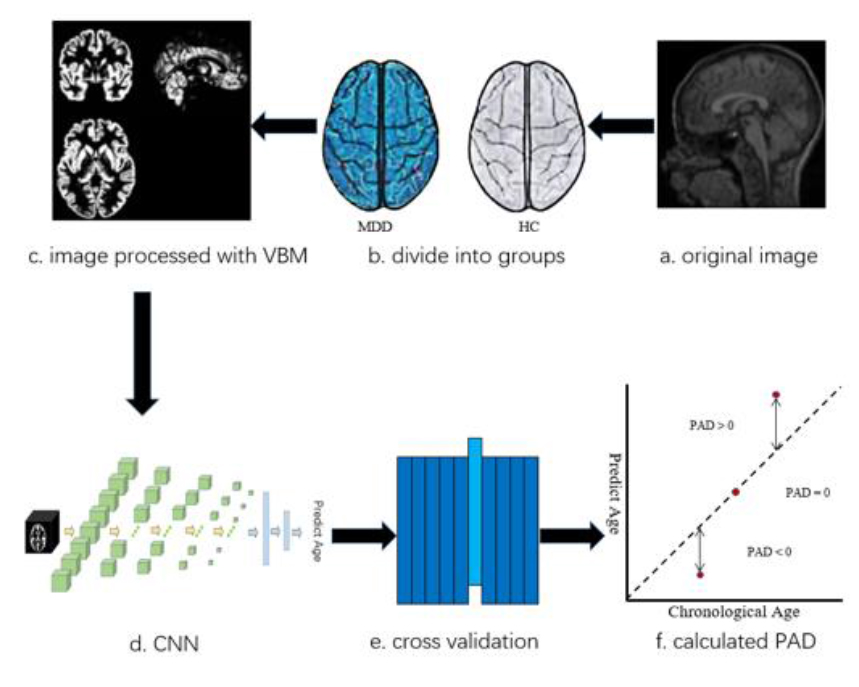
Brain age has become an important analysis object in the diagnosis and mechanism research of neurodegenerative diseases. There is no consistent conclusion on whether major depression increases the brain age of patients, and few studies in this direction have been conducted in the Chinese population. In this paper, a REST-meta-MDD (resting-state functional magnetic resonance imaging dataset of major depressive disorder) dataset collected from 25 hospitals in China was used to construct a convolutional neural network model based on high-resolution T1-weighted three-dimensional magnetic resonance images of brain structures to predict the brain age of patients and calculate the difference from the actual age. The mean absolute error and correlation coefficients of the final results were 3.16 and 0.93, and the mean brain age of the patients with major depression increased by 3.94 years compared with the healthy group, further confirming that major depression accelerates brain aging, and the severity of the disease is related to the gender, age, and education of the patients. Compared with the traditional machine learning algorithms, the average absolute error of the results obtained by this model is smaller and the correlation coefficient is higher.
Key words: brain age; major depression; convolutional neural networks; brain aging
ZHANG Haowei , WANG Yuncheng , LIU Ying . Brain Age Assessment of Patients with Major Depressive Disorder Based on Convolutional Neural Network[J]. Chinese Journal of Magnetic Resonance, 2024 , 41(2) : 139 -150 . DOI: 10.11938/cjmr20233081
| [1] | HIRSCHFELD R M. Differential diagnosis of bipolar disorder and major depressive disorder[J]. J Affect Disorders, 2014, 169(S1): S12-S16. |
| [2] | VERHOEVEN J E, RéVéSZ D, PICARD M, et al. Depression, telomeres and mitochondrial DNA: between- and within-person associations from a 10-year longitudinal study[J]. Mol Psychiatry, 2018, 23(4): 850-857. |
| [3] | PENNINX B W J H. Depression and cardiovascular disease: Epidemiological evidence on their linking mechanisms[J]. Neurosci Biobehav Rev, 2017, 74: 277-286. |
| [4] | K?NIG H, K?NIG H-H, KONNOPKA A. The excess costs of depression: A systematic review and meta-analysis[J]. Epidemiol Psychiatr Sci, 2019, 29: e30. |
| [5] | HAN L K M, DINGA R, HAHN T, et al. Brain aging in major depressive disorder: Results from the enigma major depressive disorder working group[J]. Mol Psychiatry, 2021, 26(9): 5124-5139. |
| [6] | LóPEZ-OTíN C, BLASCO M A, PARTRIDGE L, et al. Hallmarks of aging: An expanding universe[J]. Cell, 2023, 2: 243-278. |
| [7] | BOCKLANDT S, LIN W, SEHL M E, et al. Epigenetic predictor of age[J]. PLoS One, 2023, 6: e14821. |
| [8] | ELLIOTT M L, BELSKY D W, KNODT A R, et al. Brain-age in midlife is associated with accelerated biological aging and cognitive decline in a longitudinal birth cohort[J]. Mol Psychiatry, 2021, 26(8): 3829-3838. |
| [9] | BAO H, CAO J, CHEN J, et al. Aging biomarker consortium. Biomarkers of aging[J]. Sci China Life Sci, 2023, 5: 893-1066. |
| [10] | SHAHAB S, MULSANT B H, LEVESQUE M L, et al. Brain structure, cognition, and brain age in schizophrenia, bipolar disorder, and healthy controls[J]. Neuropsychopharmacology, 2019, 44(5): 898-906. |
| [11] | LUO Y, CHEN W, QIU J, et al. Accelerated functional brain aging in pre-clinical familial Alzheimer’s disease[J]. Nat Commun, 2021, 1: 5346. |
| [12] | SONE D, BEHESHTI I, MAIKUSA N, et al. Neuroimaging-based brain-age prediction in diverse forms of epilepsy: A signature of psychosis and beyond[J]. Mol Psychiatry, 2021, 26(3): 825-834. |
| [13] | HO T C, GUTMAN B, POZZI E, et al. Subcortical shape alterations in major depressive disorder: Findings from the enigma major depressive disorder working group[J]. Hum Brain Mapp, 2022, 43(1): 341-351. |
| [14] | COLE J H, POUDEL R P K, TSAGKRASOULIS D, et al. Predicting brain age with deep learning from raw imaging data results in a reliable and heritable biomarker[J]. NeuroImage, 2017, 163: 115-124. |
| [15] | MANARD M, BAHRI M A, SALMON E, et al. Relationship between grey matter integrity and executive abilities in aging[J]. Brain Research, 2016, 1642: 562-580. |
| [16] | HAN S, CHEN Y, ZHENG R, et al. The stage-specifically accelerated brain aging in never-treated first-episode patients with depression[J]. Hum Brain Mapp, 2021, 42(11): 3656-3666. |
| [17] | BALLESTER P L, SUH J S, NOGOVITSYN N, et al. Accelerated brain aging in major depressive disorder and antidepressant treatment response: A can-bind report[J]. NeuroImage: Clinical, 2021, 32: 102864. |
| [18] | BESTEHER B, GASER C, NENADI? I. Machine-learning based brain age estimation in major depression showing no evidence of accelerated aging[J]. Psychiatry Res Neuroimaging, 2019, 290: 1-4. |
| [19] | H?GEST?L E A, KAUFMANN T, NYGAARD G O, et al. Cross-sectional and longitudinal MRI brain scans reveal accelerated brain aging in multiple sclerosis[J]. Front Neurol, 2019, 10: 450. |
| [20] | FRANKE K, GASER C. Ten years of brainage as a neuroimaging biomarker of brain aging: What insights have we gained[J]. Front Neurol, 2019, 10: 789. |
| [21] | AYCHEH H M, SEONG J-K, SHIN J-H, et al. Biological brain age prediction using cortical thickness data: A large scale cohort study[J]. Front Aging Neurosci, 2018, 10: 252. |
| [22] | FRANKE K, ZIEGLER G, KL?PPEL S, et al. Estimating the age of healthy subjects from T1-weighted MRI scans using kernel methods: Exploring the influence of various parameters[J]. NeuroImage, 2010, 50(3): 883-892. |
| [23] | COLE J H, RITCHIE S J, BASTIN M E, et al. Brain age predicts mortality[J]. Mol Psychiatry, 2018, 23(5): 1385-1392. |
| [24] | TANVEER M, GANAIE M A, BEHESHTI I, et al. Deep learning for brain age estimation: A systematic review[J]. Information Fusion, 2023, 96: 130-143. |
| [25] | YANG H, CHEN X, CHEN Z-B, et al. Disrupted intrinsic functional brain topology in patients with major depressive disorder[J]. Mol Psychiatry, 2021, 26(12): 7363-7371. |
| [26] | YAN C G, CHEN X, LI L, et al. Reduced default mode network functional connectivity in patients with recurrent major depressive disorder[J]. Proc Natl Acad Sci USA, 2019, 116(18): 9078-9093. |
| [27] | CAI W Q, WANG Y J. Advances in construction of human brain atlases from magnetic resonance images[J]. Chinese J Magn Reson, 2020, 37(2): 241-253. |
| 蔡文琴, 王远军. 基于磁共振成像的人脑图谱构建方法研究进展[J]. 波谱学杂志, 2020, 37(2): 241-253. | |
| [28] | BEHESHTI I, GANAIE M A, PALIWAL V, et al. Predicting brain age using machine learning algorithms: A comprehensive evaluation[J]. IEEE J Biomed Health Inform, 2022, 4: 1432-1440. |
| [29] | QIU X X, HAN X, WANG Y, et al. The alteration of rich club in brain functional network in internet gaming disorder[J]. Chinese J Magn Reson, 2022, 39(3): 258-266. |
| 邱先鑫, 韩旭, 汪耀, 等. 网络游戏障碍人群大脑功能网络rich club结构的改变[J]. 波谱学杂志, 2022, 39(3): 258-266. | |
| [30] | KOUTSOULERIS N, DAVATZIKOS C, BORGWARDT S, et al. Accelerated brain aging in schizophrenia and beyond: A neuroanatomical marker of psychiatric disorders[J]. Schizophr Bull, 2014, 40(5): 1140-1153. |
| [31] | HAN L K M, DINGA R, HAHN T, et al. Brain aging in major depressive disorder: Results from the enigma major depressive disorder working group[J]. Mol Psychiatry, 2021, 26: 5124-5139. |
| [32] | DUNLOP K, VICTORIA L W, DOWNAR J, et al. Accelerated brain aging predicts impulsivity and symptom severity in depression[J]. Neuropsychopharmacology, 2021, 46(5): 911-919. |
| [33] | AI A L, NICDAO E G, APPEL H B, et al. Ethnic identity and major depression in asian American subgroups nationwide: Differential findings in relation to subcultural contexts[J]. J Clin Psychol, 2015, 71(12): 1225-1244. |
/
| 〈 |
|
〉 |